









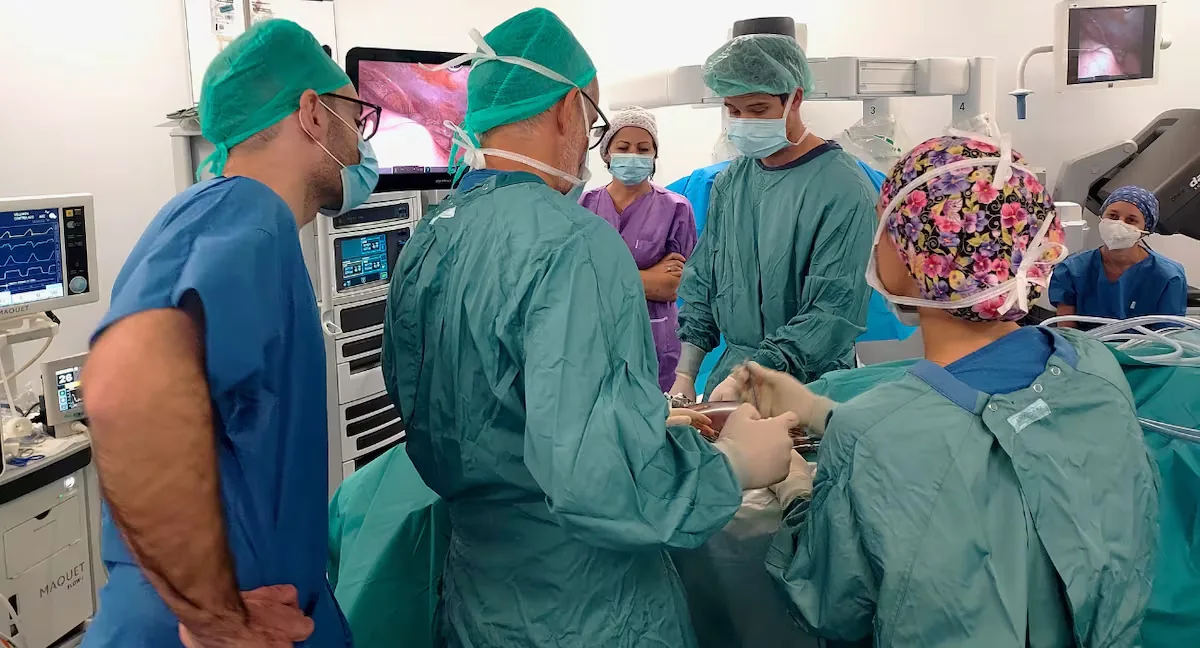
For four decades, organ donation was a medical procedure forbidden to people with HIV. They could receive a transplant (since 2005), but not be donors. A law prohibited it. Until last year, when the Ministry of Health modified a 1987 regulation. It was a milestone against the stigma associated with HIV, but also an opportunity: thanks to that legislative change, today, Manuel (fictitious name), a man with HIV suffering from severe kidney failure, lives with a kidney altruistically donated by a friend of his who also has the infection. The transplant, which was recently performed at Hospital Vall d’Hebron in Barcelona using robotic surgery, is the first to be done in Spain between people with HIV.
Read more Trump imposes a chaotic trade system in his third round of tariffs
Manuel suffered from chronic glomerulonephritis, an inflammation of the small filters in the kidneys that, although not related to HIV, had become complicated to the point of requiring a kidney transplant. “In the afternoons I was very tired, I had to be careful when eating… My kidneys were barely filtering at 7%,” says the recipient by phone. These organs are responsible for filtering waste from the blood, eliminating water and salts through urine, and maintaining mineral balance, among other things; when kidney function is altered, as happened to Manuel, toxins accumulate in the body, there can be fluid retention, and the risk of cardiovascular problems also increases.
Manuel urgently needed a transplant and a friend of his, who also has HIV, offered to donate a kidney. “He came with me to all the tests and the doctors told us we were compatible. So we did it,” he recounts. The intervention, which lasted about four hours, was performed by robotic surgery at the Barcelona hospital. “First the extraction was done and then the implant with a minimally invasive intervention. From a technical point of view, it is a transplant that does not differ from what is usually done in the hospital in people who do not have the infection,” explained Enric Trilla, head of Urology at the hospital. To preserve the anonymity of donor and recipient, EL PAÍS will not provide details of the operation date or information that could identify them.
For his part, Jordi Navarro, an infectologist at the Barcelona hospital, pointed out that the particularity, when donor and recipient have HIV, is that an exhaustive review of the donor’s treatment history and viral evolution must be carried out, to see if there has been any treatment failure or if the virus is of a resistant strain. “And from here, we adjust the treatment to the transplanted patient because you have to give them a regimen that covers the donor’s and recipient’s virus. But immunosuppression does not have to reactivate the virus. Before, antiretroviral drugs had many interactions, but for 10 years, the treatments used as first-line have minimal interactions,” he explained.
Francesc Moreso, head of the Renal Transplant Unit section, added that, although there may be “some interference between some antiretrovirals and those given to prevent organ rejection, it is the transplant team’s job to control” these interferences and adjust the treatment to avoid the failure of any of the therapeutic lines. The nephrologist insisted, in any case, that “the risk of rejection in a person with HIV is the same as that of the non-infected population.”
Each year, around 50 people with HIV await an organ in Spain: 30 a kidney transplant, 15 a liver transplant, and five a heart, lung, or pancreas transplant, according to data from the National Transplant Organization (ONT). The case of Manuel and his friend marks a new milestone in the history of medicine and HIV and shortens waiting lists in a population that has historically suffered the consequences of carrying a socially stigmatized ailment.
Read more Gregorio Casamayor: “I would give anything to understand string theory”
“It is one more step to destigmatize HIV by giving people with the infection the option to be donors if they wish,” said Albert Santdiumenge, coordinator of the hospital’s Donation and Transplant Program: “It is a milestone because we are expanding the number of people who can be donors. This benefits all patients on the waiting list: it helps HIV recipients get an organ sooner and also benefits people on the waiting list without HIV, because with more organs available, there is a greater possibility of being transplanted,” he added.
During the eighties and nineties, organ transplantation in people with HIV infection was considered a high-risk intervention. Having the virus was a contraindication for this procedure and the scientific community took its time to change the paradigm.
The leap forward to incorporate seropositive people into the donation and transplant program was made gradually and sponsored, fundamentally, by the success of antiretroviral therapy, which has allowed the infection to be controlled and given this group a life expectancy similar to that of the rest of the population. In that context, a little over two decades ago, in 2005, the Government allowed seropositive people to undergo a transplant and although the first transplant between people with HIV was performed in South Africa in 2008, it was not until last year in Spain that the rule prohibiting donation to people with this infection was corrected.
According to the ONT, in the last decade, 65 potential deceased donors with HIV infection could have donated their organs and allowed up to 165 transplants to be performed. “Our goal is not only to increase transplant opportunities, but also to make effective the right of people with HIV infection to be organ donors if they wish,” said Beatriz Domínguez-Gil, general director of the ONT. The procedure is safe and the scientific evidence generated shows that transplanted patients with HIV infection have similar outcomes with organs from HIV-positive or negative donors.
Cases of donation and transplantation between people with HIV vary greatly between countries. The United States approved a law in 2013 authorizing these interventions within the framework of clinical trials and since 2024, liver and kidney transplants between people with the infection are part of routine clinical practice. In Europe, this procedure is also authorized in six countries (including Spain), but it is still prohibited in 11 others and not regulated in 18. According to Domínguez-Gil, in Europe, since 2011, around 70 kidney transplants have been performed between people with HIV, but they have been concentrated, fundamentally, in the United Kingdom, France, and Italy. “However, in the European context, only two living donor transplants are recorded.”
Read more Anti-corruption asks the judge to expand the information about Zapatero’s jewels