




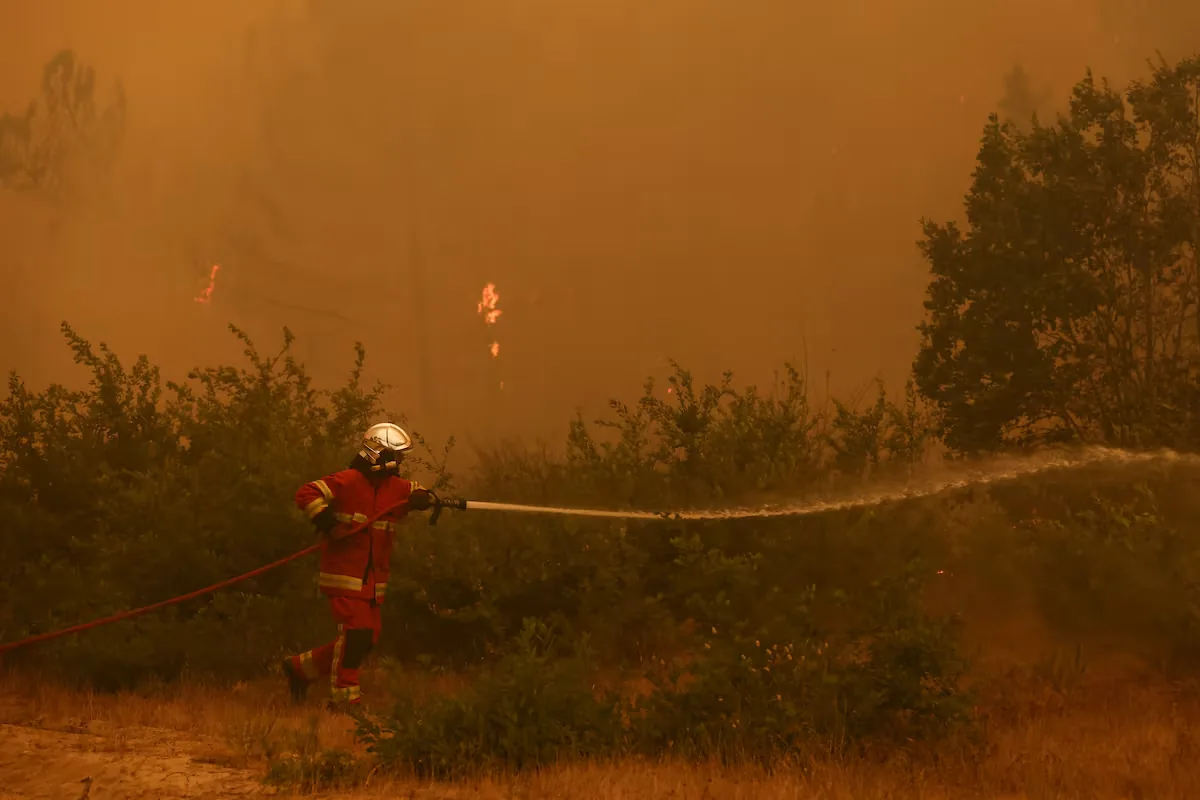
The European Commission has deployed seven aircraft from its rescEU emergency fleet —four planes in Spain and three planes plus two helicopters in France— to combat the wildfires hitting Spain and France. The EU executive warned this Friday that the European Union is preparing for increasingly severe scenarios as extreme weather events intensify.
Read more Barcelona will ask for the price of commercial premises rentals to be regulated
“We are preparing for a serious situation, given that we are going to see these extreme weather events more frequently and they will be harsher and more brutal,” a community spokesperson declared. “Obviously we hope that hell doesn’t break loose, but we are preparing for it,” she added.
The warning comes a day after a group of independent climate scientists, gathered in the international World Weather Attribution initiative, published a study indicating that the drought affecting Europe this summer is mainly explained by heat, not by lack of rain, which directly “dries out the soil” and makes episodes like the current ones more likely.
The European Union had already warned in similar terms through its official climate service. The Copernicus Climate Change Service (C3S) confirmed in early July that Western Europe experienced its hottest June on record and linked that heatwave to increased wildfire activity “especially in the Iberian Peninsula and southern France”.
Community Mechanism
Spain requested the activation of the Union Civil Protection Mechanism (UCPM) on Thursday night, the instrument used at the community level to coordinate emergency aid between countries. This is the second time it has done so this summer, while the government maintained the national interest emergency in Madrid and Ávila. France also submitted its request on Thursday amidst a situation that Brussels described as “very dramatic” in the Bordeaux region, with mass evacuations.
The European Commissioner for Crisis Management, Hadja Lahbib, confirmed this Friday that Brussels has activated the mechanism at the request of Madrid and Paris. The system has two levels of response. The first is the European Civil Protection Pool, a common fund of assets —planes, ground teams, brigades— that countries voluntarily make available to their neighbors and which the EU co-finances up to 75% of their operational costs. The second is the rescEU reserve, a strategic buffer that comes into play when national resources and those from the common fund are insufficient, and which is fully financed by the Commission through the common budget.
In practice, neither the planes nor the firefighters already battling the fires in France and Spain travel from Brussels: they remain pre-positioned all year round in their countries of origin (Greece, Italy, Croatia, Portugal, Spain, Czechia, Slovakia, Cyprus, and others) and only move to the Member State requesting assistance when an emergency arises. The four planes sent to Spain took off from bases in Greece and Italy, while the reinforcement to France came from Portugal, Slovakia, Czechia, and Croatia.
The EU also has a parallel mechanism to coordinate direct bilateral aid between neighboring countries when the European reserve is insufficient. Brussels has also confirmed that the program will continue to “develop and strengthen depending on the situation”.
This week’s activation comes in a summer that the Commission itself had already described as having the largest preventive deployment in its history. It currently has a reserve of 22 planes and five helicopters, in addition to a contingent of 777 firefighters from 14 countries pre-positioned this summer in Mediterranean risk areas, as explained by the spokesperson for the EU executive. In recent years, Brussels has allocated 600 million euros to the purchase of 12 new firefighting planes that will join the fleet from 2027, housed in Croatia, France, Italy, Greece, Portugal, and Spain.
This summer’s deployment equals, in terms of personnel, the highest level since the EU launched its pre-positioning program in 2022 —the year nearly 660,000 hectares burned in the Union, then a record—. That threshold was surpassed again in 2025, with over a million hectares scorched, the worst season on record in the EU.
The Commission has also activated the EU’s satellite observation system, Copernicus, which combines images from Sentinel satellites with thermal data to detect active hotspots, delineate the perimeter of flames, and generate maps of burned areas within hours, which are made freely available to civil protection authorities. This is the same system that powers the European Forest Fire Information System (EFFIS), the public tool that records burned area across Europe in near real-time.