




Catalonia once again has problems with the PISA test sample. On the verge of knowing the results of the new edition, in which the entire educational community has its eyes fixed after the disastrous results four years ago, the Generalitat has reported an error that will not allow its results to be compared with those of previous years.
This Friday it was announced that this year’s results – which will be published on September 8, the start of the school year in Catalonia – will have relative validity, as the Generalitat has stated that, due to “a technical incident,” they will not be comparable. It is, according to Sònia Fernández, Director General of Curriculum, “an isolated and specific incident, which means that the results are not comparable to those of previous years or those of other communities.”
The Department of Education explained this Friday that this incident – about which it received notice in March – consists of 23.2% of the student sample used being exempt from taking the tests for different reasons (because they are recent arrivals and do not master the language or because they have a learning disorder…), when the Organisation for Economic Co-operation and Development (OECD), which promotes the PISA tests, recommends that this percentage be a maximum of 5%.
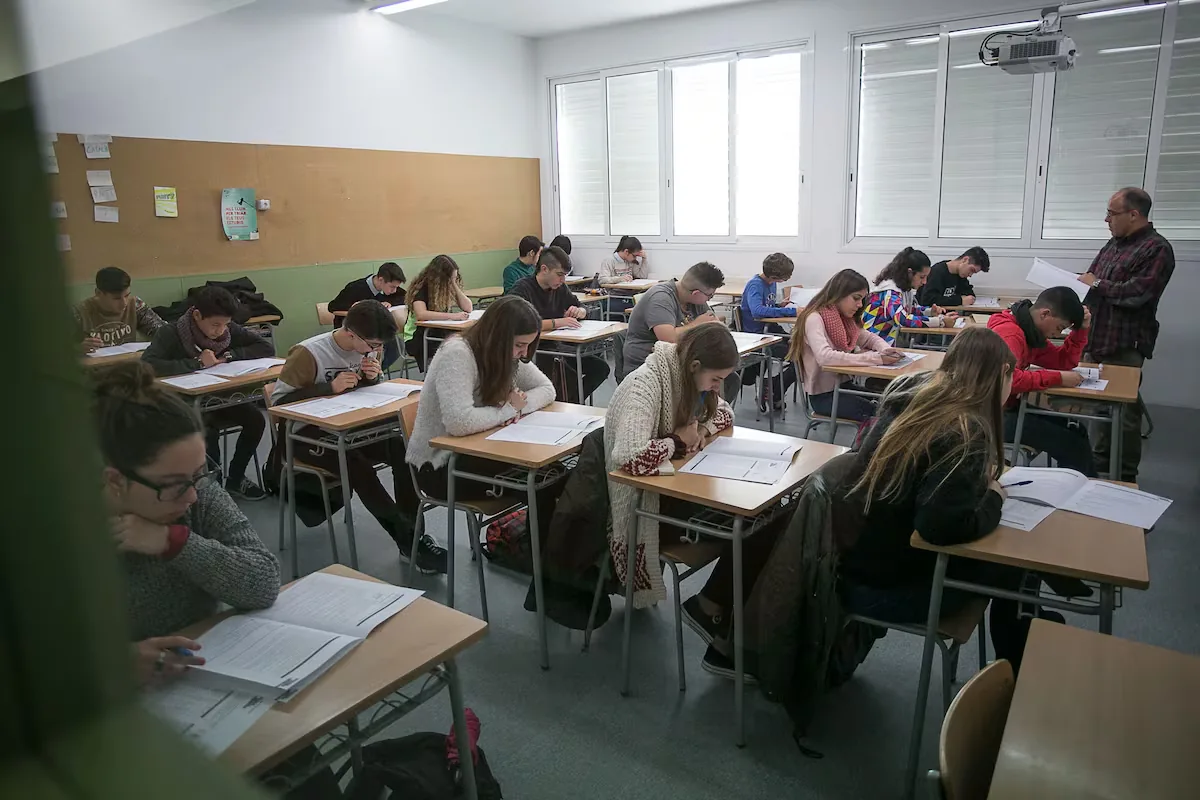
Specifically, of the approximately 2,500 15-year-old students who were supposed to participate in Catalonia – the exams were held in April and May 2025 – 591 were excluded (six for physical disability, 493 for cognitive, behavioral or emotional disorders, and 92 for insufficient language proficiency), so only 1,909 were tested, a deviation that represents “a problem of statistical representativeness,” according to the director general.
Nevertheless, the Generalitat assures that the test results are valid and that, in fact, they will be taken into account by the Ministry of Education when preparing the state report. For its part, the ministry has declined to comment on the incident and refers to the explanations given by the Generalitat.
Education explained in an informative session that the process of selecting and validating the student sample that takes the exam – 51 centers in Catalonia in the last edition – goes through the hands of the Catalan Evaluation Agency, the Ministry, and the OECD, and admits that they do not know at what point the error occurred. For this reason, the Department has announced that it is opening an “internal and reserved procedure to clarify the facts and, when evidence is available, to make the necessary decisions,” Fernández assured.
Despite the long history of organizing evaluation tests and the absence of problems, and without having the results of the investigation, the director general suggested that a possible cause is that Catalonia did not have at that time “a unique or coherent framework of exemptions” between regional and international exams, and that in the former “more flexible criteria than those admitted by the OECD are applied,” thus “a culture of exemption was generated that was reproduced in international evaluations.” In fact, Fernández also pointed to a “confusion” among centers when preparing these student lists, as “in a very short time” the PISA tests coincided with the end-of-stage tests, i.e., those carried out by the Generalitat in 6th grade of primary school and 4th year of ESO, that year in all centers.
Read more Body announces the reactivation of the entity that will settle customer claims against banks
For now, it has been decided to create a Coordination Commission for tests and evaluation studies of the educational system to provide “coherence” and “traceability” to the application protocols of the different evaluation tests, such as those promoted by the Generalitat, the Ministry of Education, or various international ones. “These processes involve a plurality of internal and external agents, with differentiated responsibilities and circuits, which requires a high degree of coordination to guarantee homogeneity and reliability,” argues Education in the order creating the commission published this Friday in the Official Gazette of the Generalitat.
A void in the responsible body
For 35 years, Catalonia has had an organization dedicated to preparing and analyzing various evaluation tests. This is the Superior Council of Evaluation, which came under scrutiny in December 2023 after the 2022 PISA results, which were dismal for Catalonia. At that time, the failure was also attributed to the sample, but on this occasion, to an excessive representation of immigrant students, an argument that the Generalitat had to correct the next day. However, the then head of the Council, Carles Vega, who was dismissed a few weeks after the controversy, did not appear at the presentation of the results.
This episode created a void in the organization, while the preparation of evaluation tests did not cease. At that time, its members already claimed that it was “deactivated” and functioning by “inertia.” Education did not quickly find a substitute and decided to leave the organization in the hands of the General Directorate of Curriculum and Educational Innovation, then headed by Joan Cuevas, and currently by Sònia Fernández. For this reason, she was tasked with explaining the incident, even though evaluation tests are not currently within her competence. This error in the sample occurred at a time when the council was partially dismantled and managed by the department.
After the controversy, the Government decided to convert the Council into the Evaluation Agency, with more powers. This Friday, Education avoided exposing the officials of the renewed institution. But, on the other hand, it takes away part of its power to manage the tests, as the newly created commission will depend directly on the Department of Education and its Secretariat for Educational Improvement, whereas traditionally all responsibility for the tests had fallen to that independent body without serious incidents of this type. In fact, the Agency has also addressed the controversy by stating that it began its activity in July 2025, “after the management and application” of the PISA tests.
The case has already caused a reaction from political parties, and Junts has requested the appearance of the Minister of Education, Esther Niubó, in the Parliament.
Read more A car bomb intercepted near the border between Ireland and Northern Ireland