







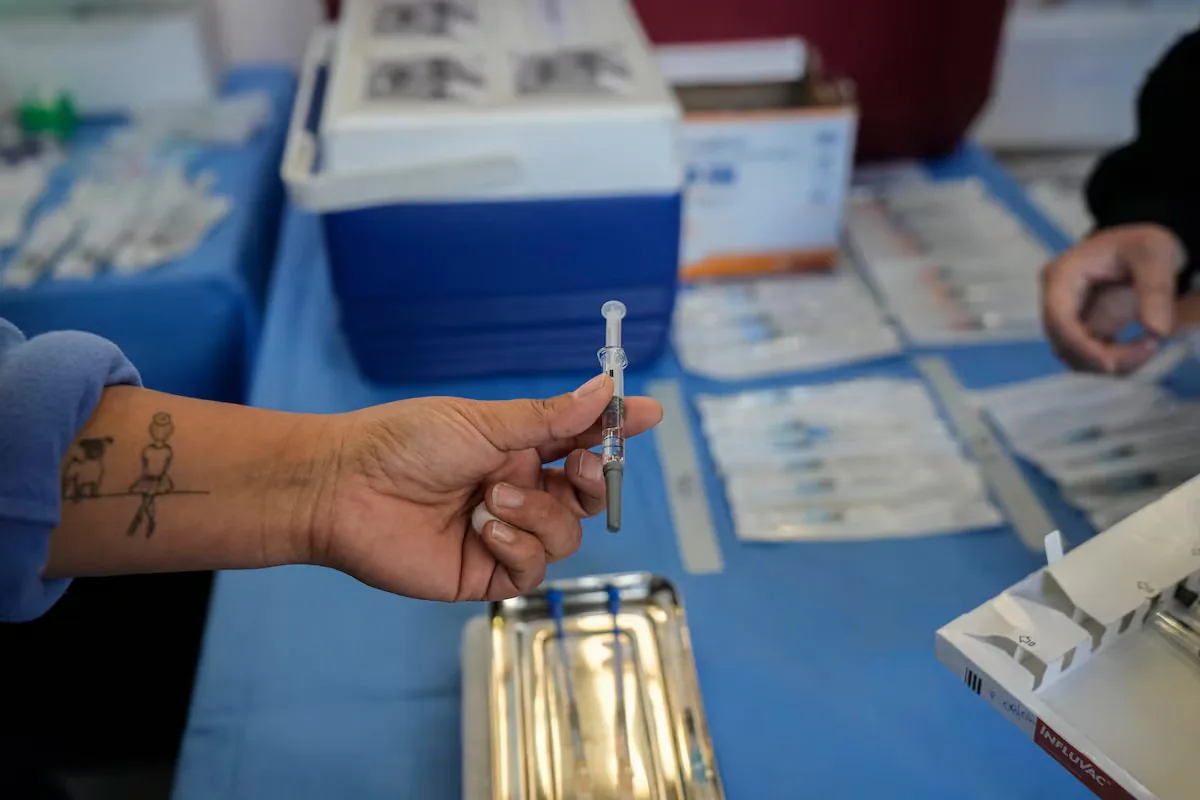
Chile’s Ministry of Health (Minsal) this Thursday opened the delivery of the influenza (flu) vaccine to the entire population, regardless of whether or not they belong to a risk group. The authority has taken the measure after detecting an increase in the viral circulation of respiratory diseases, with a predominance of influenza A and B. The increase in infections is associated with the return of schoolchildren to classes and the drop in temperatures, due to greater overcrowding, humidity, cold, and less ventilation in homes, which favors infections. Another argument supporting the decision has been the slow progress in immunization, which as of July 22 reached 7.7 million people, representing a 78% advance of the target group. One of the groups with the lowest level of immunization corresponds to children older than six months and younger than five years, whose coverage only reaches 62.6%.
Experts have reiterated the importance of inoculation in winter, especially after the powerful series of frontal systems that affected the central-southern zone of the country. The Chilean Society of Pediatrics (SOCHIPE) has called on citizens to adhere to the vaccination campaign, especially in the case of children, who are part of the vulnerable population to respiratory viruses. In addition to the influenza vaccine, the medical entity has called on parents to get immunization against Respiratory Syncytial Virus (RSV) for infants.
Where to get vaccinated against influenza in Chile?
To receive the influenza vaccine for free in Chile, one must attend one of the 1,200 inoculation points implemented by the authorities. These facilities include public primary care vaccination centers (Cesfam, Cecosf, and health posts) and authorized hospitals. In addition, there are mobile operations that are carried out sporadically in public places such as fairs, Metro stations, and other extraordinary points. Inoculation can also be accessed at private vaccination centers that have an agreement with Minsal.
How to find the nearest vaccination center
People interested in receiving the flu vaccination can visit the MeVacuno.cl website, a platform implemented by the Government, which has a special search engine to find available vaccination centers. Upon entering the site, the user can select their region, commune, and even the exact address of the health center where the vaccination center is located. The page displays a block with information about the type of vaccine available, whether it is open to the public or not, and a map with directions to get there. You can also call the Salud Responde phone number (600 360 77 77), which is available 24 hours a day.
What is needed to get vaccinated
The only mandatory document to receive the influenza vaccine for free at public vaccination centers is the identity card (or passport/DNI for foreigners). It is also suggested that patients with chronic diseases bring their medical order and their control or vaccination card. It is necessary for the patient to provide all information about their medical history.
Read more Barcelona will ask for the price of commercial premises rentals to be regulated
When to get vaccinated
Authorities and specialists recommend that people get the vaccine as soon as possible, in order to obtain the necessary protection in time and avoid hospitalizations. The dose takes about two weeks to generate complete protection for the body with the production of antibodies against the disease. The Undersecretary of Health, Alejandra Pizarro, has said that general inoculation seeks to strengthen community protection against the extensive circulation of viruses. “We have high circulation of respiratory viruses (…) and we are in the perfect conditions for the transmission of respiratory diseases to increase, such as cold, environmental conditions, and overcrowding. So we are reinforcing seasonal influenza vaccination and from tomorrow (Thursday) vaccination will be extended to all population groups. This is also in response to the alert raised by PAHO about the greater circulation of respiratory viruses in the southern hemisphere,” Pizarro explained.
Who remains a priority
Although the influenza vaccine is provided to the general population, there are some groups for whom inoculation is essential due to the risk they run of developing a severe illness after infection. These include those over 60 years of age; health personnel in public and private establishments; chronically ill individuals between 11 and 59 years old with risk conditions (diabetes, pulmonary, cardiac, renal diseases, among others); pregnant women at any stage of pregnancy (they will also receive the Tdap vaccine from 28 weeks); infants and schoolchildren from 6 months up to those in 5th grade (primary education); and preschool and school workers up to 8th grade.
Why vaccination is important after the frontal system
Specialists have warned that the conditions following the storm that hit a large part of Chilean territory are ideal for the spread of respiratory diseases, making influenza vaccination more necessary than ever. Jorge Carrasco, the president of SOCHIPE, has warned that low temperatures favor staying in enclosed spaces with less ventilation, increasing the risk of transmission of respiratory viruses. “After episodes of rain and when a cold wave sets in, it is common to observe an increase in consultations for respiratory diseases, especially in young children. Therefore, it is essential that families take this opportunity to review their children’s vaccination status and complete the corresponding schedules,” he noted. Carrasco has recommended maintaining other preventive measures in addition to vaccination, such as ventilating indoor spaces, avoiding exposing newborns and infants to people with respiratory symptoms, reinforcing frequent hand washing, and using a mask when there are symptoms compatible with a respiratory infection, especially when in contact with young children.