





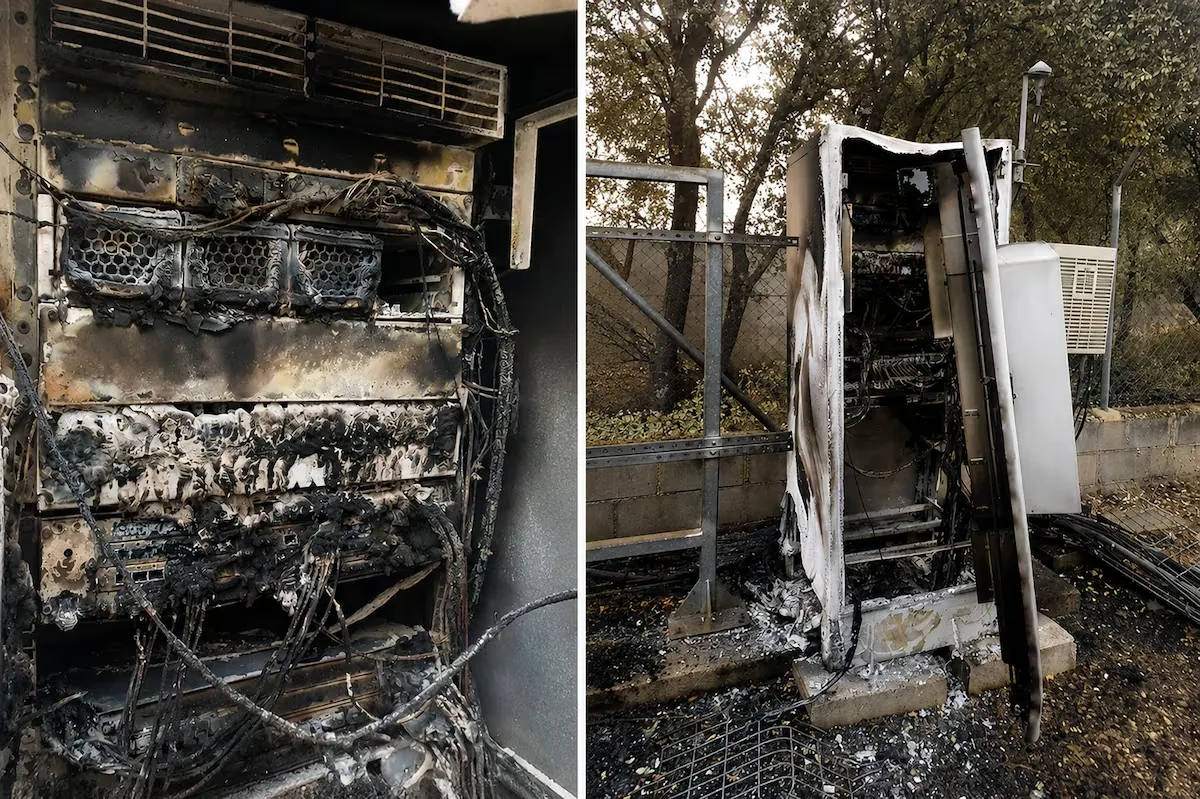
The declaration of a national interest emergency (Level 3) on the border between the Community of Madrid, Ávila, and Toledo has forced the main telecommunications operators to activate a special operation to restore network infrastructures affected by forest fires. The unification of several active fires, fueled by unfavorable wind gusts and extreme temperatures, affects more than 90,000 people in the central area of the peninsula. The burning of telephone sites and the cutting of fiber optic cables initially left 16 municipalities and around 40 population centers without mobile or fixed coverage. In the most affected areas, the physical network depends on Vodafone and Telefónica infrastructures.
In the Community of Madrid, Vodafone has fully restored mobile and fixed network service after deploying two emergency mobile units in the municipalities of Pelayos de la Presa and Cenicientos. In the province of Ávila, the operator maintains four base stations out of service, located directly at the fire’s epicenter in the municipalities of La Adrada, Piedralaves, and Sotillo de la Adrada.
The persistence of the flames and safety protocols currently prevent technicians from accessing these facilities or sending backup mobile units. Additionally, Vodafone reports 600 fiber optic customers affected in indirect fixed networks under Telefónica’s NEBA access. The company’s technical teams remain deployed to monitor the fire’s evolution and maintain active services during the emergency, company sources reported.
For its part, MasOrange maintains a continuous monitoring operation in its nodes and facilities. The company moved a mobile coverage unit to the Advanced Command Post in Cenicientos, which was later relocated to Navalcarnero when the control center moved there. To mitigate the lack of signal in hard-to-reach areas of Madrid and Ávila where the 5G network had no coverage, the operator enabled a contingency data service that has allowed communication for nearly 5,000 users. At the displaced persons’ reception center in San Martín de Valdeiglesias, the company installed mobile WiFi antennas with satellite connectivity to provide service to the evacuees. Additionally, the group provides free data vouchers to its affected fixed-line customers in the area and maintains technical teams to deploy new portable infrastructures when the competent authority authorizes access.
Regarding the fire in the province of Castellón, there are specific mobile coverage problems in some areas very close to the La Vall d’Uixó fire, especially where the advance of the fire or preventive power cuts may affect the operation of certain base stations. However, so far, no significant impact on telecommunications infrastructure has been detected, and networks continue to operate normally throughout the affected area, operators report.
Telefónica has not provided details on the affected municipalities and networks but has issued an institutional message. “Telefónica has been working from the outset to maintain and restore communications in areas affected by the fires, prioritizing people’s safety and the re-establishment of essential services. In constant contact with authorities and emergency services, the company has deployed extensive technical and human resources to maintain communications and restore services, through coordinated work by Operations, Network, Engineering, Security, Territory, and Customer Service,” it stated in a press release.
Read more “Emergency” situation in Ceuta due to the extraordinary arrival of migrants in a few days
Satellite Connectivity
As a technological novelty in the country, authorities and operators have for the first time activated a direct mobile connectivity system from satellites to conventional terminals in a real emergency situation. Starlink’s satellite network broadcasts an open and free signal for Movistar and MásOrange customers in areas where terrestrial infrastructures have been rendered inoperable.
This exceptional transmission service uses mobile network code MNC 16 with a 5 MHz FDD bandwidth at the 2,600 MHz frequency, corresponding to radio spectrum assigned to Orange and displayed on devices under the name Orange Space X. The technology allows LTE-compatible smartphones to automatically connect to satellites to send and receive SMS messages and maintain limited low-speed data usage without needing to modify terminal settings or hardware. The implementation of this emergency roaming service has been formalized through agreements between the Ministry, Telefónica, MásOrange, and Starlink, also with technical support for infrastructure and frequencies from Castilla Telecom.
The technical teams of Telefónica, Vodafone, and MasOrange remain coordinated with the Military Emergency Unit (UME), the Ministry of Interior, and Civil Protection, awaiting the fire extinguishing services to secure the fire perimeter. The immediate objective of the operators is to repair the burnt fiber optic sections and install additional portable stations as fire brigades stabilize the various active fire points.
The Minister for Digital Transformation and Public Function, Óscar López, confirmed the scope of the measures during an inspection visit to the affected areas over the weekend. López stated that companies in the sector permanently collaborate with the Government in disaster situations to ensure the necessary connectivity for rescue teams, the affected population, and the media. The minister detailed that the actions range from reinforcing 5G technology antennas to activating emergency satellite links.
Read more The left facing artificial intelligence: an extinction event?