






When summer approaches, Spain is divided between July lovers and August lovers, between those who prefer to rest away from the season and those who remain faithful to the traditional summer vacation. The choice is not innocent. It has consequences on the price, the overcrowding at our destination, enduring record temperatures, and even on work-life balance. Is July the smart choice for those who have learned to avoid summer chaos, or is August still the month when the country truly stops, activity ceases, and one can disconnect without remorse? Sergio C. Fanjul and Jimena Marcos, journalists, take sides.
We love July so much
Sergio C. Fanjul
There were some years —I think no longer— when, as July approached, the internet was filled with memes starring Julio Iglesias. They said things like “July is coming, and you know it” about that iconic image of the singer, extremely tanned, with a seductive smile and pointing at the audience. It was a pretty simple joke, but perhaps because of that childlike innocence, people found it funny. The trend passed, as digital trends do (or perhaps it had to do with the sexual assault accusations against the eternal Spanish heartthrob). It doesn’t matter, there are other Julios. Like Julio Cortázar, about whom I recently saw other memes saying “July is getting long,” referring to the tall stature of the writer (1.93 meters). After Cortázar’s death in 1984, a pre-internet meme became popular: the phrase “we love Julio so much,” which paraphrased the Argentine’s book titled We Love Glenda So Much, to show affection for a writer who, with his tenderness, imagination, and drawn-out accent, garnered so much love.
When summer arrives, some of us love July so much and others love August so much. I will call them July lovers and August lovers. I am among the former, although, due to family logistics, I am forced to vacation in August (perhaps that marks my preference: we all long for what we don’t have). As a good July lover, I believe the most sensible thing is to take vacations away from the heart of summer: July is good, but it would be better to do it in June or September when those who can enjoy a more peaceful, sophisticated, and cheaper summer vacation while most work. What a pleasure. I am not a radical July lover: I wouldn’t mind being a June or September lover.
From orthodox July lovers, we defend the greater tranquility of July, not so massive and hot, for summer activities. Vacationing then gives the impression that summer lasts longer. July is the fulfilled promise of summer; you don’t breathe the chronophobic melancholy that sees the labor wolf’s ears, as in the sad end of August. July has the advantage of arriving earlier, calming the anxious; it is also true that it leaves earlier: but working during August is cooler, the workload decreases dramatically — you get paid the same for doing less — and the city is more spaced out. Although urban August is no longer what it was when the big avenues were deserted like the Gran Vía that Eduardo Noriega walked at the beginning of Open Your Eyes. Now there are always people in the city. Actually, now there are always people everywhere.
Summer, in general, is changing, as Enrique Rey explains in his recent essay Melon with Ham (Temas de hoy), which is becoming the reference book on the subject. Rey says that summer vacations are no longer so coordinated, they fragment, lose intensity, and it is now difficult to achieve that feeling of total disconnection and pleasant boredom with watermelon in hand and the Tour in the background.
In July, this dissolution is more noticeable, and a colleague mentioned the other day a “nostalgia for July” that fits perfectly with the July lover ideology: there is nothing like a lost cause to energize a movement. They are stealing from us, not the month of April, but the month of July! A nostalgia for the summer peace that no longer exists. Let’s not forget that in July 2023 President Pedro Sánchez called elections (the angry reaction of Àngels Barceló upon hearing the news will go down in history), and that is just the most notable example that current events are nowadays hard to stop and we have to be thinking about political backstabbing even when, finally, we put our butt on the seashore.
I will end with a call for consensus. Despite everything, whether we are July lovers or August lovers, the best stance is a Hegelian synthesis that gathers and surpasses opposites: more than choosing between July and August, the ideal and recommended thing would be to take a vacation of two months, or more. If only we could! There is a third of Spaniards, says the INE, who cannot go away even for a week, due to poverty. Maybe we will achieve it when machines work for us. Allow me to laugh. Ha, ha, ha.
At least August still scorches
Jimena Marcos
The seasons have ceased to be themselves due to climate change, and we have become accustomed to any strange phenomenon to the point of calling them “the new normal.” On that capacity for adaptation, British writer Zadie Smith reflected in an essay published in The New York Review of Books. In a kind of melancholic consolation, Smith clung to the only certainty that seems to repeat every year: “at least August is still reliably ablaze.”
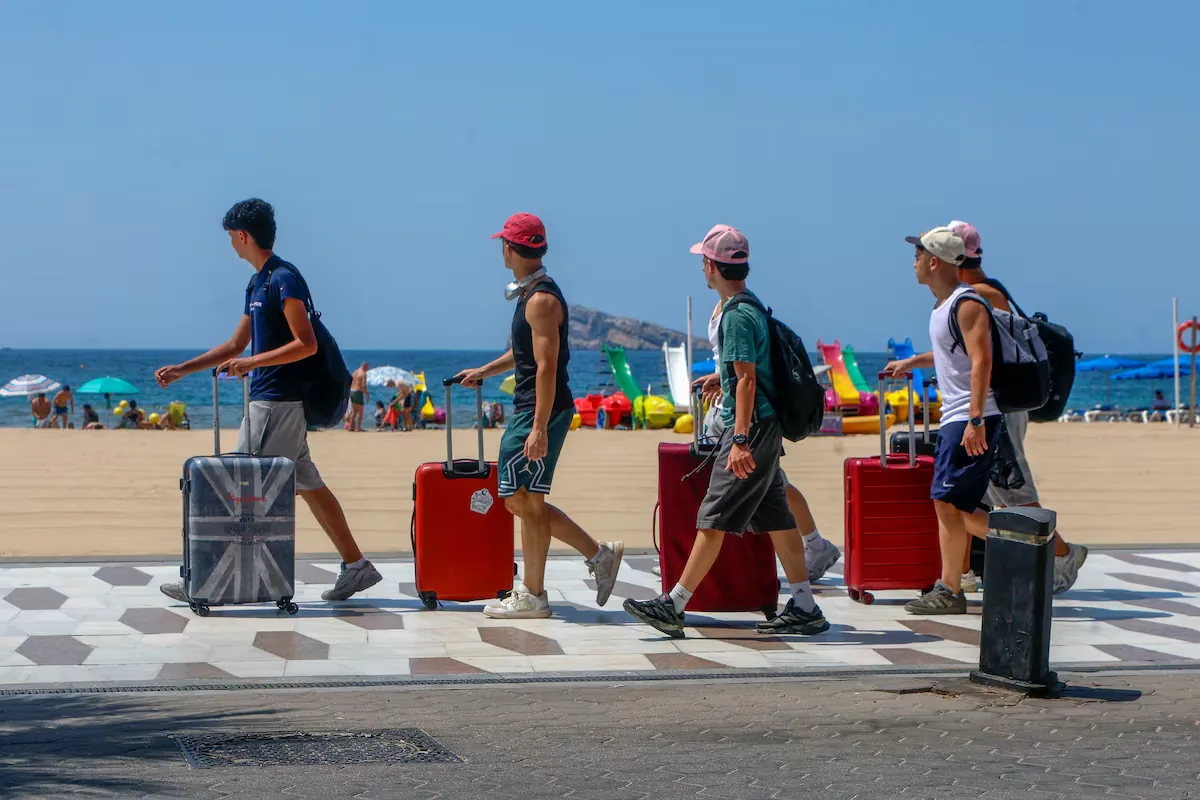
August does not disappoint. Unlike January or June, which pretend optimism and then there are years when they suddenly become treacherous, August always waits for us, patient, at the end of the work year. July can disguise itself as August and appear more festive and lighter than it really is, but August will never stoop to July’s level, that mediocre rest still not settled. July augusts, but August does not july. When the world collapses, when the seven plagues arrive and the already burned lands cannot be set on fire, when humans have become the ultimate zombies, Benidorm will remain intact, stiff, Botox-injected, and August will remain proud, resounding, filled with vacation time.
Feriae Augusti, Ferragosto, the conquest of the right to rest for the working class. Every year, Spain’s brains coordinate to disconnect in unison. Except for hospitality and tourism workers, farmers, ranchers, emergency and health personnel, firefighters, caregivers, and a few other trades, August is ruthless with those who seek self-exploitation: 45 degrees, unbearable heat, the impossible task of thinking. I surrender to it and its dictatorship of horizontality with resignation and enthusiasm because, as journalist Xoan Tallón often says, doing nothing is one of the hardest tasks there is since we always tend to fill rest with small obligations.
August is an anti-system stronghold and naps seem less guilty when the world dozes off at the same time. Vacations in August equalize us and turn us into the kind of tourists some deny: those who seek the cheapest accommodation, the emptiest beach, and the menu with the now established three-ingredient salad (iceberg lettuce, tomato, and four strips of onion). Taste classifies, as Bordieu would say, and I choose not to stand out. I am not interested in secret places or hidden restaurants. I don’t have a boat, nor do I want to rent one. I’m not looking to find myself in India nor to surf “in the north,” as the posh would say. I don’t want to fight to maintain any social status I don’t have because I prefer to be a tourist like all tourists. I want to go where you all go, squeeze into your cars, drink your summer reds, be a tourist in your tourism to finally surrender to the effervescence and shared joy of the Perseid meteor shower and the solar eclipse.
On August 12, astronomical time will align with human time, making the sun, the moon, and our lives coincide for a few minutes. They say there are emotions that only reach their full intensity when they are collective. Fergus Neville, social psychologist at the University of St Andrews, explained in the The New York Times that, by seeing our emotions reflected in the faces of those who feel the same, we receive a kind of social confirmation of our experience. Emotional tourism, suddenly. Something similar happens with the physical environment: apparently, sunlight shapes our mood much more than we usually think. And we will be able to experience this sudden darkness together precisely because it is August and because most of us will be on vacation.
I reach the end of July feeling that I am missing things I don’t quite know what they are, as if I had left my keys somewhere. I know the world is crazy, that life changes, that the seasons are no longer the same, so walking toward August feels like walking toward the end of the beach. It is the rock you have to touch with your foot before turning around, before starting again. A simple, melancholic, and popular consolation. It is the tranquility of vacations and rest, but also knowing that there is something that will never change: “at least August is still reliably ablaze.”
Read more The mystery of Muse: if almost no one likes them, who fills their concerts?