









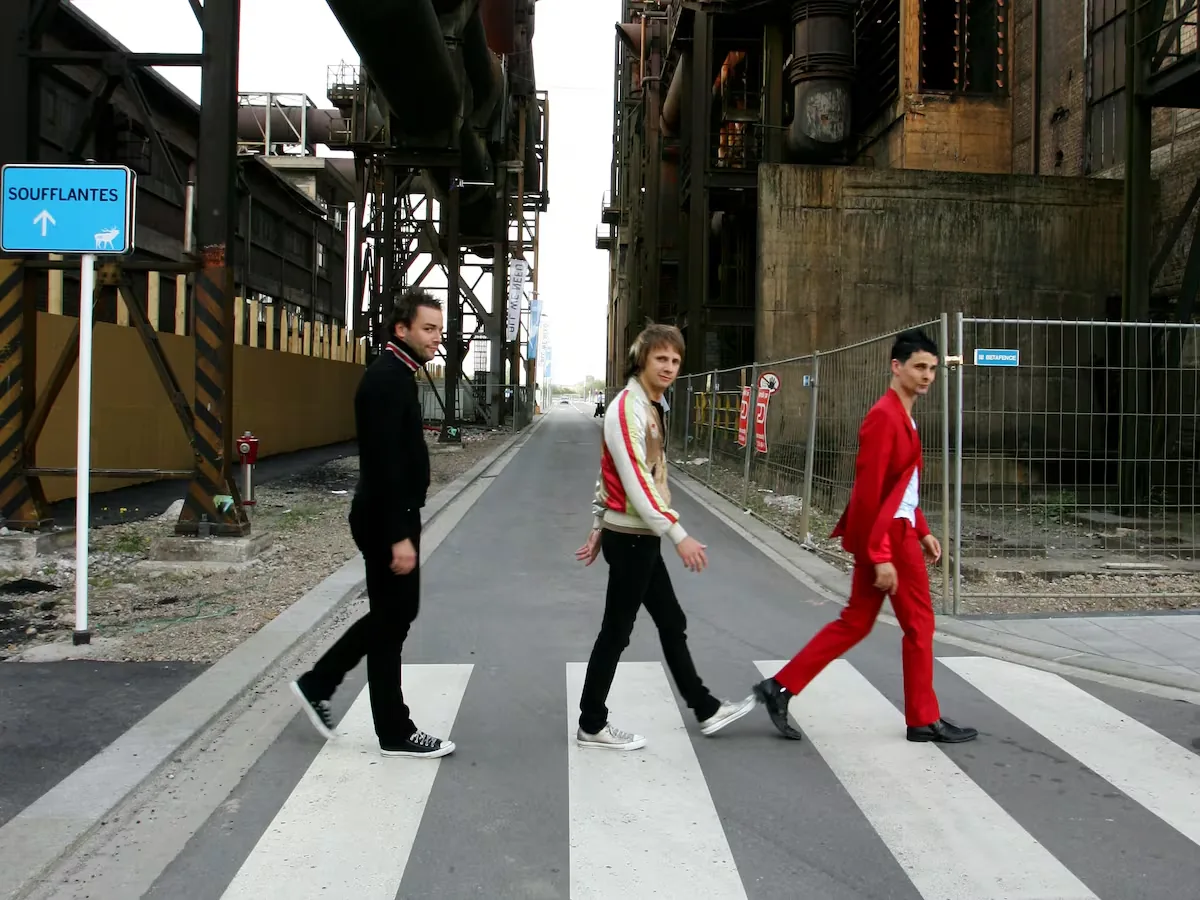
There are few musical confessions as uncomfortable as admitting you like Muse. The British band has been filling stadiums and writing some of the most recognizable anthems of 21st-century rock for over two decades, but it has never achieved something that, on paper, should have been much easier: prestige. In Muse, success has never served as an argument in their favor. Quite the opposite. The bigger the band has become, the easier it has been to ridicule them.
Read more Germany advances in its goal of becoming a major arms power in the face of the Russian threat
What is striking is that this rejection has rarely had to do with Muse’s vocalist and leader, Matt Bellamy. Unlike other great stadium rock frontmen, his figure barely arouses animosity offstage. What is uncomfortable about Muse is the very nature of the band. They have never felt the need to tone down their ambition to seem more respectable. Their songs are heroic, theatrical, and excessive. They talk about surveillance, conspiracies, artificial intelligence, or apocalypse with a conviction that today seems almost anachronistic. While much of rock has learned to avoid grandiloquence, Muse has never stopped embracing it.
And yet, that bet has never backfired. Almost three decades after Showbiz, Muse continues to sell out tickets, headline festivals, and place their albums among the best-selling in the UK. The Wow! Signal confirms that their drawing power remains intact. What is exceptional is that this success has never been accompanied by critical consensus. Each new album reopens the same discussion: for some, Muse represents one of the most unique proposals in contemporary rock; for others, they repeat the same excesses as always.

This division is somewhat paradoxical. Everything Muse has been ridiculed for over the years — Bellamy’s impossible falsetto, the influence of Queen and Rachmaninov, the theatricality, or their messianic lyrics — is exactly what their followers consider indispensable. What some dismiss as pompous, others experience as an almost cathartic experience.
The problem has never been only the content of their songs, but the way the band presents itself. Bellamy is far from the classic rock imagery. He sings with an almost operatic register and turns each song into a small show. Often it seems like Muse is parodying themselves, but the reality is that their proposal contains not a hint of irony; they are completely serious.
The Wow! Signal does not tone down any of the traits that have made Muse such a divisive band. The mammoth guitars, impossible falsettos, melodies designed for stadiums, and a concept that looks to the sky again are all still there. The title refers to the mysterious radio signal captured in 1977 that some interpreted as a possible extraterrestrial message. At first glance, The Wow! Signal seems like another sci-fi exercise in the band’s trademark style.
That choice is no accident. Bellamy has been describing Muse for years as an attempt to find meaning in emotions he himself did not fully understand. “The hardest moments in your life are those when you have no answers. You feel lost, alone, and don’t know what will happen,” he recently explained about the origin of The Wow! Signal. In another interview, he recalled that Muse “started as an emotional expression of unknown anxieties” and that, over time, they have tried to understand what emotions lay beneath all that. Before a political discourse or a collection of conspiracy theories, Muse was born as an attempt to name an anxiety Bellamy still didn’t know how to explain.
This need to find explanations goes back a long way. Bellamy has said that his mother often reminds him that when he was four or five years old and learning to write, he would throw the pen on the floor and ask over and over: “But why?” He himself says he has never stopped doing it. “I have always needed an explanation for the reasons behind things. I want to decipher the motivations and who benefits from them.”
Perhaps it is this need to find answers that explains much of Muse’s imagery. Secret societies, mass surveillance, authoritarian governments, or extraterrestrial signals function less as conspiracy theories and more as a way to make sense of a world Bellamy perceives as confusing. More than writing about conspiracies, he writes about anxiety using the language of conspiracies.
In fact, one of his most revealing confessions points exactly in that direction. “I tend to fall into paranoia, anxiety about technology or the future of the world,” he admitted recently. “I think part of all that comes from what the music itself makes me feel when I listen to it.” Emotion comes before the story. First comes the feeling of urgency, threat, or uncertainty; then come the conspiracies, cosmic language, and all the images Bellamy uses to shape and understand those emotions.
Bellamy never distances himself from the anxiety he describes. He fully surrenders to it. The result is hyperbolic and absolutely paranoid songs, but never cynical or ironic. Paranoia, in Muse’s songs, is nothing more and nothing less than the truth. Perhaps that is why Muse has never been a particularly cool band.
Read more The Community of Madrid buys a luxury penthouse in Chamberí for Ayuso to use as a temporary «office»
That reading is no accident either. Uprising, probably their best-known anthem, uses the language of uprising and social revolution, but the threat it describes is never identified, remaining open to interpretation. That ambiguity allows each listener to project their own obsessions: governments, corporations, media, or any other form of power. More than a political discourse, the song paints the feeling that there are forces too big to fully understand.
However, it is enough to look a little closer at their songs to see that they rarely talk about what they seem to tell. Bellamy has explained that The Wow! Signal, an album full of extraterrestrial references, actually comes from the breakup with the mother of his children. “Love was our failed rebellion,” Matt sings in Hexagons. The same happens with Supermassive Black Hole: beneath an avalanche of astronomical images lies simply a love song. Even songs like Plug in Baby or Hysteria, which seem to talk about manipulation, control, or loss of freedom, come from much more personal emotions. Bellamy does not ground his feelings; he projects them onto the cosmos. He turns them into planets, alien invasions, or black holes. It is the same emotional impulse of any romantic composer, only expressed on a cosmic scale.
Perhaps that is part of the rejection Muse still arouses. Their songs talk about love, fear, desire, or loss like many others. The difference is that Bellamy never expresses those emotions in everyday terms: he turns them into science fiction movies. That aesthetic choice, as excessive as it is sincere, has always occupied an uncomfortable place in a rock canon that has tended to value restraint, irony, or confessional realism more.
Far from correcting that tendency, Muse has decided to make it their identity. The grandiloquence that appeared in Origin of Symmetry has grown with each album. From Black Holes and Revelations to The Resistance, the conceptual Drones, or that Muse squared album that is Will of the People, Bellamy has never seemed worried about being excessive. The band has preferred to keep expanding their universe rather than tone down their ambition to gain prestige.
That aesthetic clash is no accident either. Muse appeared when rock was heading in the opposite direction. In the early 2000s, while The Strokes or The White Stripes championed authenticity, restraint, and unadorned guitars, Bellamy looked to the exaggerated drama of Queen, Pink Floyd, and classical music. While indie aspired to sound like a garage band, Muse dreamed of filling stadiums by writing songs that seemed like cinematic superproductions.
That difference was not limited to the music. Bellamy has never fit into rock iconography. He is not a cursed hero, a style icon, or a typical sex symbol. On stage, he has always conveyed the feeling of being a musician fascinated by physics, synthesizers, and classical music rather than a traditional rockstar. Even when performing one of the most spectacular falsettos in contemporary rock, he seems less interested in seducing the audience than in pushing a musical idea to the limit.
Unlike much of rock, Muse has never distrusted pop. Their discography includes riffs close to metal alongside songs as melodic as Starlight, Madness, or Panic Station. For Bellamy, a great melody has always been above any rock orthodoxy. Perhaps that is why Muse has achieved something unusual: appealing simultaneously to hard rock fans and pop listeners. Paradoxically, that same ease in moving between both worlds has fueled suspicion from part of the critics for years, for whom sounding too accessible has always been a reason for distrust.
It is unlikely that The Wow! Signal will change the opinion of those who have considered Muse an exaggerated band for two decades. Nor does Bellamy seem especially interested in convincing them. By now, it is clear that Muse has never wanted to correct what makes them recognizable. They keep writing small operas for stadiums. They keep elevating emotions to the size of a black hole. And they keep doing it with the same conviction as twenty years ago.
Perhaps that is the real secret of Muse. For years we have debated whether their songs talked about conspiracies, aliens, or revolutions, when in reality they have always talked about the same things as the rest of popular music: fear, desire, love, uncertainty, or loss. The difference is that Bellamy has decided to express those emotions with the language of science fiction, physics, and dystopias. Perhaps that is why Muse continues to divide so much. Or maybe simply because rock has not yet fully reconciled with those who dare to feel big.