



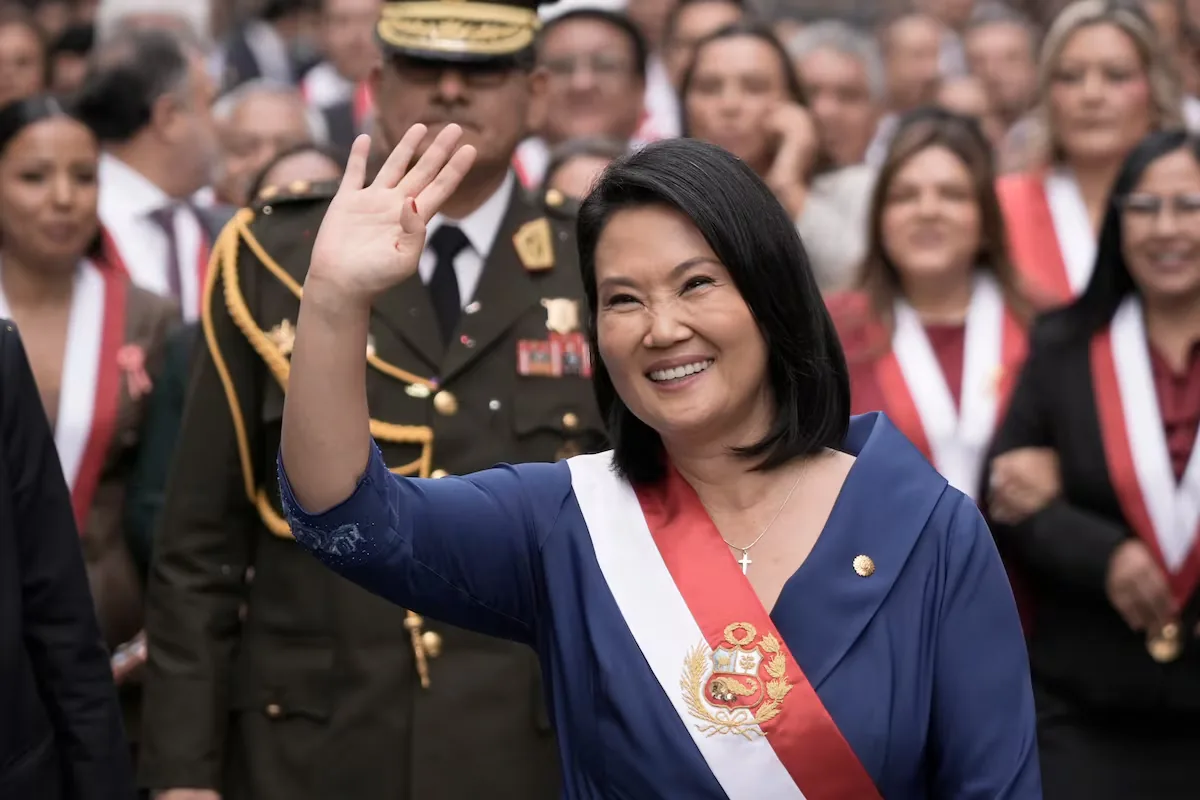
Shortly before Keiko Fujimori addressed the country for the first time as president of the Republic, opposition congressmen withdrew from the Chamber. They carried black and white printed photos of the victims of state repression in recent years. They shouted “justice.” Others simply booed her. At that moment, Keiko Fujimori, who usually controls her emotions to the millimeter, began to blink repeatedly, with a distressed face. It was the first gesture of institutional rejection towards a government that comes to power in a fractured country.
As she did throughout the campaign, Keiko Fujimori placed citizen security at the center of her first speech as president. In a nation hit by extortion and organized crime, she announced that the Armed Forces will take a leading role in the fight against crime and assured to “restore respect” to the National Police. To do this, she offered an “ambitious technological modernization process” that will include interconnected video surveillance systems, artificial intelligence tools to anticipate and map crime, and a strengthening of intelligence work. “The fight will not only be against common criminals. We will go after national and international mafias that finance extortion, contract killing, drug trafficking, and illegal mining,” she stated.
The most controversial announcement was the role the military will play in internal security, in the fight against crime. Fujimori hinted that she will declare a state of emergency in various cities of the country and that, in those territories, the military will take an active role in maintaining public order. “During states of emergency, the Armed Forces will temporarily assume leadership of security operations and internal order control, in close coordination with the National Police, until the authority of the State is fully restored and those territories are returned to the citizens,” she announced.
Fujimori claimed to have found a “State adrift” that she intends to strengthen, and emphasized inequality, attending to those who “have historically been marginalized.” For this, she said she will reorganize state aid programs and relaunch the National Food Assistance Program, created during Alberto Fujimori’s government to distribute food to impoverished populations, especially schoolchildren. She added that she will prioritize early childhood with the goal of halving chronic child malnutrition and anemia. “Today, 12% of children under five suffer from chronic malnutrition and 35% suffer from anemia. We will reduce both figures by half, focusing efforts on the most vulnerable populations,” she said.
Several blocks from Congress, in front of the Palace of Justice, another symbol reinforced the same idea. Dozens of citizens participated in a washing of the Peruvian flag (immersing it in water and soap to symbolically clean it), a protest action that evoked the mobilizations of the early 2000s, when it became an emblem of rejection of corruption during the decline of Alberto Fujimori’s regime. This time, the organizers stated that they sought to “clean the country of evil” and express their rejection of the return of Fujimorism to power.
In her first presidential message, Fujimori dedicated only a few phrases to national reconciliation and avoided addressing two issues that marked much of the campaign and her political legacy: human rights violations and her proposal to withdraw Peru from the Inter-American Court of Human Rights. “I am committed to ensuring that the goals of order and national reconciliation are perfectly compatible terms (…) I call on the opposition political forces: let us build bridges of dialogue; let us think about the next generations and not the next elections,” she said during her speech before Congress.
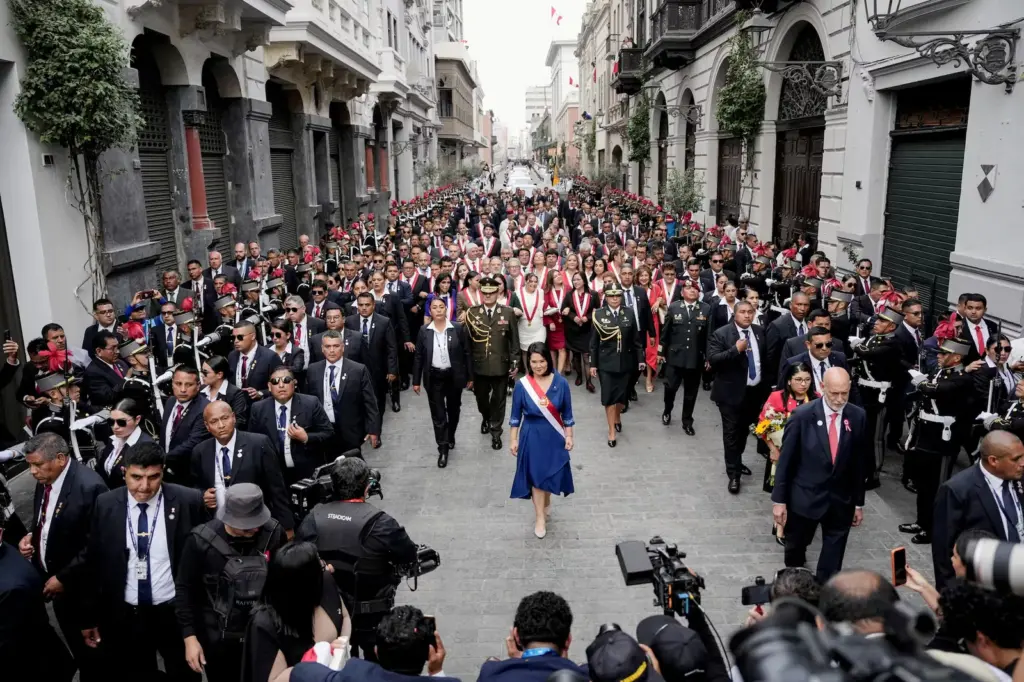
For political analyst José Carlos Requena, those silences are part of a deliberate decision. “She does not want to discuss these issues. She does not want to give them greater relevance. She does not want to feel that some canons are imposed on her. It is a convinced omission.” The strategy seems aimed at shifting the debate towards security, the economy, and public management, areas in which the new Executive intends to build its foundations.
Like her father, who made the tractor his emblem, Keiko Fujimori has placed infrastructure at the center of her government project. In her first message to the nation, she promised to connect the country through new roads and logistics corridors to strengthen production and bring markets closer. She also promised to complete Line 2 of the Lima Metro — a project started in 2014 that, after successive delays, remains unfinished — and to execute the remaining lines of the network.
The bet responds to a tangible problem. Vehicle congestion has become one of the greatest costs to the productivity of the capital. According to the Association for the Promotion of National Infrastructure (AFIN), inhabitants of Lima and Callao lose, on average, 198 hours a year trapped in traffic. Fujimori also announced the implementation of metro systems for the regions of Arequipa, Piura, and Trujillo, as well as the completion of flagship projects such as the New Central Highway.
However, the speech left the main questions open. The president did not explain how she will finance that ambitious infrastructure package, what the roadmap to execute it will be, nor the timelines she expects to meet. The team of former presidential candidate Marisol Pérez Tello has calculated that part of these works would cost 76.9 billion soles (about 22.6 billion dollars), which would be equivalent to 7% of the Gross Domestic Product. “I remind you that hope must be accompanied by realism, commitment, and work,” questioned the former Minister of Justice.
Fujimori also announced that she will raise the minimum wage from 1,130 soles (332 dollars) to 1,300 soles (383 dollars). The announcement also represents a shift from her campaign speech. At that time, she criticized the same proposal from her rival, Roberto Sánchez, considering it sought “easy applause.” Now she has made that commitment her own and incorporated it among the first decisions of her government. However, she avoided specifying when the increase will take effect and under what economic criteria it will be implemented.
Finance expert Jorge Carrillo Acosta stated that the minimum wage increase could generate more labor informality, as “it will generate an additional cost for many companies, especially small and medium-sized enterprises.” He indicates that the employer would be forced to pay employees “off the books.” “In the extreme, another measure the company could take is to dismiss workers, causing greater harm than the benefit intended to be achieved,” he explains.
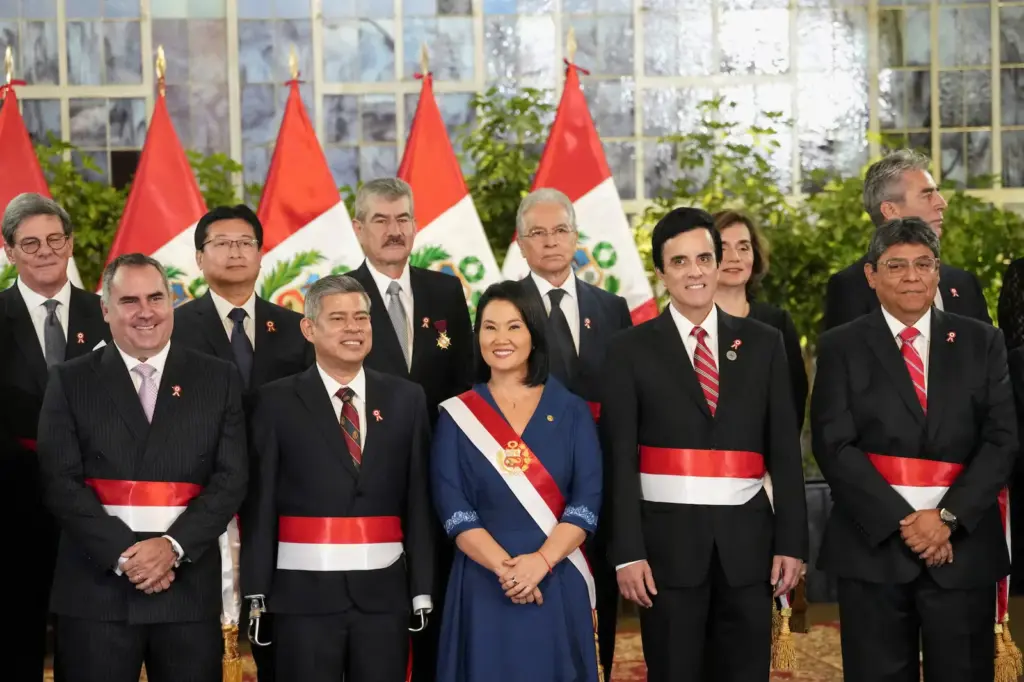
This Tuesday, Fujimori’s first cabinet was also sworn in. It has only two women out of 19 positions: Maritza Canales, Ministry of Development and Social Inclusion, and María Seminario, Ministry of Women and Vulnerable Populations. There are not many surprises. Ministers and public officials from past governments appear, such as the new Minister of Justice, Ernesto Álvarez, who was the first minister during José Jerí’s government. There are also figures without experience in the position, such as Foreign Minister Carlos Espa, who is not a career diplomat, or the new Minister of Culture, Alberto Beingolea, whose career has focused on journalism and university teaching.
Polling firm Ipsos published a survey before the inauguration. When asked what feeling the election of Keiko Fujimori as president produces, 39% of respondents answered “concern.” It surpassed “optimism” (37%) and also indifference (16%).
Read more The luggage set that thousands of travelers recommend for a very simple reason