









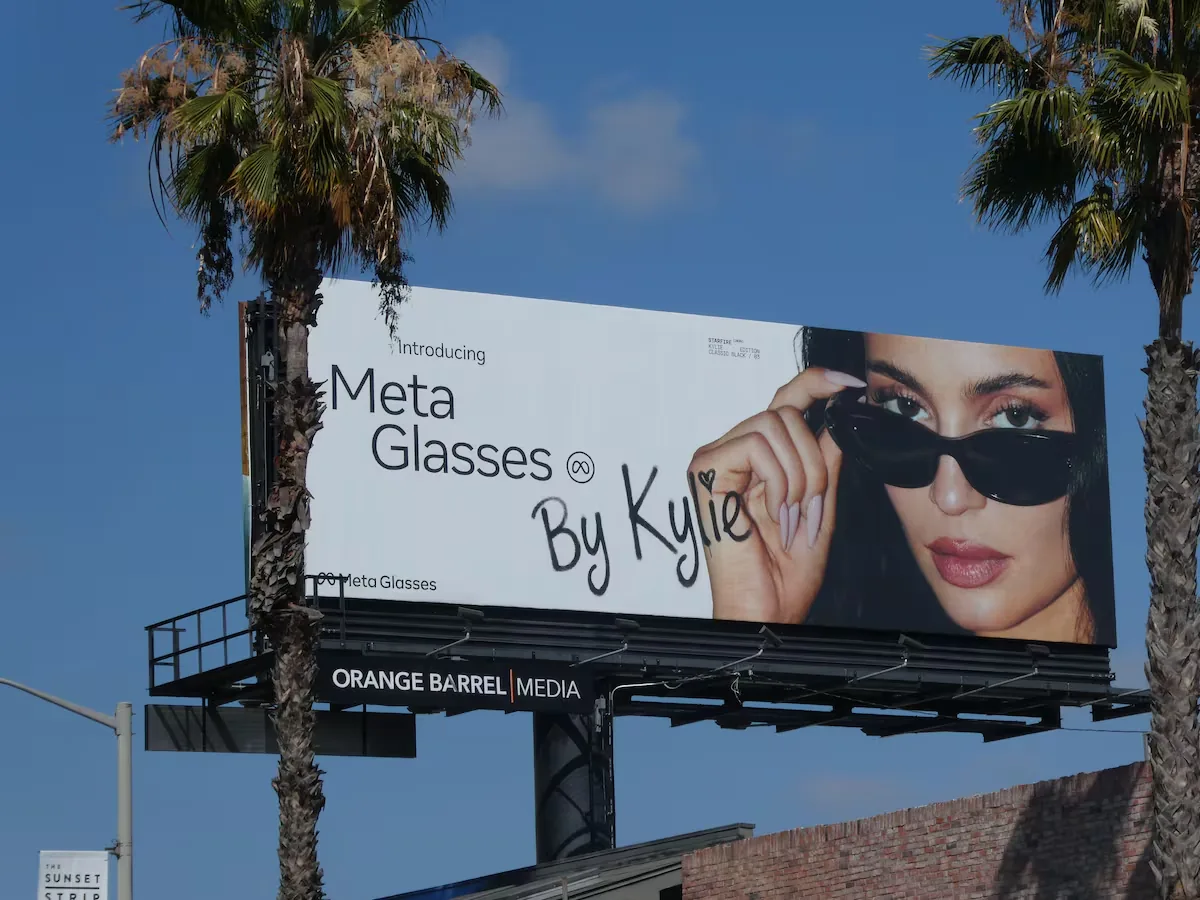
Meta’s new smart glasses have been on sale for a few weeks. They allow you to record, listen to music, or chat with AI and are no longer just the Ray-Ban model. Now there are many, including one designed by the influencer Kylie Jenner, which are sold in Spain for 419 euros, the most expensive.
@peoplevselon Recording everything we see and do constantly? It’s giving fascism, not fashion, @kyliejenner hun. It’s just been revealed that Meta is planning to make the glasses “continuously record audio while taking photos every few seconds” without any warning light* Literally NO ONE asked for this *Source: Financial Times
♬ original sound – People Vs Elon
With this global launch, a campaign by the activist group Everyone Hates Elon, based in London, has also arrived, with at least three posters: “Glasses for people who don’t do consent,” they write over an image of the pedophile Jeffrey Epstein. They have also changed the ad featuring Jenner with another slogan: “Meta. We are always watching you.” And their third slogan is about simple Meta glasses: “The biggest technological advance for perverts since the trench coat.” EL PAÍS has sent a message to the activist group to find out the impact of their campaign but has not received a response.
@peoplevselon Hey @kyliejenner this @rayban @meta glasses ad is better than your one x We don’t have to allow these pervert glasses to become normal. No one consented to this. LINK IN BIO TO LEGALLY OBJECT TO META RECORDING YOUR FACE AND VOICE VIA THEIR PERVERT GLASSES #kyliejenner
♬ original sound – People Vs Elon
The reference to pervert glasses is not new. It is such a repeated argument on social media that Instagram, a Meta platform, has decided to act: it will ban videos recorded with Meta glasses that show harassment of strangers. The announcement was made by Adam Mosseri, head of Instagram: “We don’t want people to secretly record others to harass them and then post it on our platform,” he said. There are mainly two very controversial types of recordings: pranks on workers, which can be humiliating, and flirting videos, in which women are assaulted and recorded without consent by supposed pickup artists.
Besides the difficulty of detecting these videos on Instagram, it is unclear what will happen to these recordings on other networks. The glasses will still allow filming these videos. Instagram’s solution seems, for now, a simple patch. “People use our glasses because they find them useful,” a Meta spokesperson told this newspaper. But they also want to protect privacy: “They all have an LED that blinks when you take a photo or video. It cannot be disabled, and if someone covers or damages it, the camera does not work.”
@peoplevselon Meta’s new AI sunglasses will help creeps record women without their consent. And then use the videos to train Mark Zuckerberg’s robots. God forbid these tech bros build something the world ACTUALLY F*ING NEEDS???
Read more The three houses of the week: fluid lines on an Ibizan cove for 16.7 million euros
♬ Circuit Echo Traverse – Trevor Banks
This small LED light carries a huge responsibility: it is the only signal other people have to know if someone is recording them. Until now, it was easy to cover or disable that light, but Meta claims it has made it harder. “There are huge communities of users trying to disable the LED, cover it, or bypass it, and Meta fights back with updates that catch the trick and disable the camera,” says Joseph O’Hagan, a researcher at the University of Glasgow. “Credit to Meta that it is increasingly difficult to cover or disable it: the most common method today seems to be a drill to remove it.”
It is undeniable that this type of glasses is used to record situations where a mobile phone is not wanted, says O’Hagan: “We have seen users justify covering the LED for various reasons: wanting to take photos of children who don’t like being in them; wanting to record vacation or concert videos without people around noticing. But there is also a growing perception that this facilitates shady behavior, especially with women.”
A Swedish media investigation in February showed that these fears are justified. They revealed that material captured by Meta glasses ends up being reviewed by workers at a company in Kenya. Their employees described having seen recordings with naked people in the bathroom, sex scenes, bank cards visible by mistake, users watching pornography.
These recordings are just one of the problems. Some recent news and statements from Meta’s head, Mark Zuckerberg, delve into the challenge. Those who don’t wear glasses will have a “quite significant cognitive disadvantage,” Zuckerberg said a year ago, and this Wednesday he insisted that “in five years it is almost certain that there will be billions of people with a personal agent that understands their goals and works for them 24/7.” That agent would depend on glasses that record the user’s entire life, which could feature facial recognition and include a “permanent detection” system: the frame would record audio and take photos every few seconds, creating a record so the AI assistant knows where you left your keys or what someone told you at lunch.
One of the main problems with the glasses so far is that the beneficiaries are the users and the harmed are others. No one gains anything by being recorded on the street without knowing it. People seem willing to give up privacy in exchange for something very useful, as has happened with mobile phones, apps, and mass surveillance. That kind of tacit agreement with the glasses will be much more complicated. The harms and benefits will be of a depth hard to imagine. Everything can be exploited: “From speech transcription [when someone has hearing problems or hears poorly] to eavesdropping [on someone else’s conversation] is a very short step; and a function that describes your interlocutor’s emotional state, designed for people with alexithymia [who have difficulty describing emotions], can end up being used to detect when someone is vulnerable to manipulate them. These are tensions that arise when the capabilities of these glasses outpace their protections,” explains Mark McGill, also a researcher at the University of Glasgow.
One option would be to remove the camera from the glasses, which would make them less useful. The glasses continue to sell well: in 2025 alone, seven million units were sold. At this pace and with more innovations, Meta might think people will adopt them despite the risks. But it is an ongoing debate and campaigns like Everyone Hates Elon reach many people. “We need a much more sophisticated approach to privacy, regulating when, where, and how cameras and microphones can be used on the devices we wear, what can be done with the captured material,” says McGill. “The ‘shady’ usefulness of smart glasses could be reduced if third parties appearing were blurred or replaced when there is no clear consent. We also need to rethink legislation on recording in public spaces, conceived in an era before these cameras we wear.”
Read more Angelina Jolie is not alone: why so many women have stopped looking for a partner