








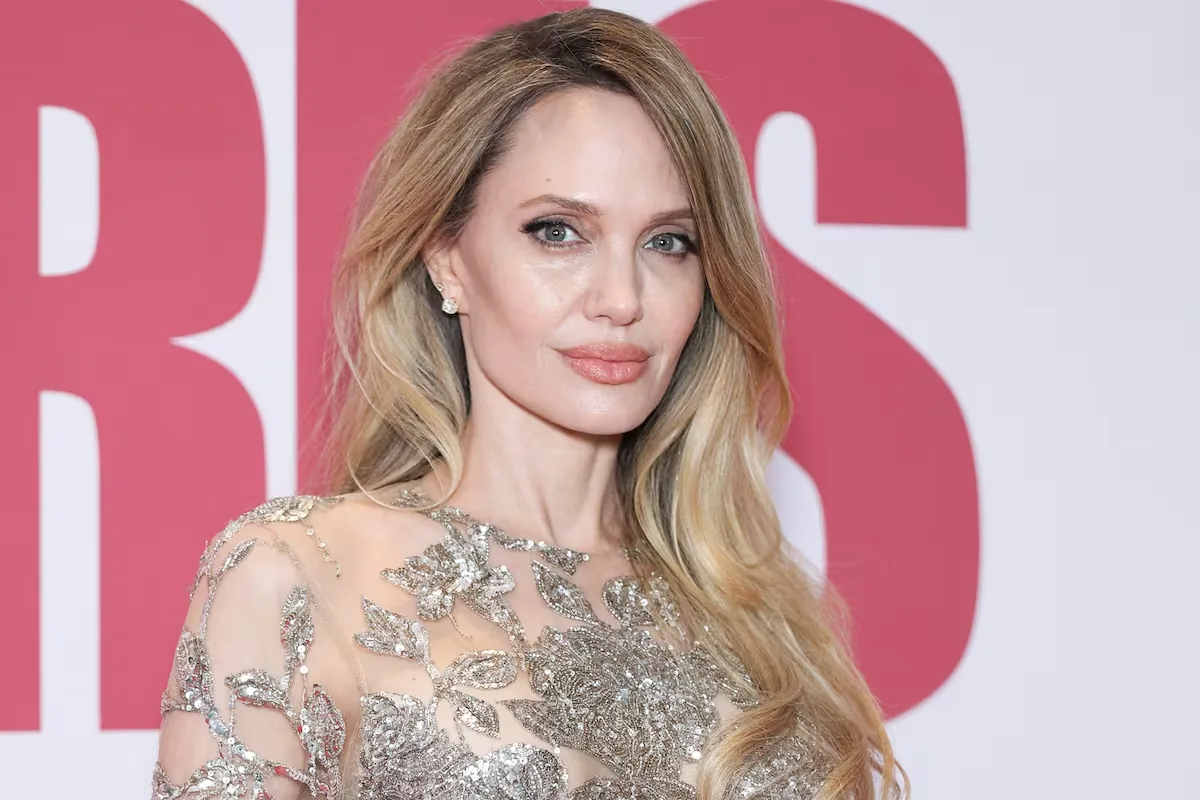
“I haven’t dated anyone or had a partner since I divorced a decade ago. In a way, I have internalized that this aspect is not the central focus of my life if I am concentrating on my children and my family,” Angelina Jolie said, immersed in the promotion of the film Couture, to Yahoo Entertainment. And this is how, after her separation from Brad Pitt in 2016, the actress has truly set in motion what so many women want or try to do: stop dating to focus their interest on aspects of their lives unrelated to romantic relationships.
Read more Trump announces a deal for the “total disarmament” of Hamas
The author Margaret Atwood made a clever play on words with the term ‘menopause’ 35 years ago, which in English takes on full meaning, since menopause could be dissected, with irony and a little humorous trick, into men-on-pause. “Menopause is a pause to reconsider men,” she wrote in the short story collection Wilderness Tips (Bloomsbury Publishing PLC, 1991). We live in hetero-pessimistic times marked by a female detachment from men, who are seen as the focus of the problem.
Although the term, coined by Asa Seresin in The New Inquiry, has been embraced by many, it needs some nuance. Magdalene J. Taylor assures this, saying in The New York Times that in reality, “there has never been a better time in human history to live heterosexuality with happiness and success.” “We have more freedom than ever to become who we want to be and date whoever we want. And that should be accompanied by optimism strong enough to make the war of the sexes irrelevant,” she said.
Very controversial and viral was Chanté Joseph’s article Is having a boyfriend embarrassing now? in which the writer analyzed whether simply having a boyfriend was somewhat embarrassing. Writer Eva Morell commented on this issue in her Substack. “Pausing is also a form of self-care. And I have practiced it for a long time. What bothers me is that we are turning into a trend – and almost a moral mandate – what for many other women is not a free choice, but the rather unglamorous consequence of an emotional environment that is shattered,” she said. When contacted to talk about the number of women like Jolie who have decided to pause the search for “romantic” love, she reflects on whether doing so somehow means ‘throwing in the towel’ or if it is an understandable form of protection. “I think it’s a bit of both, and I think pretending it’s just one would do us a disservice. There has come a time when the market is so bad that we almost resign ourselves to the situation left to us, which is being ‘alone.’ There is, if I’m honest, a component of defeat there. It’s okay to admit it. We almost resign ourselves to the situation left to us, which is being alone and being comfortable with that decision. Just because we are alone doesn’t mean we become Iris, Kate Winslet’s character in The Holiday, crying in corners because that loneliness can overwhelm everything,” she explains to S Moda. She points out that, however, it has also turned out to be one of the best decisions women have made as it is a form of protection she considers smart. “What we are really protecting ourselves from is accumulated disappointments, being fed up with lovebombing, breadcrumbing, gaslighting and all those trendy anglicisms that suddenly named things that have been happening to us in relationships all our lives, long before there was a word for them,” Morell continues.
Sociologist and gender expert Lionel S. Delgado believes there is a “very justified but dangerous” relational fatigue. “The unequal distribution of care, the difficulty for change, and comfort in passive positions are causing many women to compare with the bonds they would like to have and feel disappointed and frustrated. It’s logical, sometimes it just isn’t worth it. However, I think this hetero-pessimism is very real but limited to the most progressive environments,” says the author of Sad and Wild (Editorial Ariel, 2026) before clarifying that in more conservative sectors – in a relational sense – neo-romanticism is on the rise. “I think pessimism is a legitimate stance, but very paralyzing. Frustration immobilizes us, and meanwhile, conservative discourses propose a hetero-optimism that makes one re-engage with couple-centered and romantic logics that are much easier and more comfortable than pessimistic frustration,” he warns.
Anthropologist and sociologist Andrea García-Santesmases Fernández considers it delicate to claim hetero-pessimism as a feminist position. “While it partly stems from there (criticism of compulsory heterosexuality and romantic love), it can lead to discourses essentializing gender differences, understanding men and women as naturally and necessarily opposed and antagonistic. And this is dangerous because it legitimizes retrograde and conservative discourses,” she says.
Boredom, self-knowledge, or self-care?
Celebrities like Drew Barrymore have been single for years – she recently clarified that after an attempt to return to dating, the man ghosted her on the first date due to exhaustion. “I spent much of my life loving romance, drama, and all that. I just ended up exhausted. I am sincerely tired and worn out,” said the actress and presenter. Jane Fonda said in 2018 to Extra that dating wasn’t for her either. “I don’t date anymore, although I did until a couple of years ago. I’m 80 years old. I’ve closed the business down there,” the actress said mischievously. Khloé Kardashian, whose love life has been marked by betrayals, lies, and infidelities, is another who proudly says she has retired from dating and assures that this pause has helped her get to know herself better. “I’m not actively looking for a partner or dating anyone. And I’m very happy; I feel fully fulfilled. I also love having taken a break of about three years without dating; I feel like I’ve really come to know myself on a deeper level,” she explains on Jey Shetty’s podcast. “It’s about avoiding distractions. When you’re alone with yourself, you think: ‘Okay, I have to face this version of me,’ ‘what do I want to improve?’ or ‘how can I be a better person in this aspect?’” she said.
Andrea García-Santesmases Fernández considers that stopping dating is an understandable form of self-care at a time of gender tensions and disputes about what the sexual contract between men and women should be. “The classic contract, defined by Carol Pateman, marked female subordination against which most women rebel today (with the exception of some perverse revival like the ‘tradwives’),” says the author of A New Sexual Contract. “The post-feminist sexual contract, one that simply advocates imitating male affective-sexual relationship behaviors and trusting the market as a safeguard for our security and pleasure, is also becoming obsolete. A new sexual contract, one that is truly reciprocal and equal, taking into account the distribution of tasks and care, but also of affections and pleasures, is yet to be built,” she adds.
A life without partner(s)
Sara is a lawyer, has not dated for five years, and says she is happier than ever because of it. “It could be said that I have never been especially lucky with men. One of those afternoons when, after the fifth beer, I was repeating the same dramatic speech to my friends through tears, I decided I couldn’t go on like that. I deleted the dating apps and only hang out with my group of friends, who, by the way, are gay. If I ever go for the fifth beer again, that time I’m laughing because we’re talking about things much more interesting than my failed dates,” she says. However, she confesses that when her friends start getting married (she is 34), she sometimes feels overwhelmed thinking it will never be her case. So, is there really a way to internalize and believe that you truly don’t need a partner to be happy?
“There are several interesting issues to unpack here,” says Morell, author of Refuge. A Story of Cabins (Debate, 2025). “We can talk about the domestic drama of going to the supermarket – it happens to me every week – and discovering that sliced bread only comes in family size, that sliced cheese is always XL format, and that it’s impossible to buy half a cauliflower without condemning yourself to eat the same thing all week. Everyday life, indeed, is designed in packs of two, and that, although it seems silly, is a constant and silent reminder that there is a default life model that is not yours, and the world hasn’t bothered to make room for the one that is,” she assures. “Although it seems that now we are considered more empowered when we are single, almost as if we had won a medal, it’s not exactly like that, nor do I think that empowerment framing is needed to justify it. We have simply decided, over the years and with experience, that there are more important things than looking for a husband. And that change in priorities, more than a feminist conquest, is above all common sense,” she explains.
Lionel S. Delgado believes that putting all expectations on a partner is a formula destined for disappointment, as he does not think a partner should bear the burden of being the space for care, fun, sexual exploration, everyday time, mental support, release, and financial support. He agrees with Morell that much remains to be done regarding material issues. “The possibility of requesting mortgages with groups of friends, enhancing conflict management skills with friendships, rights to request leave to care for important people beyond the partner, having the same rights with friends as with common-law partners, etc., remains to be explored,” he assures. “If the material aspect is not addressed, the tendency will be to try to find stability in a chaotic world through a partner, because it is the only socially recognized and politically legitimate bond,” says the expert on the manosphere.
It is becoming so common for women to decide to put the dating world on pause that the dating app Bumble has the ‘Do Not Disturb’ option, which can be activated for 24 hours, 72 hours, a week, or indefinitely. “Simply identifying exhaustion and naming it can help you change your way of thinking, moving from ‘something is wrong with me’ to ‘this can be exhausting.’ From there, it’s easier to adjust your approach,” says Marisa Cohen, relationship scientist at Bumble.
“If there’s one thing I’ve learned, it’s that no one prepares you for the possibility that being single is not a kind of waiting room. Our entire sentimental education – movies, songs, even the stories we were told as children – is built on the idea that being alone is a transitional state, a ‘not yet,’ a chapter that closes as soon as the right protagonist appears. No one told us that you could stay living there, in that chapter, and that you could live well. And I think that’s the real change, we have stopped treating the partner as the central plot of our life and started treating them as a secondary character, who may or may not appear, and if they do, great, and if not, the story still makes sense. It’s not that we have stopped believing in love – not at all – it’s that we have stopped needing it as an excuse to justify that our life is complete,” Morell says.
Seresin pointed out that hetero-pessimism tends to focus considerably on men as the root of the problem, when perhaps the interesting thing would be to also question the way each person relates, the expectations placed on a date, and the mental and emotional capacity with which each faces relational attempts. Because if anything is clear, trying to find love is, in a way, a risky activity without clinics for broken hearts yet. And let’s not forget that Angelina Jolie’s statements have gone viral without considering the detail that the actress is bisexual, so claiming that she has thrown in the towel ONLY with men invisibilizes her orientation. Because Jolie is not tired of men, but of partners. In general. And she is not the only one.
Read more When culture is development