






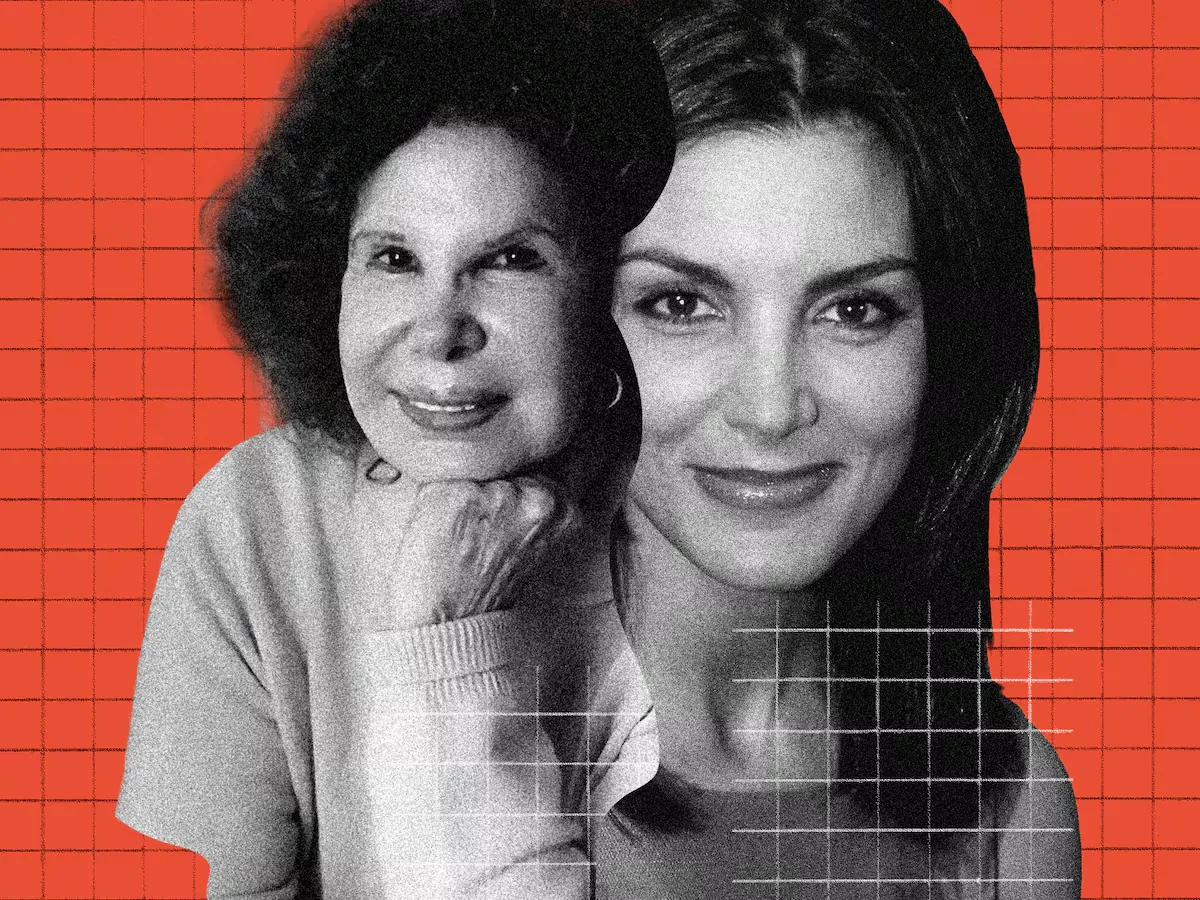
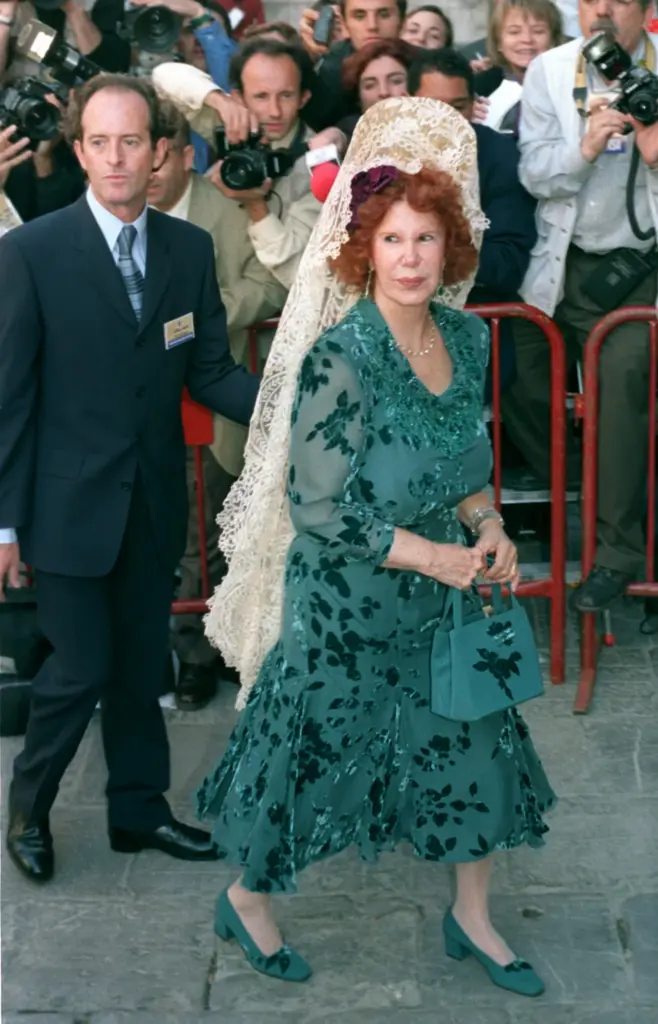
Cayetana Fitz-James Stuart had so many noble titles and was so regal that it was always said she was not obliged to pay homage to any king or queen. Oriana Fallaci was to blame for this fallacy. In 1963, the Italian journalist included an interview with the aristocrat in her book The Unpleasant Ones in which she stated: “Her blood is bluer than all the blue bloods on Earth. If Queen Elizabeth of England and the Duchess of Alba met at an elevator door, the latter should give way.” Cayetana, a monarchist hardliner and practitioner of the strict protocol and ceremonial line, hated that fallacious hyperbole. “That is literature, nonsense,” she always replied when asked about this matter. “Stupid,” she said when asked her opinion about the author of the rumor.
But Fallaci was right about one thing. Cayetana de Alba, twenty times Grandee of Spain, descendant of the Stuarts and an unlikely claimant to the Scottish throne, did behave like a sovereign. “My mother lived like an empress,” her favorite son, Cayetano Martínez de Irujo, often says. Like a good absolute monarch, she did not like to be disobeyed. It is said that the pillars of the Liria palace trembled in 1998 when the “empress” found out that Cayetano, the apple of her eye, Olympic rider and Count of Salvatierra, was dating Mar Flores.
Model, separated, mother of a son, nicknamed “the flower of Usera” for her humble origins and beautiful, extraordinarily beautiful, the mannequin was exactly everything a sphinx of the ancien régime like Cayetana Fitz-James did not want for her son. “She never referred to me by my name, she called me ‘the model.’ For her, that was all I was,” Mar Flores recalls in conversation with EL PAÍS. “She used to say her son changed girlfriends like shirts. She thought I was just another shirt. But I never took it personally,” she assures.
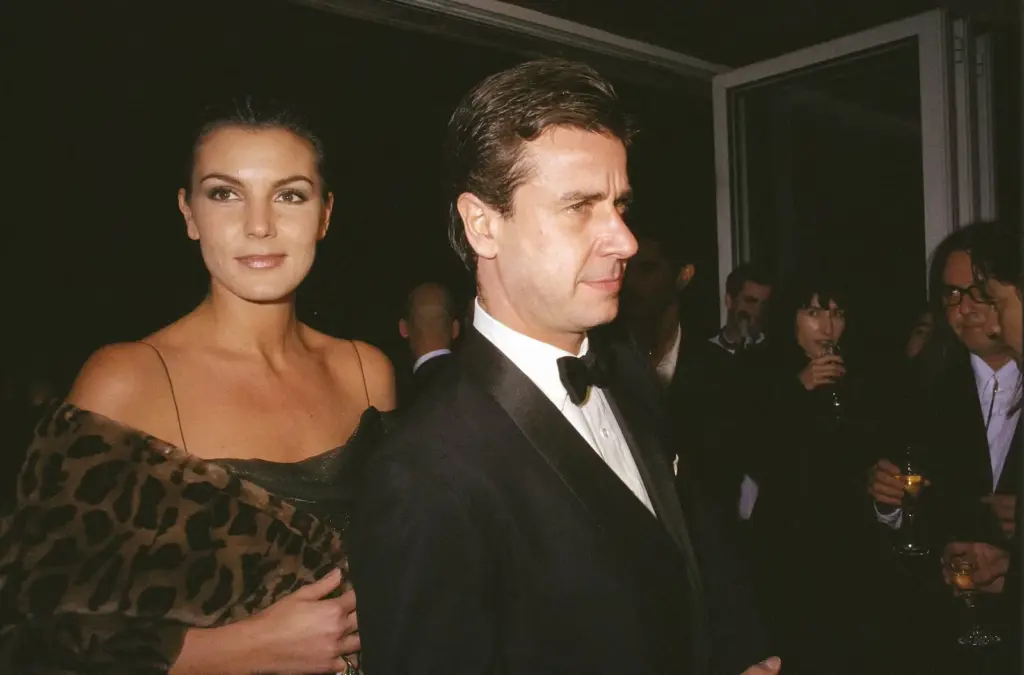
For the duchess, however, it was something personal, almost a matter of honor. It was so personal that she forbade her son to attend Eugenia Martínez de Irujo and Francisco Rivera’s wedding with the model in October 1998. “She didn’t want me at that wedding and I accepted that no. Cayetano was going to be the best man, so I told him: ‘Your sister is getting married, we’re not going to trigger a social alarm over this. You go,’” Flores explains. “But he, in his noble and chivalrous way of thinking, said: ‘If you don’t come, neither do I.’”
The conflict plunged the Albas into a silent battle of snubs and gestures. The matriarch was not willing to back down. Neither was her son. The standoff lasted until the last moment. About 10 days before the wedding, the aristocrat gave in. “Well, let the model come,” she said in a tone of defeat.
“I almost preferred she had said no. Not being invited was a humiliation, but being invited was a hassle. I thought: ‘Wow, now what do I do?’ I felt a brutal pressure. I got very stressed,” Flores admits. Now, she had another problem: the dress. There was no time to have a suit made. In extremis, she called Beatriz de Orleans, who was then the head of the Christian Dior house in Spain.
“Mar asked me for help with such subtlety, with such politeness, that I couldn’t say no. For her, going in Dior was like a carcasse, like a shield,” the Princess of Orleans recalls in a phone conversation. Flores took a ticket to Paris and spent a whole day with the French aristocrat at the maison headquarters looking for the right outfit. They found it: a baby blue skirt suit below the knee, fitted jacket and lace camisole top in a lingerie style, all signed by John Galliano, who was then the creative director of the brand. As accessories, a Lady Dior bag, the model created for Diana, Princess of Wales, ankle-strap shoes in the suit’s color range, and an antique mantilla.
The morning of October 23, 1998, Seville woke up expectant for the wedding of Eugenia Martínez de Irujo and Francisco Rivera. The first family of Spanish aristocracy and the first family of national bullfighting were going to unite in holy matrimony at Seville Cathedral. More than a thousand personalities were invited to the event, including royals such as Infanta Elena and Jaime de Marichalar. TVE was going to broadcast the ceremony live, a privilege then reserved for members of the royal family.
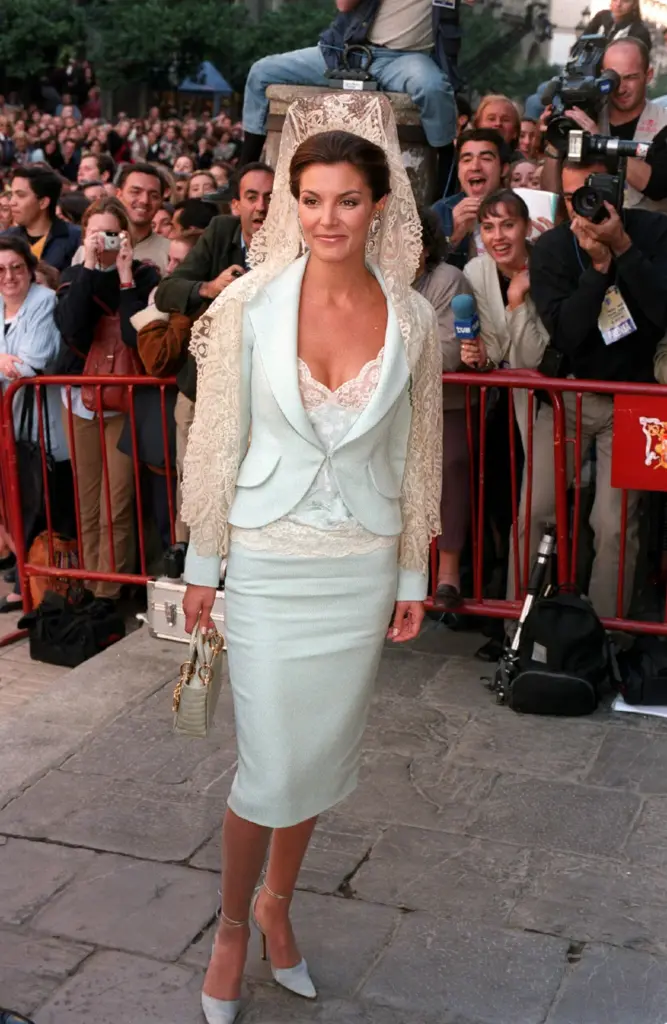
Flores’s arrival at the cathedral caused a sensation. People went wild seeing her get out of the car wearing the Dior suit and a mantilla. She was escorted by decorator Lorenzo Queipo de Llano, a friend of her boyfriend and descendant of the father of La Pepa, the 1812 Constitution. “I was quite sure I hadn’t made a mistake, that I looked perfect. I was confident because I was wearing a Galliano chosen by Princess Beatriz de Orleans,” she recalls.
The walk to the cathedral felt endless. “Seville was boiling. There were people much more important than me, but when I passed by, the volume of the Sevillians’ shouts rose. They spoke louder. I heard them as if I were in a movie. I was very focused, walking as if I were in a parade. I took it as a job,” she comments.
Read more FIFA accepts defeat: Gianni Infantino backs down from his proposal to privatize the World Cup
More than 10 million viewers saw her walk straight, serene and with her head held high. She was the sensation of the wedding. She overshadowed the godmothers —Cayetana de Alba and Carmen Ordóñez—, the most elegant guests —Pitita Ridruejo, Naty Abascal, Paloma Cuevas— and the bride herself, who wore a haute couture Emanuel Ungaro dress and was crowned with a tiara that had belonged to Eugenia de Montijo.
“Mar conquered the world,” says Beatriz de Orleans, who was there. “It was one of the star entrances. She looked very beautiful, very proper and modest for the occasion,” confirms another aristocrat of old lineage invited to the event. And this titled lady adds: “She looked very happy. We all thought it was an official presentation in the family and that there would be a wedding.”
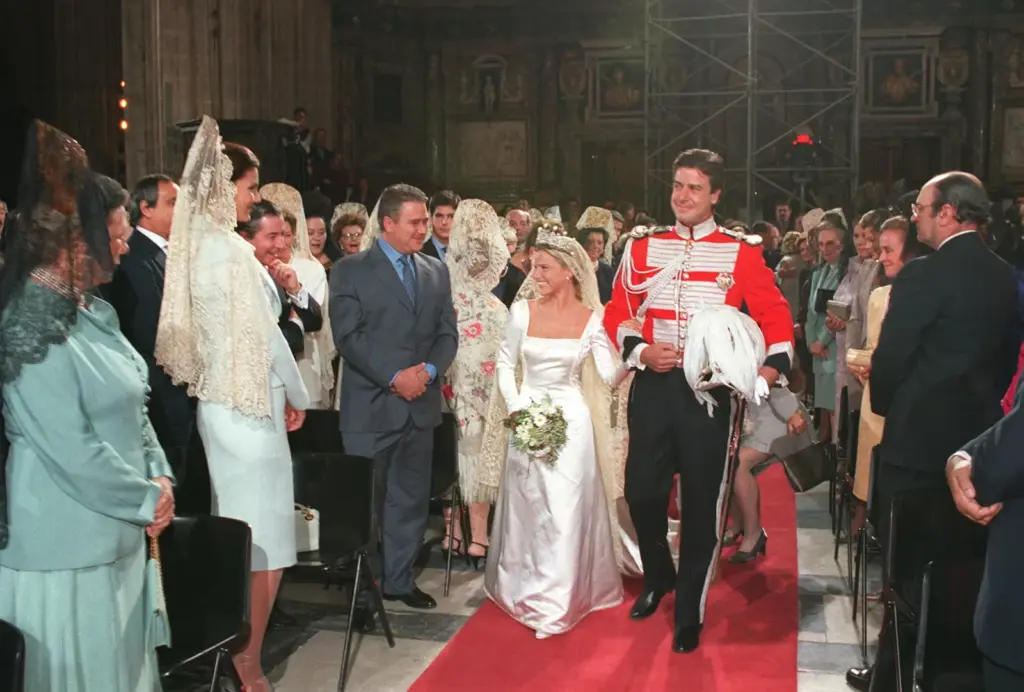
The model’s neckline sparked endless hours of debate on television talk shows and rivers of ink in celebrity magazines. Opinion columns were even written in the most serious newspapers. “I never wondered if the neckline was too low or too high,” she clarifies. “I looked perfect,” the Princess of Orleans concludes to settle the matter. And she adds: “Galliano loved it. The next day I got a call from Paris congratulating me.”
At that moment, Mar Flores was only worried about one thing. “I wondered if the duchess would want to meet me during the banquet. I expected she wouldn’t. She had invited me to the wedding, but I knew she didn’t even want to deign to greet her son’s model girlfriend,” she points out. Before midnight, a miracle happened. “Before retiring to her chambers, I saw her approaching. I thought she was going to greet someone next to me, so I turned half-profile. But she came towards me. She approached and said: ‘You’re Mar, right? Nice to meet you.’ And she left. I was stunned.”
The Empress of the Albas, the last Stuart, had to “bow” to the model. A witness to the encounter recalls it as a resounding defeat for the duchess and a crushing victory for the mannequin: “Cayetana didn’t say anything, but it must have seemed a bit too sensational. Her daughter Eugenia’s wedding was already too sensational, very much like a copla: the duchess and the bullfighter. There was no need to add more drama. But both behaved very properly, they didn’t draw knives or anything.”
Today, Mar Flores is proud of how she behaved. “I did what I felt I had to do: keep my head high, act naturally and not lose respect for anyone. It wasn’t easy, but I’m glad to know that episode is remembered for my serenity. My serenity made more impact than anything else. True elegance comes from the calm with which one lives with their decisions and how one handles certain situations.”
That calm lasted very little. On January 7, 1999, less than three months after the wedding, the magazine Interviú published intimate photos of the model with Alessandro Lecquio. They were old images, taken when she was dating shipowner Fernando Fernández Tapias. The press used them as ammunition to blow up her relationship with the Count of Salvatierra.
Flores had to be admitted to a clinic due to a nervous breakdown. Shortly after, celebrity magazines announced that her relationship with Cayetano had ended. It was said that he, wounded in his pride, had made the decision. “In life, when you are very beautiful, you attract the most unlikely and also the most terrible people. Beauty attracts extremes and the most tragic. And Mar was and still is spectacular,” reflects Beatriz de Orleans. Another aristocrat, a friend of the Duchess of Alba, disapproves of the behavior of the prince charming of this postmodern fairy tale: “If he left her for that, he wasn’t very chic. As if men didn’t have a past.”
Cayetana de Alba dedicated a couple of lines to Mar in her memoirs, published in 2011. “It was one of the most unpleasant episodes that happened in this House. It was awful, a spiral that dragged us all.” Flores could say exactly the same, but prefers to be nobler: “I hold no grudge.”
Read more The penthouse file remains a mystery protected by the Ayuso Government