






“Thursday, shooting, don’t come,” said the graffiti at a school in the Antofagasta region, in northern Chile, for which a 16-year-old student was charged with public disorder. In the last two weeks, other similar notices, such as “tomorrow, shooting,” have appeared in Santiago and the Chilean regions of Valparaíso, Coquimbo, Tarapacá, O’Higgins, Biobío, La Araucanía, and Maule; but also in various localities in Argentina: Buenos Aires, Córdoba, Entre Ríos, Corrientes, Tucumán, Chubut, Neuquén, and Mendoza.
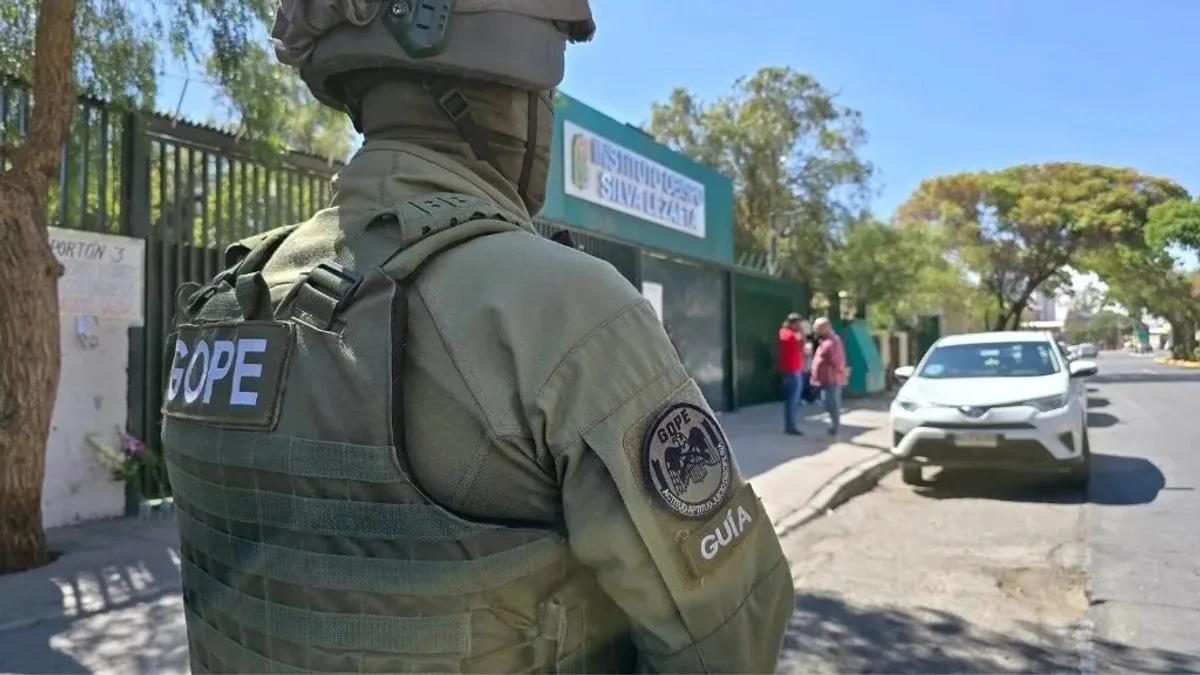
The unusual wave of threats has forced the preventive suspension of classes and the activation of security protocols in some educational institutions in Chile and Argentina, where authorities have yet to find a response to the root of this phenomenon. In the municipality of Santiago alone, in the city center, seven cases have been reported this week. In the Providencia commune, six schools have reported 27 threats, and in Lo Barnechea, five have been recorded so far this month.
The simultaneity with which these intimidating messages have been produced has raised suspicions, so those investigating this phenomenon and experts in school violence do not rule out that it is a viral challenge among young people. Mario Bugueño, an academic at the Center for Teacher Knowledge Studies at the University of Chile, suggests that it could be a temporary phenomenon, associated with “a trend, which because of the impact it produces, tends to be imitated by other young people, and does not respond to a constant that could be culturally established in South American countries.”
In Chile, the situation occurs a few days after an 18-year-old student killed a teacher and injured four others at a school in the mining city of Calama, about 1,500 kilometers north of Santiago. Since then, the visibility of school violence in this South American country has not stopped escalating, where there was also an attack with a knife by a teenager on a six-year-old child at a school, a fight that ended in gunfire at a school in the Santiago commune of Quilicura, fights with bladed weapons, Molotov cocktail attacks at emblematic high schools, and clashes with Carabineros.
In Argentina, meanwhile, the messages heightened the fear experienced after a 15-year-old student at a school in the town of San Cristóbal, Santa Fe province, shot a 13-year-old student with a shotgun and injured other classmates 20 days ago. In this last case, the judicial investigation points to the attacker’s connection with an international virtual community that brings together fans of crimes and massacres and is linked to violent incidents in several countries.
Figures from the Chilean Ministry of Education, compiled by La Tercera and updated to April 9, indicated that 58 schools had suspended classes due to some threat since the Calama crime occurred on March 27. But it has been this week when the cases of ultimatums have sounded the most.
The Chilean Public Ministry, led by National Prosecutor Ángel Valencia, has not yet provided a total number of reports for these school shooting threats, but investigations have already been opened in some regions of this country. In Valparaíso, for example, 136 reports had been filed by Thursday, said regional prosecutor Claudia Perivancich. In Antofagasta, besides the 16-year-old teenager arrested, three other students have been charged with crimes related to warnings appearing in educational institutions. One of them, a 17-year-old student in Calama, was prosecuted for simple threats, which he made through social networks.
It has also happened in a higher education institution in Coquimbo, where a 19-year-old student was arrested after posting on social media that there would be a shooting on Tuesday at the university where he studies. When questioned by the police, the young man said: “I hadn’t taken the situation so seriously, since in the morning, when I posted it, my intention was to joke, since the same thing had happened at other universities,” according to Emol.
Bugueño clarifies that although the phenomenon seems like a viral challenge, it does not mean that, if associated with the radicalization of aggression experienced in Chile, these threats could become a new expression linked to a cultural violence that has settled in the country over the last two decades. “For now, these messages seem to have no ideological motivation, but would be related to a trend. But caution is needed because they could eventually spread if they continue to have a social effect or impact.”
Days before the phenomenon occurred, and following the murder of the teacher in Calama, the government of the ultraconservative José Antonio Kast introduced two bills in Congress. One proposes to toughen sanctions, such as limiting free university education, against those who commit violent acts in educational institutions and other crimes. The other initiative seeks to incorporate security measures, such as backpack checks in schools. Both proposals are viewed with suspicion by the opposition, which considers that the package of measures would have a punitive rather than preventive approach, and they aim to address issues such as young people’s mental health and access to weapons.
Local authorities are also trying to strengthen their security and prevention measures in schools, such as in Santiago, where a WhatsApp channel was created for educational institutions to make direct reports to the Municipality’s security department, for example. Or, in the Ñuñoa municipality, where they are advancing in establishing an immediate action strategy to face the wave of threats to school security. In Providencia, as in other communes, awareness-raising sessions have been held with communities and calls to discuss the issue at home.
Read more Young woman found dead after disappearing in Mexico City