









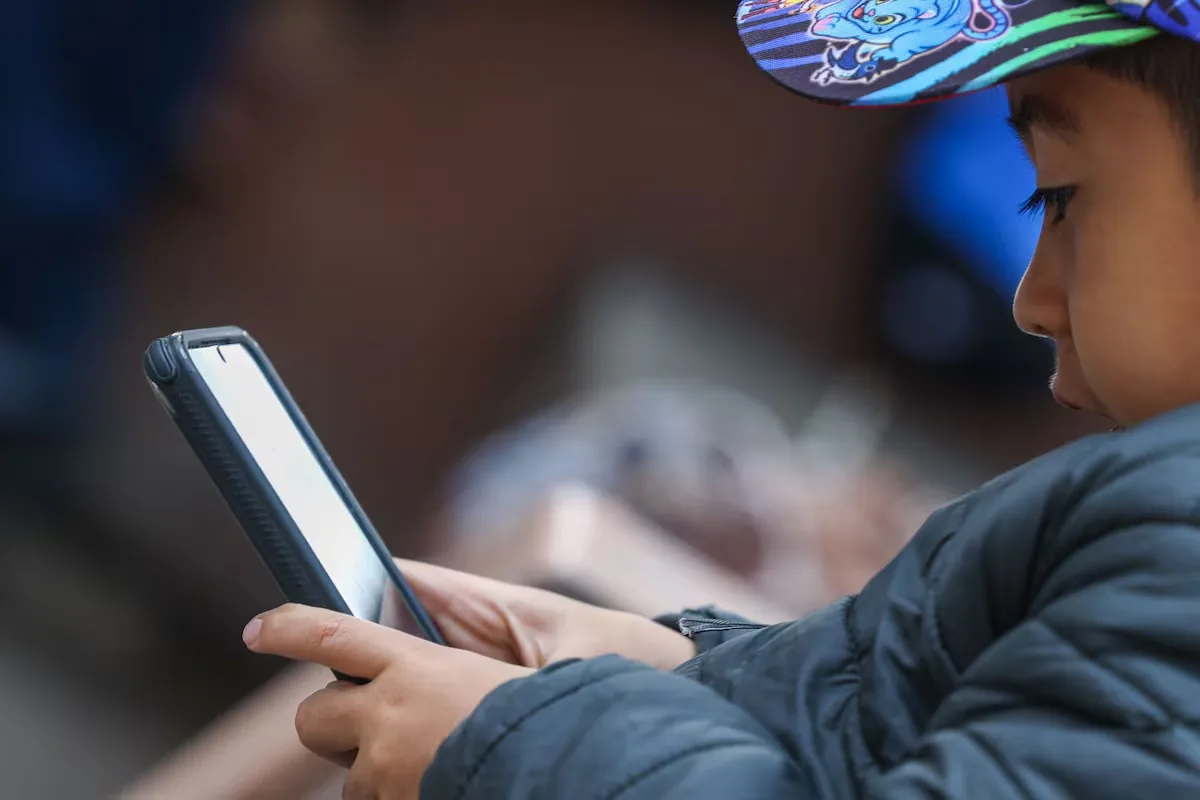
Every time a child opens TikTok, YouTube, or Instagram, an invisible system decides what they will see. The recommendation algorithm prioritizes content based on the likelihood of retaining attention: watch time, interactions, and the possibility that the user will continue browsing. Childhoods in Mexico end up immersed in and replicating this content in their daily lives, content that is often designed for adult audiences. Unlike traditional media in the country, which do have regulations such as the Federal Telecommunications and Broadcasting Law, no public body in Mexico regulates the responsibility of the big tech companies.
The harm to children and adolescents goes beyond the screen. There is a disturbing fact: 13% of Mexican minors — about 1.6 million — who have suffered sexual abuse were facilitated by the internet and social networks, according to the Disrupting Harm study, prepared by institutions such as Interpol and UNICEF. Besides sexual violence, the report shows that victims are 15 times more likely to self-harm; 12 times more likely to have suicidal thoughts; and 11 times more likely to develop anxiety. The study also warns that technological advances leave legal frameworks behind. The fourth main form of digital violence is related to the use of artificial intelligence (AI), as there are victims who receive blackmail with sexually explicit photos generated with that technology containing their face.
“The digital environment, by itself, does not generate negative elements. It is a space that offers opportunities for learning, connection, play, and self-expression for girls, boys, and adolescents. Therefore, the priority must be the creation of safe digital spaces,” explains José Antonio Ruiz Hernández, Child Protection Officer at UNICEF Mexico. However, creating these spaces is increasingly difficult when companies automate processes to reduce costs without caring about the content that reaches minors.
Mexican legislation still leaves significant gaps on the issue, the expert opines. It does not sanction those who consume child sexual abuse material, nor does it explicitly consider AI-generated content, nor does it adequately regulate live broadcasts of these crimes. These crimes are increasing due to technological advances. Despite this, there are spaces to strengthen public policy and legislative discussion along with mechanisms to investigate illicit content. One of these organizations is the Network in Defense of Digital Rights (R3D), led by Paulina Gutiérrez. “Platforms should cooperate so that these investigations result in sanctions when appropriate,” Gutiérrez points out.
Given the legal gaps, various organizations have also resorted to strategic litigation to promote changes so that platforms adopt more concrete actions to protect childhood without affecting their rights. Like freedom of expression, which protects all types of information disseminated by any means, the absence of prior censorship becomes a basic principle. Restricting access to platforms can also affect other rights such as the right to seek, receive, and disseminate information, as well as the right to participate in digital public life or the right to privacy. Therefore, the line to achieve regulation is very thin.
The Government of Mexico is trying to have this conversation, although it is still not very clear how to approach it. The issue, for example, was discussed at the presidential conference on July 27. The Secretary of Education, Mario Delgado, then stated that algorithms respond to economic interests competing for people’s attention. “The other ceases to be someone to listen to and becomes someone to defeat, to overcome,” he argued. Mexican President Claudia Sheinbaum added at the same conference that since it involves minors, the problem will have consequences for the country’s development if not addressed. So far, there is no firm initiative from the Sheinbaum Administration to regulate minors’ access to digital platforms.
Globally, several countries are already taking action. Australia became the first country in 2025 to apply a formal ban, with a law that prevents minors under 16 from having social networks. Since then, several countries have begun debating proposals that could set limits for the use of digital platforms among minors. The latest country to adopt such a measure was France. Its parliament approved on July 21 a law that prohibits access to social networks for minors under 15, being the first country in the European Union (EU) to adopt this measure.
| Country | Year | Age | Measures |
|---|---|---|---|
| Australia | 2025 | 16 years | Ban on accounts for under 16; platforms must verify age. |
| Spain | Under discussion (2025-2026) | 16 years | Project to ban social networks for under 16. |
| France | 2026 | 15 years | Minimum age for social networks with restrictions and protection measures. |
| Greece | Under discussion (2025-2026) | 15 years | Project to restrict access for under 15. |
| Portugal | 2025 | 13-16 years | Requires parental consent for users between 13 and 16 years. |
| United Kingdom | 2023 | No fixed age | The Online Safety Act requires age verification to limit access to harmful content. |
Regardless of the regulatory model each country adopts, experts agree that the problem goes beyond content and lies in the business model, the attention economy, and user profiling. If before developing new technological products or services the impact on users’ rights were analyzed to foresee possible risks, companies would move from a reactive stance — acting when the damage has already occurred — to a preventive strategy.
Read more Death blow to Cuba
From that perspective, responsibility also falls on the platforms. Through their models, companies must be accountable for the protection mechanisms they implement and how they function. “Platforms claim to have controls to protect minors, but there is evidence that they have not responded as promised,” comments Gutiérrez. Meta’s internal documents leaked in 2021 showed that the company was aware of some of the effects of its platforms on teenagers and were used by journalists, U.S. legislators, researchers, and regulatory bodies to question the transparency of their safety and protection measures.
Security by design — which aims for user safety — must include privacy settings enabled by default, accessible, clear, and effective reporting mechanisms, and systems that follow up on reports made. All this because creating safe digital spaces should not be limited to reducing risks but also enhancing benefits and offering tools that allow minors to easily access protection and reporting mechanisms.
Child protection should also not be achieved at the expense of violating their privacy. R3D considers that age verification systems present many problems, as requesting personal or biometric data from minors implies handing over sensitive information to companies that would continue concentrating more data. These mechanisms do not guarantee that the user is actually the age they declare.
Beyond the regulatory debate, the weight of platforms can also be measured by the time girls and boys remain connected. While they spend several hours a day on the internet, the time in school is barely higher.
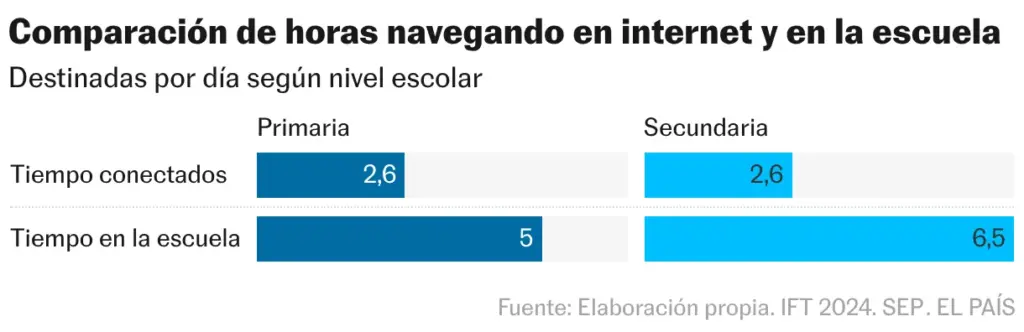
Comparing the hours primary and secondary students spend connected with the time they spend at school, it is observed that internet use represents just over half the time dedicated to in-person classes. Digital education, which is a fundamental component of any protection strategy, makes it essential to strengthen the digital skills of girls, boys, families, and caregivers. Children and caregivers “must” be included in conversations and in the design of solutions because it is the children themselves who know the risks they face on the internet, according to Ruiz Hernández.
Although TikTok is usually associated with entertainment, a study by The CIU indicates that four out of ten Mexican users consume educational content and a similar proportion seeks information on the platform. This explains why the debate no longer focuses solely on how much time girls and boys spend in front of the screen, but also on what type of content algorithms prioritize.
“Child protection is not optional, it is a shared responsibility,” assures José Antonio Ruiz. Millions of girls and boys grow up in an environment where algorithms determine what is learned and how it is normalized. While the public debate remains focused on screen time, the real challenge remains inside them. It is up to the big tech companies to assume responsibilities without violating other rights, but it is also necessary to ask who watches the system that, without being a teacher or parent, increasingly participates in the formation of a generation.