








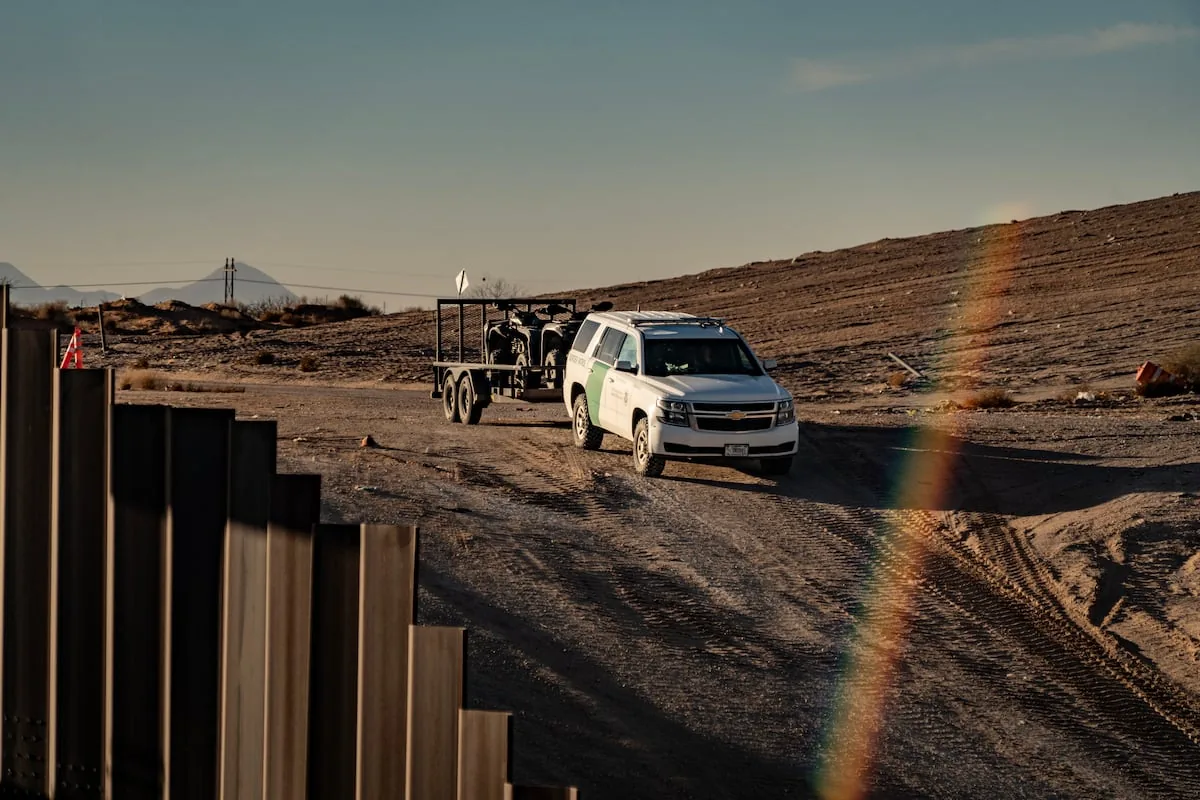
The United States government is reinforcing the border wall with Mexico and now describes it as a “smart” one. Following the approval in 2025 of the new fiscal law One Big Beautiful Bill, which includes a $46.5 billion budget package for border infrastructure construction work, the United States is expanding and raising new steel bollard walls nearly ten meters high (double the length of the previous wall), transforming water barriers, building roads, improving lighting, and installing high-tech detection tools such as infrared cameras and motion sensors. Additionally, the terrain will be constantly monitored by the Customs and Border Protection (CBP) offices.
Read more Trump, about the Government of Spain: “They have not been there for us”
The types of physical border barriers currently existing include steel bollard walls between five and nine meters high, old pedestrian fences (chain-link, stakes, or grid), concrete retaining walls with steel bollards, and temporary barriers (barbed wire, razor wire, chain-link fences).
On the CBP website, they have enabled an interactive map where the progress of the works can be tracked, as well as locating where the existing wall is and where works are being carried out – or will be carried out. For example, from Ciudad Juárez to the Santa Elena Canyon, to the east, is the wall that was built in the 1990s. Cameras and motion sensors will be installed on it.
From Santa Elena Canyon to the town of La Amistad, in Coahuila, will be the area where the fully technological block is located. After a campaign by environmentalists and local communities, there will be no physical wall dividing the territories in this area, since most of this stretch includes National Parks, whose fauna and ecological balance would be affected by a physical barrier.
On the west coast, however, the works focus on “improving” what has already been raised in the past and on building a second wall to reinforce security. In Baja California, this work has already claimed a sacred site for the Kumiai people’s culture, on Cuchumá hill.
According to community complaints, the United States used explosives as part of the works, which damaged a 35-meter-high monolith. As of the time of this publication, the National Institute of Anthropology and History (INAH), the body responsible for protecting and investigating what has happened in Mexico, has not commented on the matter nor responded to this newspaper’s requests.
Despite the U.S. government’s offensive, not everything on the border is under construction. The same map shows which areas are planned (representing the total mileage planned or funded for construction, but contracts have not yet been awarded), awarded (contracts that have been granted and the project is in the design phase or has begun initial construction activities), under construction (representing projects where border wall panels or water barriers are currently being built or installed), and completed (representing the total mileage completed since January 20, 2025). The site’s last update dates from February 11 of this year.