
Zyliss E920209
MasterChef Kitchen Knives
Victorinox Swiss Classic
Professional Japanese-style Santoku Knife Set
Best carving knife
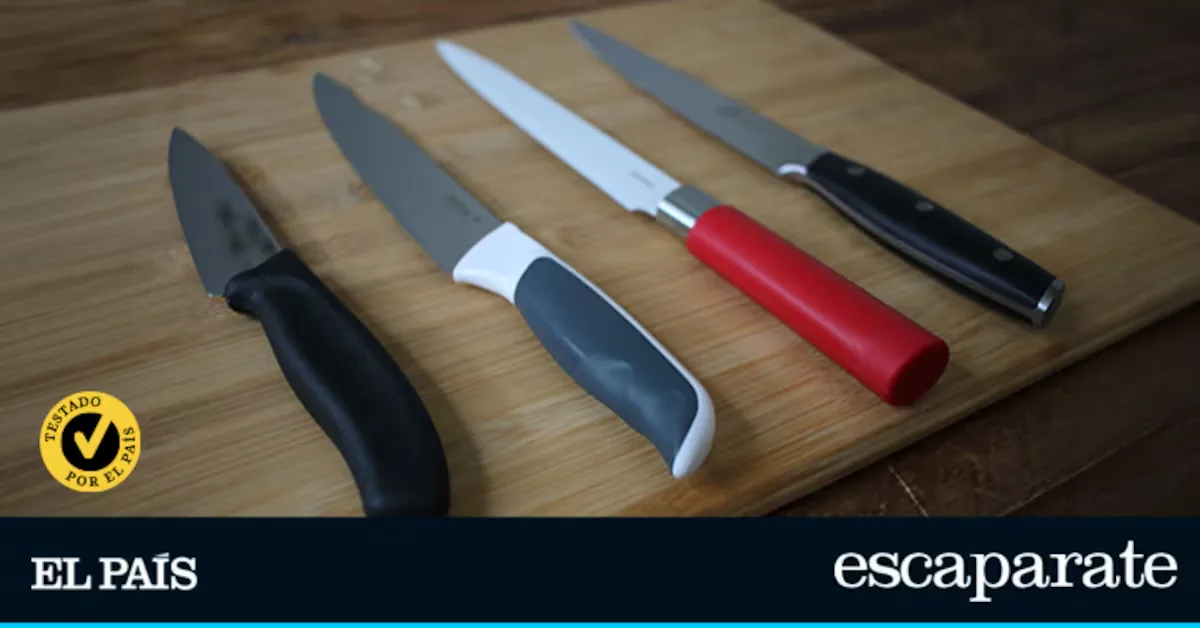
The highest level of cooking is that of maximum precision. This not only has to do with the quantities and processes of a recipe but also with the cuts of meat, fruits, or vegetables used in a dish. The reason is that this, besides improving presentation, influences the flavor and utilization of all ingredients. So, to help you practice the best gastronomy at home, at EL PAÍS Escaparate we have tested the best carving knives.
Which carving knives have we chosen and how have we tested them?
Among all the characteristics of a carving knife, we mainly focused on the models in this comparison having a stainless steel blade. The reason is that it is the most resistant and durable material for daily use in this type of product. The final selection consists of four models from recognized brands: Zyliss, MasterChef, Victorinox, and Cecotec.
To test these carving knives, we started by analyzing the blade material, since although all models are made of stainless steel, some include special coatings that can affect their resistance, maintenance, and ease of cutting. During the tests, we also paid attention to the type and thickness of the blade, an aspect especially noticeable when making fine and precise cuts on meats or large pieces. Finally, we evaluated the ergonomics of the handle, not only for comfort during use but also for the safety provided by a good grip to prevent the knife from slipping from the hand.
Why can you trust me?
I am a journalist specialized in product analysis and, in recent years, I have tested and compared dozens of devices and accessories for media such as El País. My way of evaluating starts from something very specific: understanding what a product really offers in relation to its cost. Not only in punctual tests but also in everyday use, because that is where the details that make the difference are perceived. Beyond the specifications, I am interested in how it performs in practice, how consistent it is over time, and what limitations appear when you integrate it into your routine. Because, in the end, a good product is not the flashiest but the one that best justifies its price day to day. That is the criterion with which I build each recommendation.
What is the best carving knife?
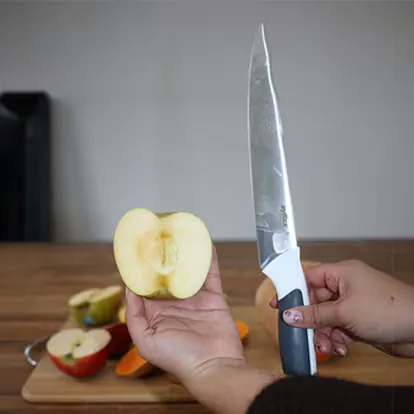
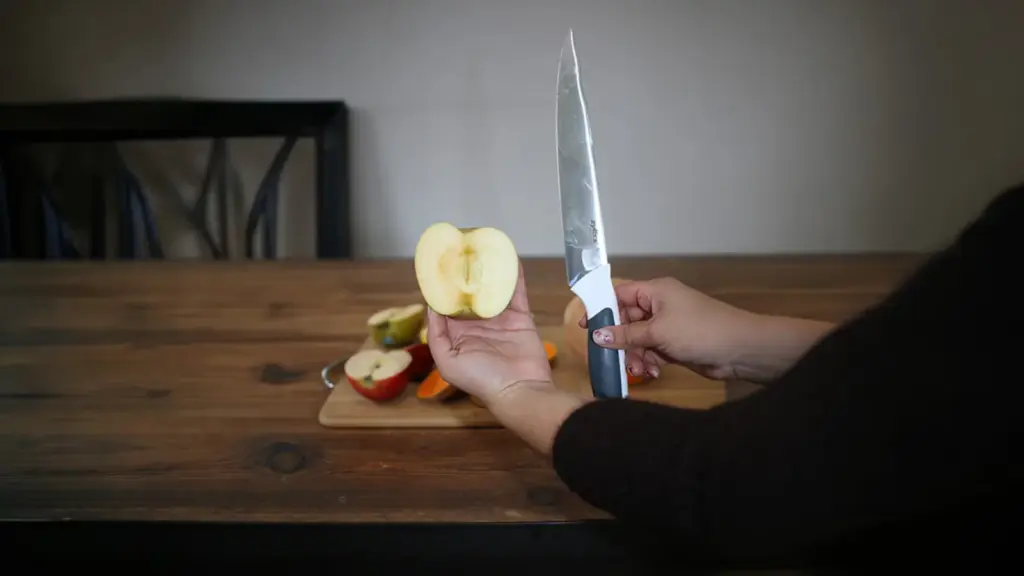
The Zyliss Comfort carving knife was my favorite in this comparison. What caught my attention most about this kitchen utensil is that it has the thinnest blade of the four models and, therefore, allows very precise cuts almost effortlessly.
Does it help in the kitchen?
There is no doubt that the Zyliss Comfort carving knife offers exceptional performance in the kitchen. With this tool, I was able to make quite precise cuts effortlessly, as I verified when perfectly slicing apples, tomatoes, pumpkin, and roast chicken. In my opinion, this is because this model has the thinnest blade of the four I tested.
To achieve these good results, I also consider it important that the blade of this knife is made of stainless steel. Although the brand does not specify that the material has any special treatment—such as forging or hardening—I found that it did not lose its edge at any time during the tests. Likewise, it turned out to be the most flexible carving knife, which was also very helpful for making delicate cuts.
Of course, when talking about knives, safety is very relevant, something this model fulfills excellently. First, because it has an ergonomic and very comfortable handle, which also incorporates a non-slip grip so it does not slip from the hands, even when wet. Added to this is that it includes a blade protector, which helps prevent accidents when storing it.
I was also struck that, despite being the knife I liked most in the comparison, it is also the cheapest. As if that were not enough, it comes with a five-year warranty directly from the manufacturer. It can be washed in the dishwasher, but I know from experience that this wears down the edge a lot, so it would need sharpening more often if cleaned this way.
Why do we recommend it?
- Thin blade that facilitates precise cuts.
- Comfortable and ergonomic design.
- Easy to clean and dishwasher safe.
- Best value for money.
- Includes a blade protector.
To improve:
- It is not specified if the steel has any special treatment.
Other alternatives to the best carving knife
MasterChef carving knife
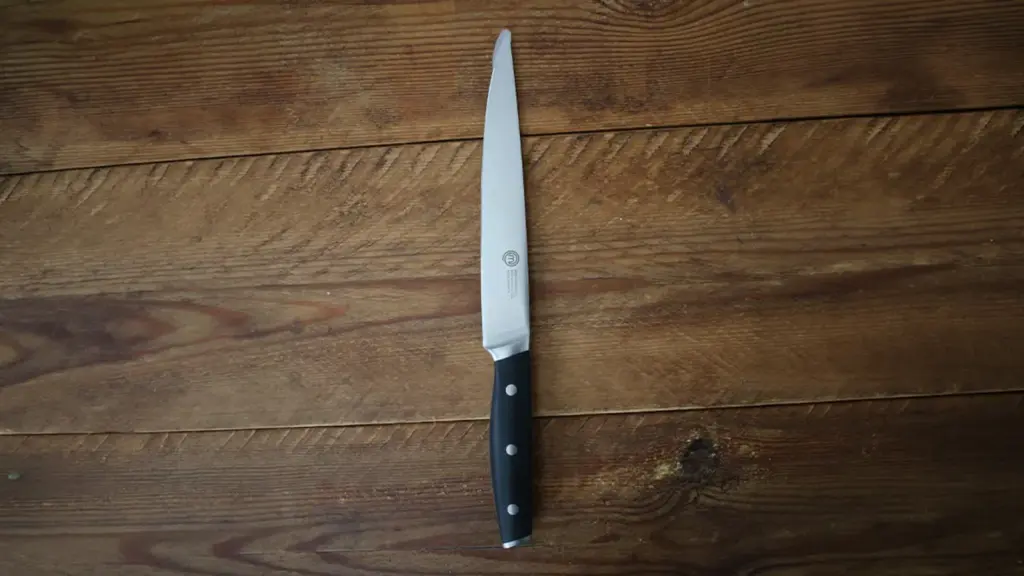
As with the winning model, the MasterChef carving knife also allows precise cuts without much effort. However, the blade is slightly thicker, although it includes a non-stick treatment to prevent food from sticking.
Does it help in the kitchen?
Regarding performance, I have little to object to about the MasterChef carving knife, as it also allowed me to make very precise cuts during the tests. Its slight disadvantage compared to the winning model is that it has a slightly thicker blade, which reduces a bit the control you can have over the cuts. It is the third in size, but I did not feel this was a limitation when working in the kitchen.
The best quality of this MasterChef knife is undoubtedly that it has a non-stick coating. This addition was especially practical when cleaning the knife, since no food had stuck to the blade. I also noticed it has a lot of flexibility, which helped me when making delicate cuts.
Although the blade of the MasterChef knife is made of stainless steel, the handle seemed to me the weakest part of this model. The reason is that it is plastic and I did not notice any non-slip treatment, which could be risky when using it, especially if done with wet hands.
Why do we recommend it?
- Thin blade that facilitates precise cuts.
- Non-stick coating.
- Made of stainless steel.
To improve:
- The handle is not non-slip.
- It is third in length.
Victorinox Swiss Classic carving knife
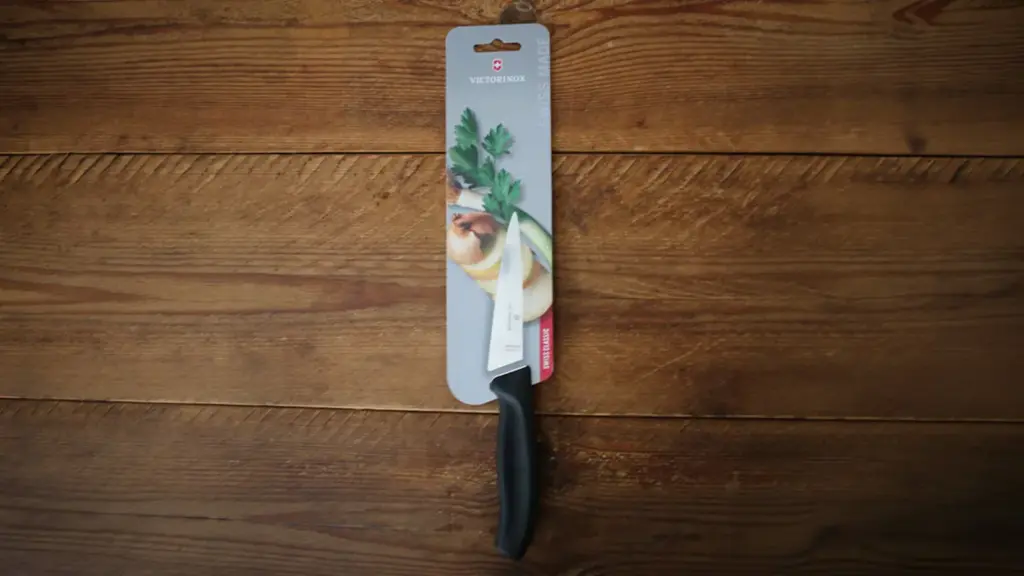
The fact that the Victorinox Swiss Classic carving knife is thicker than the two models above is directly reflected in that I had to put more effort into making cuts. Still, it allows good cuts overall.
Does it help in the kitchen?
Victorinox is a Swiss brand worldwide recognized for the quality of its knives. So, in the case of this carving knife, the cuts I was able to make during the tests meet these expectations. However, its blade is thicker than the two models above, which means I had to apply a bit more force and, therefore, the comfort when using the utensil was lower.
This knife is also made of stainless steel, although it has no special treatment, or at least the brand does not mention it. What is important to consider is that this is the smallest knife in the comparison, so in my tests, it was more difficult to carve chicken and other large pieces. It also has greater stiffness than the two models above, so delicate cuts can be more difficult to achieve.
My main disappointment was the handle, as it was not very comfortable in the hand and is not non-slip, so it would not be my choice for preparing very elaborate dishes or those that take a long time. Also, considering its price, which is definitely high for the brand, it does not seem the best choice for most people.
Why do we recommend it?
- Stainless steel blade.
- Good performance in cutting various foods.
To improve:
- Requires a bit more effort to cut.
- Poor value for money.
- The smallest in the comparison.
Japanese-style Santoku carving knife Cecotec
Although the brand highlights the special coatings of this model, the Cecotec Santoku carving knife was the one that required the most effort from me when cutting. Its design is indeed the most striking, but that was not enough for me to recommend it.
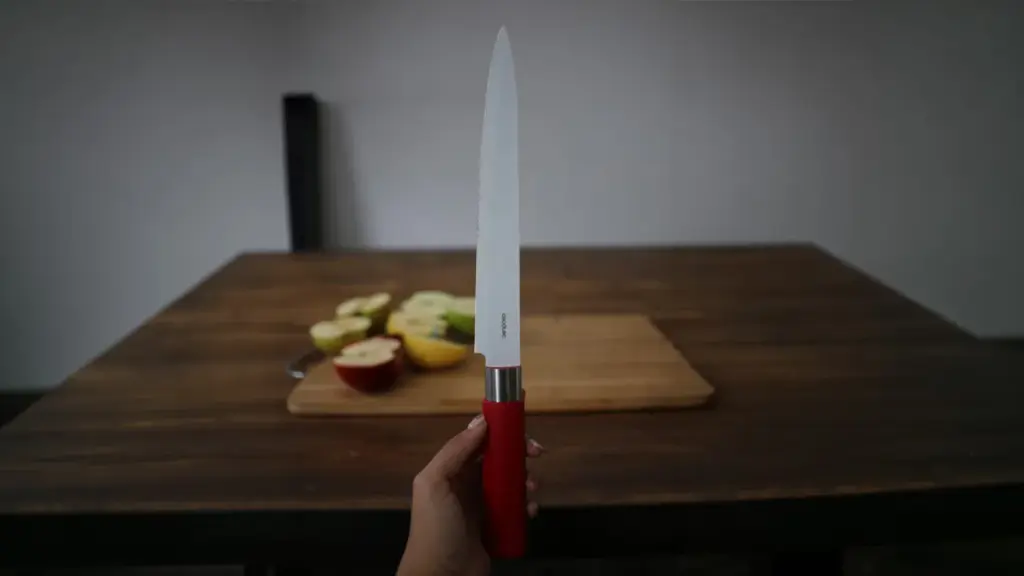
Does it help in the kitchen?
According to the brand, the Cecotec Santoku carving knife is equipped with a ceramic non-stick and antibacterial coating. But all that, in the end, was not relevant during my tests, but the fact that it was the model that required the most effort to make cuts, especially when slicing pumpkin.
The handle is made of polypropylene, which I found sufficiently comfortable in the hand. Without a doubt, my favorite part is its design, since being inspired by Japanese knives, it has a very refined aesthetic. Unfortunately, this quality is not reflected in its blade, which is also the thickest in this comparison.
Why do we recommend it?
- Blade with non-stick and antibacterial coating.
- Elegant design.
To improve:
- Thick blade that makes cutting food difficult.
Frequently asked questions about carving knives
What is a carving knife?
The carving knife is characterized by its long, thin, and flexible blade, designed to cut thin and uniform slices of meat. Unlike other knives, its edge is usually smooth, allowing a clean cut without tearing the fibers.
What is a carving knife used for?
The use of a carving knife focuses on cutting cooked meat, from poultry and fish to beef or pork. Its blade allows separating the meat from the bone easily and obtaining thin and attractive portions for serving. It can also be used to cut delicate foods, such as fruits and vegetables.
What is the ideal carving knife like?
The characteristics of a carving knife vary depending on the intended use. However, some aspects are common:
- Blade: It should be made of high-quality stainless steel, with a durable and corrosion-resistant edge. The ideal length ranges from 20 to 25 cm.
- Handle: An ergonomic and non-slip handle facilitates grip and control during cutting.
- Design: The balance between the blade and handle is fundamental for comfortable and precise use.
[Remember that if you are an Amazon Prime user, all purchases have free shipping. Amazon offers a free and no-obligation trial period for 30 days.]
*All purchase prices included in this article are updated as of August 5, 2026.
You can follow EL PAÍS ESCAPARATE on Instagram, or subscribe here to our Newsletter.
Read more The summer when a Greek poem and a spider-man came to Hollywood’s rescue