









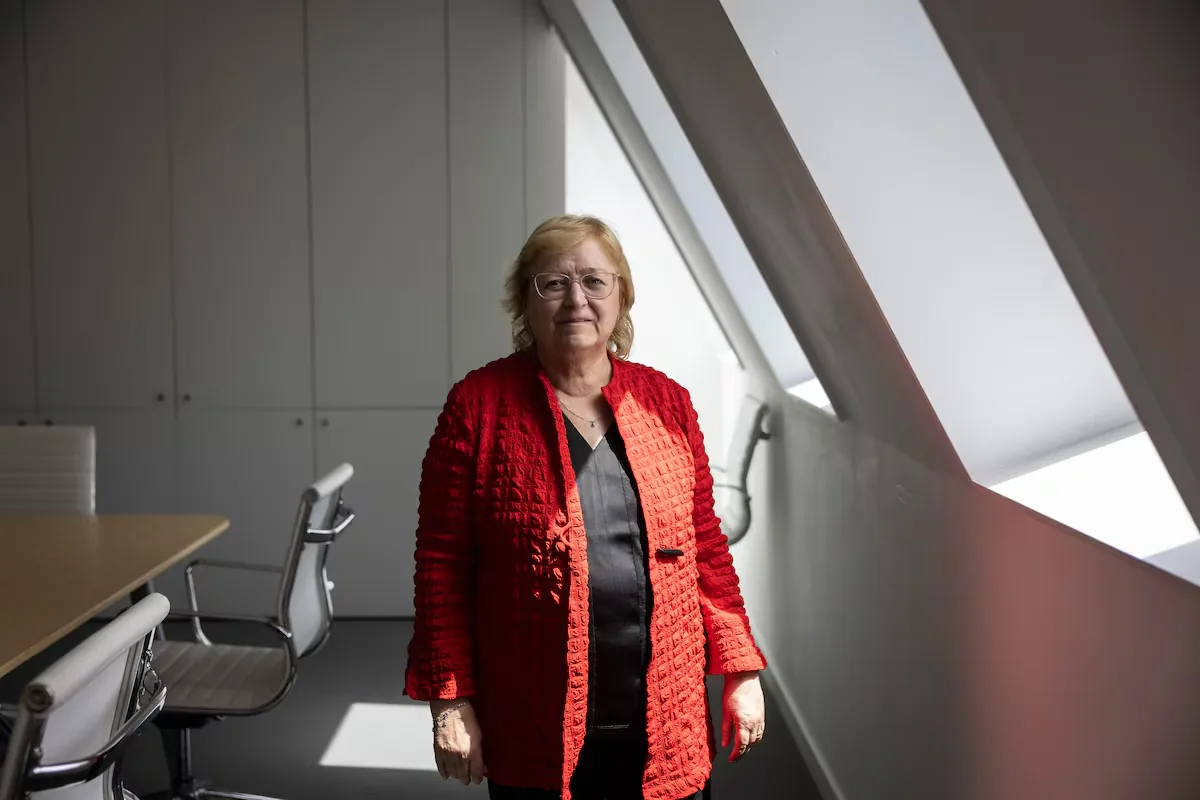
Llum Rodríguez (Rioseco, Ourense, 1961) has been the first woman in charge of the Sindicatura de Comptes for a month. A jurist and political scientist, she was unanimously elected by the plenary after the resignation of Miquel Salazar. After the first days in office, she defends the independence of the body serving the Parliament and calls for more culture of control, more planning, and greater follow-up of the recommendations in its reports.
Question. Is it news that she is the first woman in charge of the Sindicatura?
Answer. It shouldn’t be. Women should reach positions of responsibility under the same conditions as men, but unfortunately, that is not the case, it is evident.
Q. What is your goal as chief auditor?
A. To preserve the independence of the institution. Control is part of transparency, and transparency is a basic tool of democratic systems.
Q. Do you receive a lot of pressure?
A. I have not received any, but the interpretation made in some cases of our work may not have been the most objective possible. Auditors apply international standards in preparing the reports, which are approved by the Plenary of the Sindicatura, and the result should not be viewed from a partisan interpretation.
Q. How will you safeguard that independence?
A. By working with objectivity and rigor, without considering opinions that may be expressed in the press or other media. It has been said about some of our reports that they responded to actions or opinions of some people. Logically, that is not the case. Auditors are fully qualified and apply international auditing standards. In addition, the content of the report is contrasted with the audited entity, and they are given the opportunity to present allegations and, as a result of these, changes may be introduced in the text.
Q. Are the reports understandable to the citizen?
A. We must make them more so. They are reports with a lot of technical content, and we have to facilitate their reading. We now prepare a summary and a quick-read document called “The report in 2 minutes,” and in some works, we make infographics and videos.
Q. It is often difficult for audited entities to introduce changes following the reports. Does the Sindicatura lack sanctioning capacity?
A. Our work is directed to the Parliament, on which we depend. The Parliament has control powers over the Executive, and the Sindicatura is one of the tools it has to carry out that control. The Sindicatura does not have a mandatory return of recommendations, although it can make a follow-up report. I do not think the solution lies in having sanctioning capacity; we are based on the principle of trust.
Q. But then improvements end up depending on the will of the audited entity.
A. Within the Generalitat, the ministries have responsibilities, and I understand that they take measures to comply with the recommendations. In operational audits, we analyze a public policy holistically, from all areas, and assess whether its design and the actions carried out really respond to the needs they intended to cover. Often we detect deficiencies in the design or planning of public policy, and others are more technical or material aspects, such as the need to have the necessary human or technical resources. And that, obviously, also depends on the ministry.
Q. What are the most vulnerable areas to the misuse of public resources?
A. Mainly contracting, personnel management, and the granting of subsidies or public aid, which requires ex-post control.
Read more National Lottery: Saturday, August 8 draw
Q. Is the current subsidy system robust enough to prevent misuse?
A. The subsidy law is comprehensive but also complex; it is true that it can generate a lot of administrative burden. Perhaps, if it were simplified a bit, it would help control to be done more agilely.
Q. Does the public-private model facilitate or complicate your work?
A. Neither. Public-private collaboration is necessary because not all administrations, especially the smaller ones, have the capacity to provide all services with their own resources. The problem is not so much the public-private collaboration itself but the controls established by the Administration.
Q. Are controls lacking?
A. Yes. Among other things, because private collaborators are often technically more powerful than the Administration itself.
Q. What do you propose?
A. That the terms of reference are very well analyzed from the public side and perhaps not taken as so good, without review, what the private side technicians propose. And, above all, subsequent control.
Q. Doesn’t that happen?
A. Often there are not enough resources, but there is also not enough culture of control. Once I entrust management to a third party, it seems I can disregard it, but no. You have to keep controlling how that service is provided.
Q. Are inspectors lacking?
A. Control resources are necessary, such as doing a prior study and good technical supervision. We often end up concluding that the benefits obtained by the contractor are excessive compared to the market, and that may be because initial prices were accepted that were already above market value because a sufficiently rigorous analysis had not been done.
Q. What is the level of good administration culture in Catalonia?
A. In Nordic countries, there is a more ingrained culture of compliance. In the Mediterranean area, that culture is different, and obviously, the Catalan Administration is part of that context. However, compared to other administrations, I would not classify the Catalan one as a non-compliant administration. It is true that it shares a problem that is quite widespread in Spain, and I would say also in other countries: endemic planning deficits. I think many times actions are taken from immediacy and little from planning.
Read more Holiday on September 17 in Chile: what the bill that seeks to extend the National Holidays says