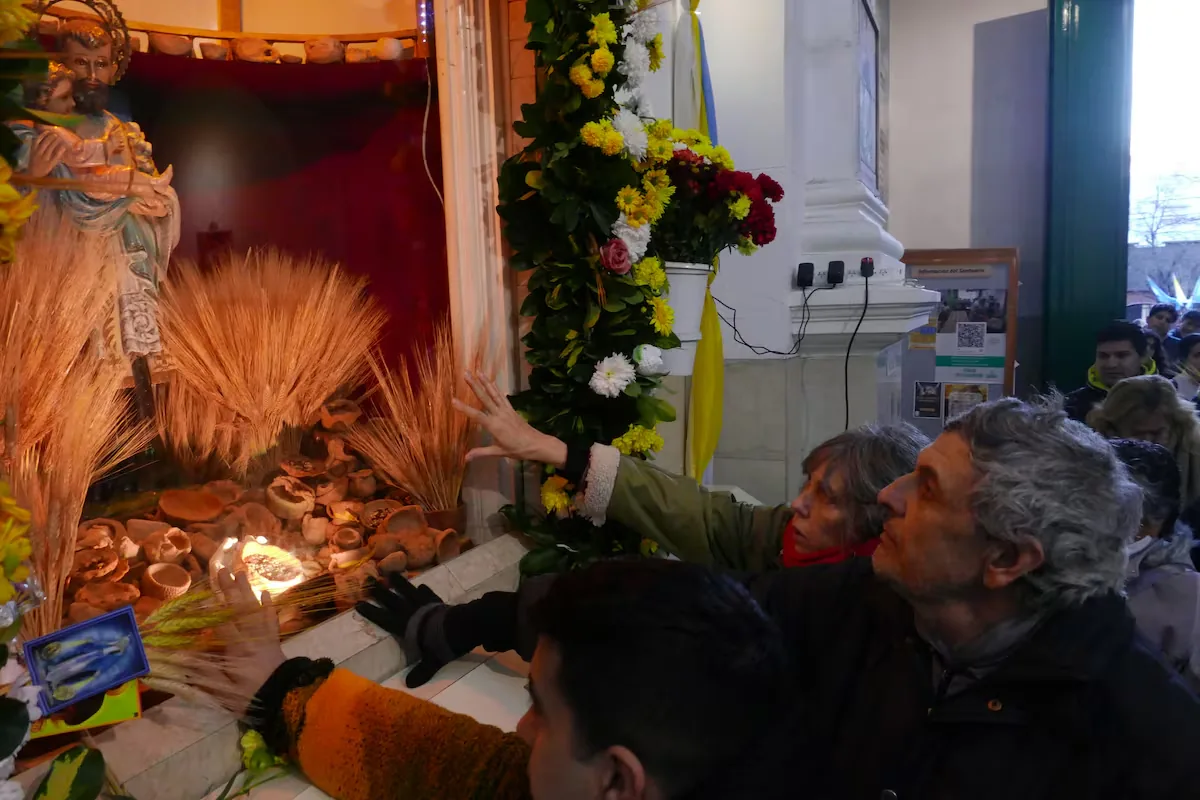
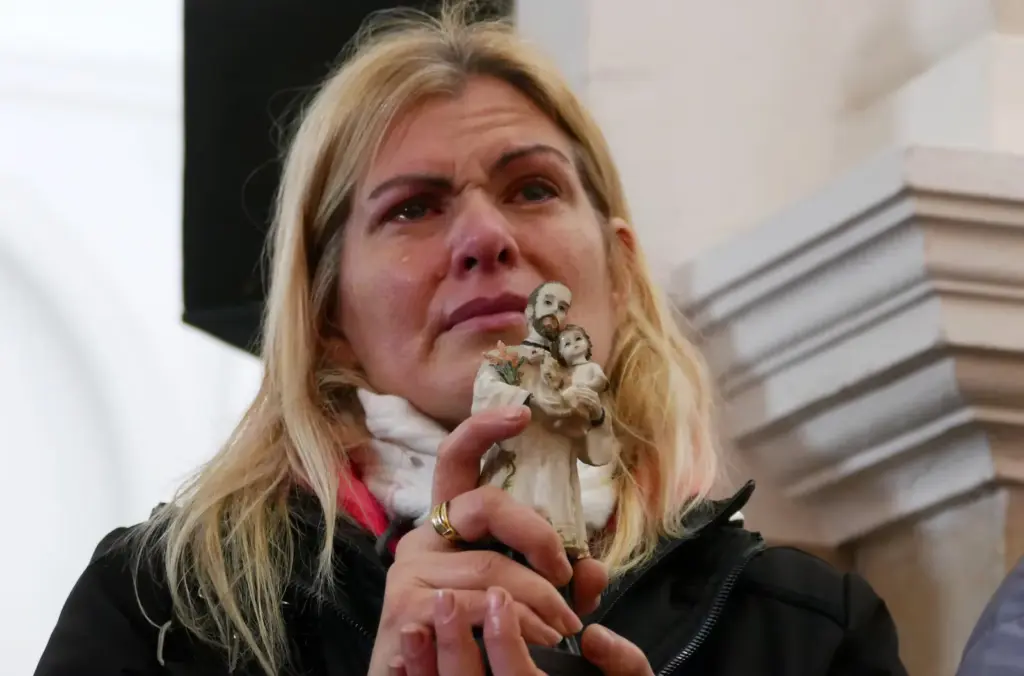
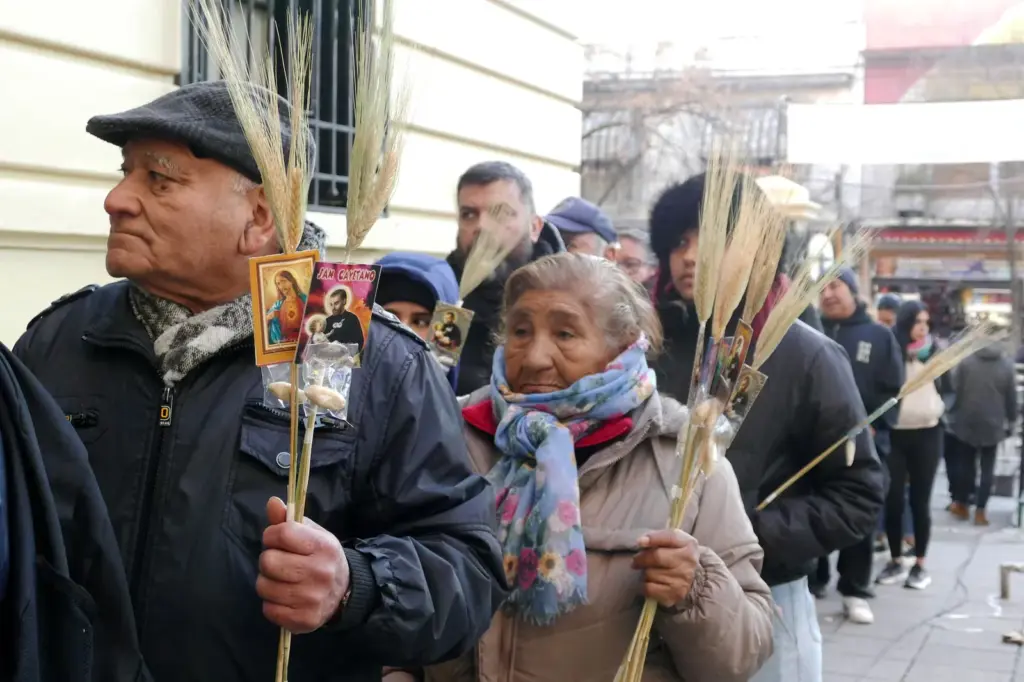
Rosa presses two wheat ears, three holy cards, and a small plaster statue against the glass that separates her from the image of San Cayetano. She hopes that the aura of the patron saint of bread and work will infuse them with his mystique. She has waited several hours in line to enter the sanctuary located in the Liniers neighborhood of Buenos Aires, where every August 7th hundreds of faithful arrive to ask for work or to give thanks for it. With her head covered by the black hat that has protected her from the winter cold, Rosa says she is Peruvian, a food engineer, and that she arrived in Argentina 30 years ago to do a postgraduate degree. Since then she has always had work in her profession, but lately she has also accepted occasional jobs to supplement her income. “I take care of little girls, I take whatever comes — she says —. Have you seen how the situation is?”.
Read more The storms that have battered the rector’s administration: 11 months of crisis at UNAM
In Argentina, the universe of people who have formal jobs has not grown for more than a decade. It is a problem that crosses governments of different political colors, but it has deepened in recent years. Data from the Ministry of Human Capital show that since Javier Milei took office in December 2023 until the latest available record (April 2026), almost 400,000 formal salaried jobs were destroyed: 250,000 in the private sector, 130,000 in the public sector, and 17,400 domestic workers.
The data also show that a good part of those who were expelled from the system — along with the thousands of young people who join the economically active population each year — ended up being absorbed by precarious jobs in apps or directly fell into informality. The multiplier effect on employment that the Government promised by promoting a labor reform aimed at making hiring and firing cheaper for employers has not materialized, at least not yet.
“In this economy, the only thing that grows is what we call ‘refuge employment’: those informal jobs, with low income, that are usually done at home, on the street, and in public spaces, and that are the only opportunities found by people who are shut out of jobs with better conditions and income,” points out Matías Maito, director of the Training and Studies Program on Work and Development at the National University of San Martín. The question he asks is how long they will be able to continue functioning as buffers against the growth of unemployment, which was 7.8% in the first quarter of 2026 and remains practically at the same level recorded two years ago.
The deterioration of the situation is not necessarily reflected in this year’s turnout at the San Cayetano Sanctuary which, according to the sharp eye of a street vendor of wheat ears and holy cards, was less voluminous than other times. She attributes this decrease to the advance of evangelical churches. “There is not a directly proportional relationship between the number of people who can come and the social situation,” predicts Deacon Jorge Barletta, who collects from his faithful the anguish over what is lacking but also the gratitude they express for what they still have and, standing in the middle of the street, receives, listens to, and blesses each person who approaches him. “There are fewer people for different reasons, but faith was never lost. San Cayetano is more than a patron saint protector for Argentines: he is a friend. He is there in good times and bad,” he assures, with his very white and perfumed cassock.
The Church has been one of the actors that most openly questioned the libertarian government’s policies and this Friday, on an altar set up in the street in front of the sanctuary, the Archbishop of Buenos Aires did so again in the mass offered as part of the Feast of San Cayetano. “We become mute, choked with anger because it seems that economic well-being will never reach the common citizen,” Jorge Ignacio García Cuerva said in a homily in which he also mentioned increases in transportation, tariffs, rents, and food; “salaries that are not enough” and “brothers who rummage through the trash to eat.” “This people do not want to resign themselves to work being a commodity and having to have two or more jobs to make ends meet,” he said.
Read more Ángel Aguirre, a cheap and expensive prisoner at the same time
A growing popular economy
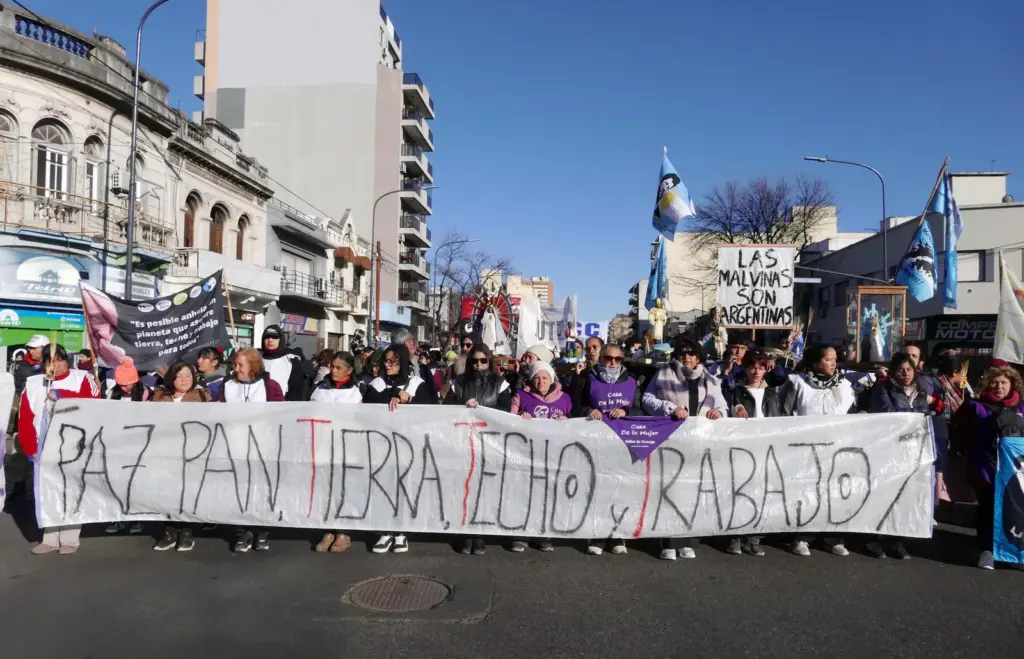
The universe of the informal economy is far from small or marginal: it represents around 45% of the economically active population in Argentina, according to economist Pablo Chena, researcher at the National Scientific and Technical Research Council (Conicet) and university professor. That underground economy is politically represented by different organizations grouped in the Union of Workers of the Popular Economy (UTEP), which since 2016 — when they still did not have a joint label — began to mobilize every August 7 from the San Cayetano sanctuary to Plaza de Mayo with the demand for “Peace, Bread, Land, Roof, and Work.” That is why, at first, the local press baptized them “the Cayetanos.”
That year in which this tradition was inaugurated also marked a milestone with the enactment of the Social Emergency Law, a regulation that gathered cross-party political support and sought to know, recognize, and value that sector of the economy called the popular economy. The law established a registry that reached four million people registered — out of the estimated eight million who work informally — and promoted public policies aimed at building bridges with formal employment, increasing the productivity of those activities, and supplementing income with State transfers, as a way to recognize the value generated by people who, for example, do recycling tasks or cook in community kitchens.
“None of these policies remain standing today,” says Chena, who was national director of Social Economy between 2020 and 2023, when the regulation made significant progress in its implementation. “The popular economy is once again understood today as a surplus of the formal economy and not as an economy with a different logic that must be developed. Conceptually, it becomes a subsistence universe that remains outside the State’s view,” he states.
With that change in perspective, its political expressions have lost entity, having ceased to have the prominence they had some years ago both in public discussion and on the street. “The Milei Government only keeps the Universal Child Allowance (AUH), which is economic aid aimed at children and does not generate any labor commitment, as other programs that no longer exist did. That changes the logic of social aid and also demobilizes,” points out Chena. According to his view, activism around the recognition of the popular economy has also diminished because the context forces its members to devote their energy to the immediate, “to survive day to day.”
Read more There are no free lunches