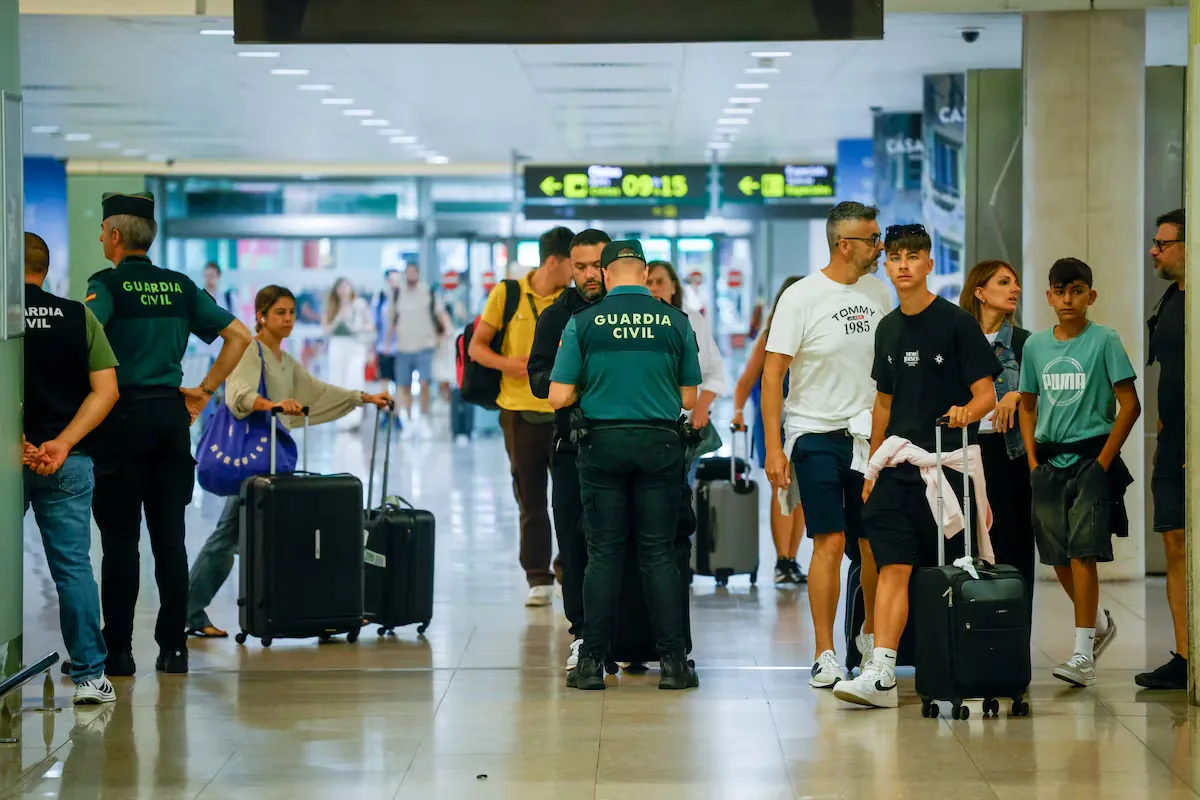
Since this Saturday, around one hundred National Police officers are participating in the border controls established for travelers coming from Italy, according to sources from the Ministry of the Interior. The deployment stems from the Government’s decision, made late Friday afternoon, to temporarily reinstate controls at Spanish airports and ports with direct connections to the transalpine country. The measure came into effect at 00:00 this Saturday and will initially remain until the same time on September 7, although the period may be modified depending on the evolution of the situation. Spain reinstated border checks after Giorgia Meloni’s Government refused to lift those applied since August 1 to travelers coming from Spain, following the massive entry of migrants into Ceuta, a territory that, however, does not practically belong to the Schengen area, because all travelers wanting to go from there to the Peninsula have their documentation checked.
Spain has notified the European Commission of the recovery of these controls, as confirmed by the EU Executive. The measure, being unforeseen, can only be extended for one month and is renewable for another two, reports Manuel V. Gómez. The Minister of the Interior, Fernando Grande-Marlaska, communicated this Saturday to the European Union authorities the Government’s decision to reinstate the controls. Marlaska informed the European Commission’s Executive Vice-President, Henna Virkkunen, and the European Commissioner for Home Affairs and Migration, Magnus Brunner. Additionally, he addressed the President of the European Parliament, Roberta Metsola, and the Secretary-General of the EU Council, Thérèse Blanchet. In his letter, the minister justifies the measure due to the evolution of migratory pressure on the central Mediterranean route affecting Italy and its possible repercussions on “public order and internal security,” especially due to the activity of cross-border criminal networks linked to irregular migration. Spain has reinstated the controls under the Schengen Borders Code and will reassess the situation when the scheduled period ends to decide whether to maintain, modify, or lift them.
This Saturday, each plane is being supervised by between two and four police officers — depending on the number of passengers — who randomly check the documentation of between 5% and 10% of the passengers, according to the Interior Ministry. This means an average of about 15 people checked on flights operated with medium-sized planes and about 25 on those with larger capacity.
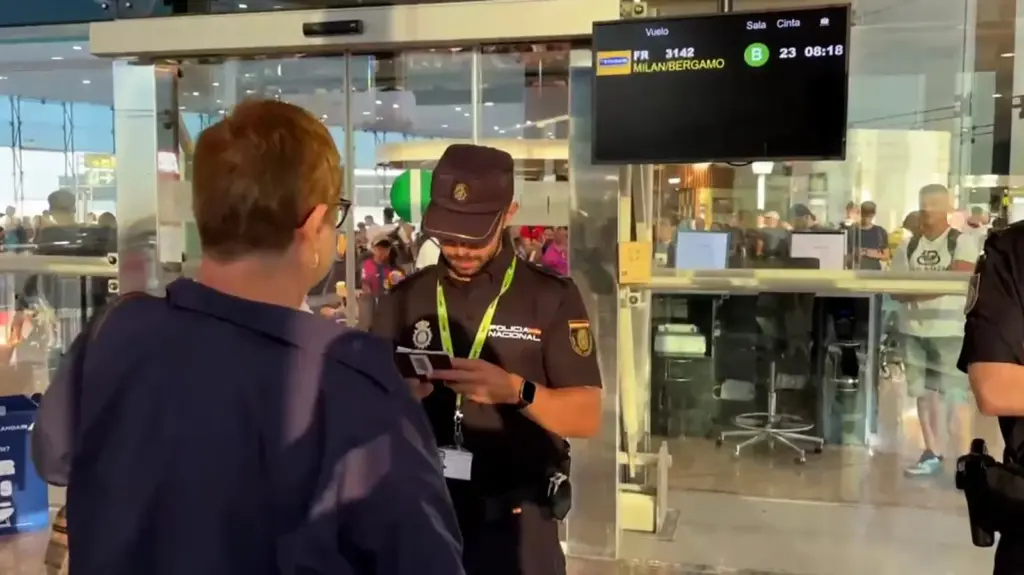
La Moncloa decided to raise the tone towards Rome after Meloni’s Government introduced border controls last week on citizens coming from Spain due to the massive entry of immigrants into Ceuta. The Spanish Government responded harshly this Friday to the Italian Government and warned that if these restrictions were not lifted before the end of Sunday, August 9, “Spain will be forced to adopt proportional measures to protect the interests and dignity of its citizens,” as has finally happened.
The controls began at midnight at Adolfo Suárez Madrid-Barajas and Josep Tarradellas Barcelona-El Prat airports and have extended throughout the morning to Málaga, Seville, Bilbao, Alicante, and Valencia. The Interior Ministry also plans to extend them during the day to the airports in the Balearic and Canary Islands.
Among the main points of origin of the flights subject to these checks are Fiumicino and Ciampino in Rome; Malpensa in Milan; Naples, Venice, and Florence, but the list will increase in the coming days. Regarding maritime traffic, this Saturday only the arrival of a cruise ship from Italy to the Barcelona Port terminal is expected, where random checks will also be carried out.
Two types of control
The teams in charge of border controls for travelers coming from Italy are deciding on the spot whether to carry out checks on all passengers of a randomly selected flight or only on certain individuals within a plane. “Both methods are used,” sources from the Ministry of the Interior explained to EL PAÍS, specifying that the choice depends at each moment on the team in charge of the control.
To carry out these checks, the teams have information from the Passenger Name Record (PNR), through which airlines communicate in advance the data of travelers they transport to the destination country. Based on that information, they can choose to “select a flight” and check all its passengers or select individuals within a plane to be checked, according to the same sources.
Read more The wind threatens to complicate the evolution of the fires in Tírig, Castellón, and Niebla, Huelva
Border controls on passengers of flights from Italy are being carried out at the exit of the boarding bridge — the so-called finger — without diverting the flow of travelers to the usual external border control areas, according to sources from the Ministry of the Interior this Saturday.
The number of border police deployed adapts to the number of passengers on each flight, and checks are carried out randomly, not systematically, on citizens from countries outside the European Union. Officers verify that these travelers meet the requirements established in the Schengen Borders Code, such as having a valid passport and, when necessary, a visa or residence card. Citizens of member states are exempt from these inspections to speed up the disembarkation from planes. When there are doubts about a passenger requiring a more thorough examination, they are taken to the border post, where additional checks are carried out and, if appropriate, entry denial or other procedures provided by immigration regulations are processed.
A passenger: “I hope it ends as soon as possible”
At El Prat Airport in Barcelona, travelers who did not carry their ID were taken to a separate room for identification. Giovanni (who did not give his last name) boarded a plane in Rome this Saturday bound for El Prat Airport in Barcelona. “Upon arrival, the police divided us into two groups. They asked Italians for documentation. I hope this situation ends as soon as possible,” he admitted somewhat annoyed in the departures area of Terminal 1 of the Catalan airport.
Sources from the National Police at the Barcelona airport infrastructure assured this Saturday: “Italy is a hot country regarding immigration. We will only check passengers we suspect boarded a plane but are from non-EU origin and want to enter Spain.”
In practice, controls in Barcelona have been carried out completely randomly, focusing on a flight from Rome. In fact, normality prevailed this morning at the airport. Jorge Villoslada is Spanish. He travels very often and this Saturday left Rome heading to Barcelona. “Something very strange happened. Upon arrival, the police asked us what we were doing in Spain. I showed my ID and they let me go. Those without Spanish documentation were taken to a room for identification,” he says.
The flight from Bologna was luckier regarding police controls. Libia (who did not give her last name) is from Modena. She boarded a plane in Bologna this Saturday heading to Barcelona. “Upon arrival at El Prat, we found no controls. I think the problem is more in Italy.” Nicoletta is from Turin and landed on the same flight: “We arrived with our ID card in hand in case there were problems, but no one said anything.”
Criticism in Italy
The Italian opposition criticized this Saturday the Meloni Government’s decision not to lift controls at maritime borders and areas with Spain, imposed after what happened in Ceuta, considering that “an unfounded diplomatic crisis” has been created and harm caused to its citizens. “The cynical propaganda of Meloni’s government has produced what was predictable: a boomerang that Italians will pay dearly for,” explained the leader of the Green and Left Alliance, Nicola Fratoianni, according to Efe. For Fratoianni, “this is a huge mistake and they should stop it immediately and immediately withdraw the nonsense of suspending Schengen,” especially after the Spanish Government introduced the same measure from midnight. For the deputy of the largest opposition party, the Democratic Party (Pd), Laura Boldrini, Meloni’s move “could not have gone worse.” “This time, the unfounded diplomatic crisis with Spain, caused by Meloni’s Government with the aim of making Spain look ridiculous internationally, has turned into an own goal,” said Boldrini.
Read more Olivetti Lettera 22