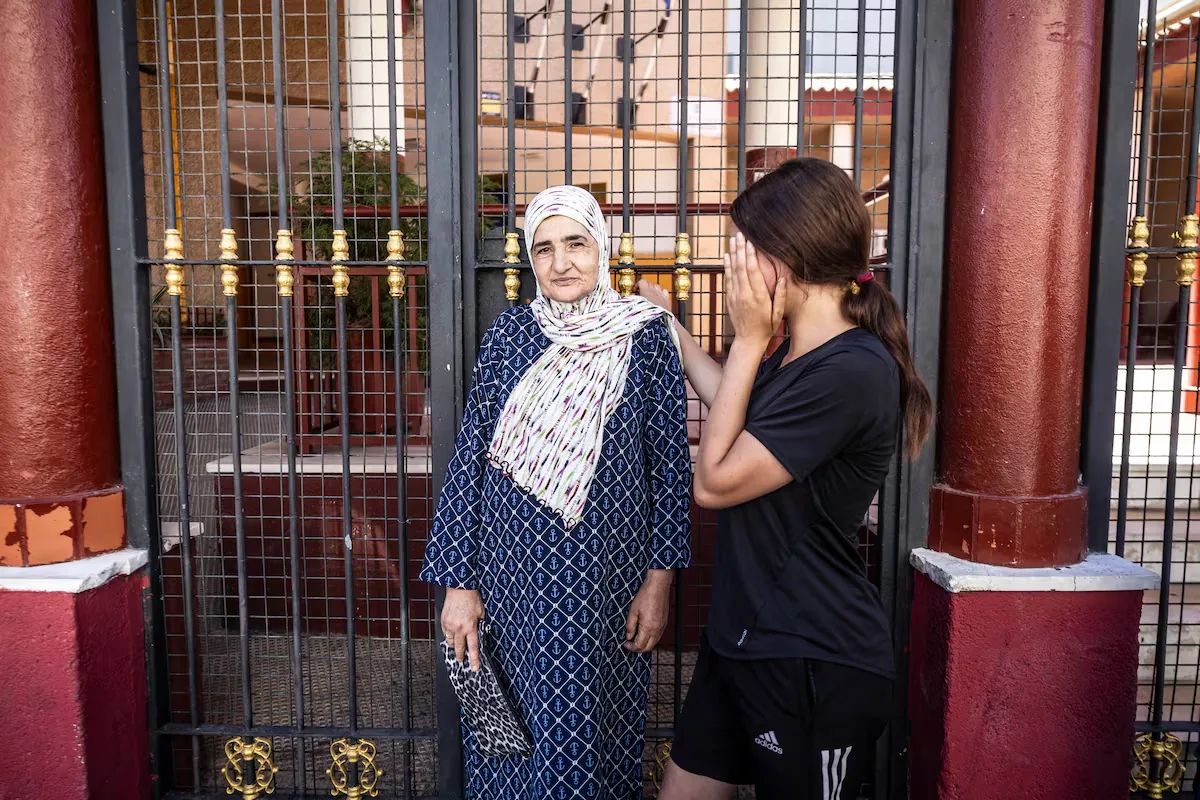
Zohra Mohamed takes three steps forward and six steps back. She has been trapped in the same stretch of the street for hours. Someone told her that behind the black bars of the multifunctional building in the El Príncipe neighborhood there might be hope, but for now it does not appear. She is 62 years old, has 11 grandchildren, and for three days now, one more who is not of her blood. It is Aya, 17 years old, a young Moroccan who swam across to Ceuta. Dressed in a men’s t-shirt, she watches Zohra’s tiny comings and goings, and repeats her own nervous ritual, nibbling on the pendant of a small butterfly she wears around her neck. “They don’t open, they just don’t open here. Tell me what to do, where to go,” Zohra begs everyone she meets. Three days ago she saw Aya in an alley, with legs full of wounds and still wet from the crossing. She was alone, had no shoes, and it was night. “How could I leave her like that? A girl alone, how could that be?” she repeats, agitated. Many Ceutans have taken in some of the thousands of minors who entered Ceuta on July 30 and 31 through the El Tarajal border breakwater, but the solidarity of the neighbors barely suffices to alleviate the situation of these young people, especially the girls, who are also exposed to sexual violence.
Read more Lessons from the crisis in Ceuta
Until last Thursday, Aya lived on the other side of the border, in Rincón, and studied hairdressing. Her 14-year-old brother woke her up by shaking her in the middle of the night saying he was going to cross to Spain. She didn’t believe him and he didn’t wait for her. She checked her phone and saw it was true: there were dozens of people crossing the border checkpoint.
Aya ran out of the house with what she was wearing. She walked 22 kilometers in the dark, following the crowd moving by the light of their phones. She says it was hours, she doesn’t know how many. Then, she threw herself into the sea. She remembers the avalanche, points to the still tender wounds, but says that wasn’t fear. She felt that later, when the police chased her through the streets of Ceuta and she hid under a car. She doesn’t want to tell what happened the two nights before Zohra found her and shakes her head as if shooing away something invisible, but that still hurts. Zohra hugs her immensely; her eyes fill with tears as she runs her calloused hands around the circumference of her face: What is she going to do here alone, what is she going to do? “I have already spoken with her parents and they don’t want her to return to Morocco, neither does she,” she says. But she can’t, she doesn’t know how to provide her a future. She has been sleepless since she found her, looking for alternatives. She took her to the temporary minors’ reception center and didn’t even have time to see that it was overwhelmed.
“It was full of boys, men already, I couldn’t leave her there with all of them, they could do anything to her,” Zohra fears, looking up to the sky, mentioning an unspeakable terror. They returned home and now try again in this building, where word of mouth assures there is some reception option.
Wafa and Ilhame are in the same desperate search. Wafa is 42 years old and has taken in four Moroccan minors, who sleep on a two-seater sofa in her house. Ilhame has placed her in her daughter’s room. While telling this, Ilhame puts her hand on her heart and lowers her gaze, a gesture of anguished, heavy gratitude. She wipes her eyes with the cream-colored jilbab and says she wants to study nursing, that’s why she came. She is 15 years old and from Río Martín; she also swam across. She doesn’t know where the rest of the friends she crossed the sea with are. “I would love to take care of her, I don’t want her to be on the street, but I just can’t manage,” says Wafa. She is sniffling from a cold and something else. She is on her way to the supermarket to buy more food, but the numbers don’t add up. “I also have children, my mother, the rent, and I’m doing everything possible for the five of them, but money only goes so far. We don’t fit. But what am I going to do, leave her to her fate?” she wonders. She squeezes Ilhame’s hand and whispers something in dariya, the Moroccan dialect of Arabic. “Nothing will happen to you, I’m here. That’s what I told her.”
Read more Carlos Senghor Diatta does not want to be a footballer
Sexual violence
Zohra and Wafa’s fears are not unfounded. This Friday, the Government Delegation confirmed that five cases of rape of Moroccan minors have been received, which the Family and Women’s Care Unit of the National Police is investigating. And Rajaa also confirms the fears, entering the El Príncipe neighborhood association holding a 12-year-old girl by the shoulders, protecting her with her body. “Please, please,” she begs. She is very nervous, and the girl, Yuli, has eyes full of congestion and panic. She trembles. She has been crying since last night. She was falling asleep behind a container when several men tried to drag her into the woods, groping her. Her screams woke Rajaa, who lives in one of the colorful houses on the hill, and she looked out fearing a fight. Seeing the scene, she ran out into the street with her son-in-law and the attackers fled. “Some sons of bitches, pulling her clothes, dragging her. They were five men from here, about 30 or 35 years old,” she says. She pulls Yuli close to her chest and cradles her. She hiccups. “Calm down, now you are my daughter too, I won’t abandon you,” she says, showering her forehead with small kisses. She is from Agadir and crossed alone. They have spoken with her mother, but she doesn’t want her to return. “Now this is your sister,” Rajaa tells her, pointing to her blood daughter.
Throughout the neighborhoods of Ceuta the scene repeats: women who take in girls, mostly Moroccan, who wander the streets trying to make themselves invisible. It happens in Benzú and Hadú, but it is in Sidi Embarek, in Los Rosales, where frustration has exploded into something like a fragile temporary solution. Led by the neighborhood president, Abdellah Mustafa, the neighbors have set up a futsal field to shelter them. Two burly men guard the narrow door and keep watch during the night and during the day try to prepare the space, which was going to be a summer cinema before everything changed in Ceuta. They have put up tents, tarps, and mattresses on the green floor. Underage girls arrive at all hours, guided by word of mouth, and peek into the field. Something calms on their faces seeing that there are only girls and teenagers there, and when they enter, they seem lighter. Only on the first day the field opened, fifty girls arrived. At nightfall, more than a hundred. After two days, they started writing their names in a white notebook that soon ran out: the number now reaches 200, and not all fit. Most spend the day outside and return only to sleep, but collapse is beginning to be glimpsed. The City Council has sent them a portable toilet, nothing more.
While they install it, a pair of girls share laughs leaning against the wall: Jamnat, from Castillejos, and Zineb, from Agadir. They met here and make the heart symbol by touching index finger and thumb when asked if they are friends. They are 17 and 16 years old, and although they have not had a foster mother to guide them here, they proclaim they also have zhar, “a lot of luck.” Last night, they were taking a walk when a group of boys carrying bags of beer, no more than five, tried to sexually assault them. Abdellah was around and confronted them. “They were a pack, a pack. Tattooed, about 40 years old,” he repeats, furious. By fighting, he managed to make them flee, although he has seen them again riding motorcycles around the area.
Jamnat listens to Abdellah recount what happened and confesses in timid Spanish that she was very scared. She compulsively rubs her left shoulder, where they grabbed her. Zineb finds it harder to talk about the details, and presses a lasting shock to her lips. They went to the police, in the center of Ceuta, but they were not attended to. “They told them to go to the Tarajal warehouses. They couldn’t even enter the police station,” Abdellah explains. If they go to a minors’ center, whenever it is, they want to go together. They tell this while hugging and chanting inshallá. Hopefully.