1. What an author fears most, in any field of creativity, is that the work they produce becomes an object of ridicule. The capital of ridicule that a book, a play, a painting, or a film can carry is equivalent to the threat of ruin. Therefore, facing public laughter requires courage and a great capacity for adaptation. At this moment, Christopher Nolan, however, will undoubtedly be protected from such attacks by the box office success of The Odyssey, by the feats recounted around its production, the millionaire salaries, the tricks, the behind-the-scenes episodes, all that abundance of curiosities and oddities that spur the imagination of lovers of great productions.
Read more Alone and harassed: the drama of the girls who swam to Ceuta
But if Nolan has learned anything from the model of modern consciousness he portrayed in his Ulysses, he will know very well that he has brushed the threshold of a greater work, without reaching it, and will feel serene with the distance at which he has remained. I do not believe that anyone who has hoisted those magnificent red sails over the Mediterranean or buried the mythical horse in the sand does not glimpse that a masterpiece could be within their reach. If he deviated from that path, it was either because the author of Oppenheimer did not manage to transition from the great biographical documentary to poetry, or because he preferred to submit to the common laws of box office success, combining the generosity of the means at his disposal with the grandeur proposed by Homeric narrative.
2. Ulysses and Jesus Christ are the two mythical figures that have presented the greatest challenges to Western creators. Their names and images have permeated fiction and our imagination since their stories began to be told. Not even at the dawn of the most radical positivism did Christ ever disappear from the horizon as a reference and character. Dostoevsky, Kazantzakis, or Saramago are just some of the hundreds of relevant authors who have addressed him in modernity. Even if only to deny him, Christ emerges as a human being who embodies the model of altruism, the son of a god who is confused with God himself. But in Ulysses’ chest beats a human heart like any other that transcends itself through cunning and ferocity, without accessing any kind of divinity. He symbolizes all those who went to war, won by ending their enemies, but return home aware that every battle is a defeat and every victory an illusion. He appears in history 12 centuries before Christ and is contemporary with the end of the Bronze Age. The director lends him a melancholic consciousness, emphasizing the idea that killing other men is a breach of the pact with Zeus and that such ferocity announces the end of an era. Many have laughed at Nolan for the psychotic melancholy interpreted by Matt Damon. From this point of view, I believe all irony is unfair.
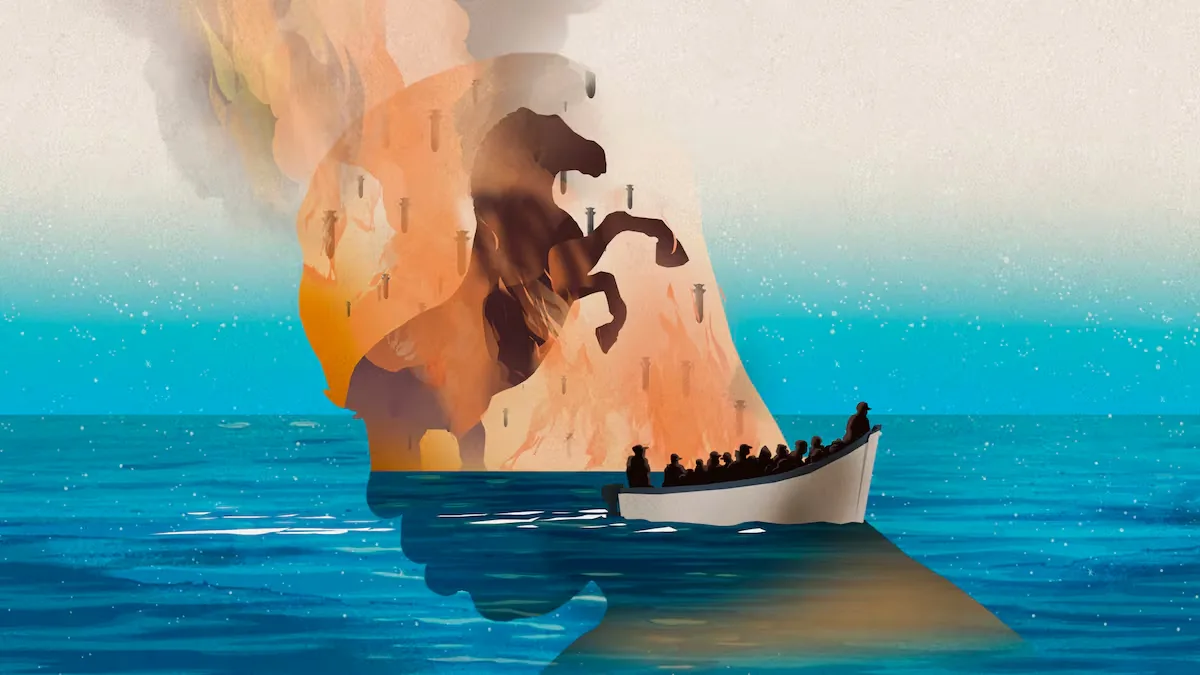
3. Even under the enormous umbrella of big productions, it seems as if Nolan conceived some of his films as acts of warning. Oppenheimer warned about the imminence of a nuclear war looming over us. The Odyssey serves Nolan to talk about the perverse feelings of the great captains of current violence, to show that the final disaster is likely if the human heart remains wrapped in the meanness of Homeric conquest. The Trojan horse, which in the film does not seem to be made of wood but of metal, has a futuristic echo that should not be underestimated. Still, it is far from the current specimen that marks our days.
The difference between the horse that Ulysses conceived to breach the walls of the besieged city and the horse that today bursts into cities at war is that the latter overshadows the entire Earth and does not have a closed belly. The guts of the horse that assaults us day after day have no limits, they are wide open, and from its interior come intercontinental ballistic missiles, not soldiers wielding axes. Today’s horse rests its hooves in many places and advances across the globe, without silence or secrecy, disorienting the planet. We all know we are being assaulted by a great Trojan horse that reaches peaceful towns and countries without us being able to do absolutely anything. We remain inside the walls of our cities, with the doors wide open, powerless, waiting for the assault. The phrases Nolan chooses, many of which make the original text pompous, are messages directed at the arbitrariness of the evil that afflicts us. Nolan’s corrective intention is also most evident in his way of addressing xenophobia by giving Helena the symbolic role of a black woman whose face bears a deep scar left by Agamemnon’s war. Personally, Lupita Nyong’o’s figure destroys the image I have built of Helena throughout my life, but I understand to whom the message is addressed and the warning it implies.
Read more Lessons from the crisis in Ceuta
Just as I take seriously and observe with emotion the image of the dead rising from hell to accuse and pursue Ulysses. I do not know what Nolan was thinking, but I know what he makes me think of: today’s violent ones, whose names are clearly visible on the signs of armed conflicts in various regions of the planet, would do well to visit hell. Before them would rise not hundreds or thousands, but millions of wandering specters, lamenting having sacrificed their lives in vain. There is no screen that can contain the number of their victims. But since we know the faces of those who ordered it, it does not seem that any of them have the dignity of this Ulysses to declare themselves guilty.
4. It remains true that Nolan could have avoided some reasons for repulsion that offend even the common viewer. The mockery caused by poor Argos, turned into a mangy dog — and then into a Portuguese podengo — detracts from the gravity of the film. There is a clear concession to the taste of the viewer addicted to visual hysteria to satisfy the deep throat of a mass audience, who only find solace in settings worthy of Bosch’s paintings. And the sound?
At the beginning, we are warned that the cinema in our city is not prepared for IMAX. The soundtrack then becomes deafening and thunderous. When there is finally a pause, in the dimness of the room, the sound of rodents eating popcorn frenetically is heard. It is a shame, a real shame, and I say it without irony, that Nolan and other great directors, with as much talent in their heads as money in their pockets, give in to the temptation to make films for popcorn devourers instead of maintaining the level announced by their best poetic moments.
5. Even so, despite these slips, I will return to this film. The sum it offers me is much greater than the evaluation of its parts. I will forget that the actors have the swagger of Western gunslingers, and I will ignore that the facial expressions of Mediterraneans remain restrained today, and that their penetrating gaze does not blink, it remains fixed. I will forgive, above all, that it was not understood that the vociferous stereophonic immersion does not correspond to a virtue. Art is representation and requires distance from the object. While immersion invites combat, art invites the sublime, which implies contemplation. I will watch Nolan’s The Odyssey again. I will do so for the value of its entirety, following the advice George Steiner gives regarding books: to enter them as one does into a friend’s house. Respecting perfection and imperfection, understanding what has been achieved and forgetting what was left by the wayside.
Read more Carlos Senghor Diatta does not want to be a footballer