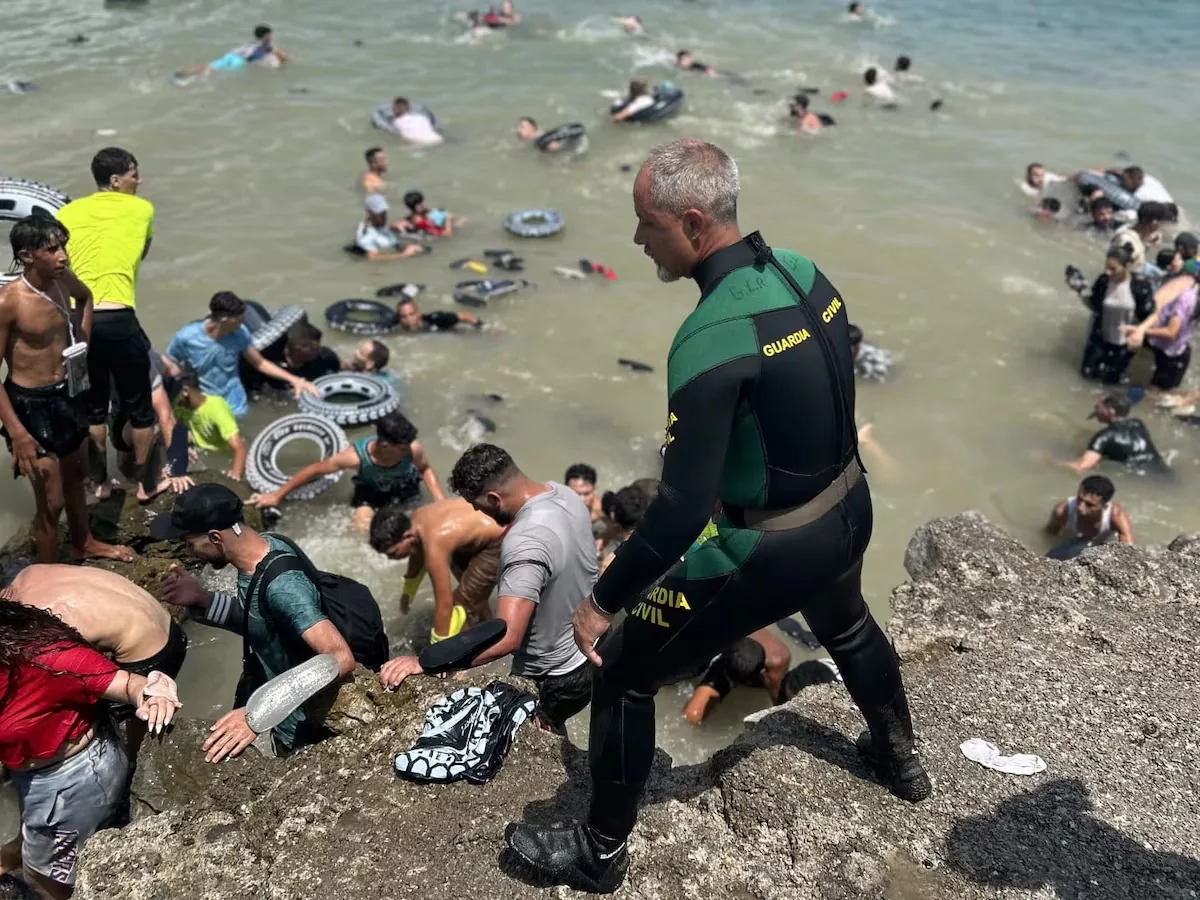
The director general of the Civil Guard, Mercedes González, has given instructions not to grant new “vacations, permits or licenses” to agents of the armed institute stationed in Ceuta and Melilla due to “the operational situation resulting from the increase in irregular migratory pressure” in the two autonomous cities, according to an internal document accessed by EL PAÍS. The memo, signed last Friday by the operational director general (DAO), Lieutenant General Manuel Llamas, justifies the decision on “the need to guarantee the proper provision of service, the maintenance of citizen security and the surveillance of the State’s external border” and comes in response to reports pointing to a supposed new attempt at a mass border jump by irregular migrants being encouraged on social networks for the coming Saturday. On July 30, more than 72,000 irregular migrants entered Ceuta after swimming around the El Tarajal breakwater, according to an estimate by the Ministry of the Interior.
The document states that the “operational effort” made in recent days to address the migratory crisis has been “significantly diminished at this time due to the enjoyment of summer vacations and personal leave permits.” It adds: “Given this situation, and the security conditions that must be guaranteed in the two autonomous cities, it is considered necessary to adopt extraordinary temporary measures regarding vacations, permits, and licenses to ensure adequate coverage of services in the Ceuta and Melilla Commands.”
González cites for this purpose article 20 of the law regulating the rights and duties of members of the Civil Guard, which establishes that, “in case of serious disturbance of citizen security, serious emergency, urgent risk situation or public calamity, civil guards will report to their assigned post or the nearest one and will be immediately available to the corresponding authorities.” However, the measure will not affect permits and vacations that were authorized “prior” to the date of the order, but exclusively those processed now.
Therefore, the document signed by General Llamas orders that “until further notice” no new permits will be granted to agents. “The Headquarters of the Ceuta and Melilla Commands will keep the chain of command informed about the evolution of the operational situation that motivated the adoption of these measures, proposing their maintenance, modification, or lifting when circumstances allow,” the text adds.
The Civil Guard’s decision has not been accompanied, on this occasion, by a similar measure in the National Police. In the case of this police force, the measure adopted at the outbreak of the crisis remains in place. In this case, the director general, Francisco Pardo, activated a mechanism of extraordinary services (with complementary economic remuneration) that allows members of the Police Intervention Units (UIP, the so-called riot police) and the Prevention and Reaction Unit (UPR) based in Ceuta to voluntarily extend their working hours. Sources from the Ministry of the Interior indicate that this measure “has enabled a greater presence of the National Police on the streets of the Autonomous City of Ceuta.”
Read more The UNAM scandal exposes the cracks in Mexico’s higher education system
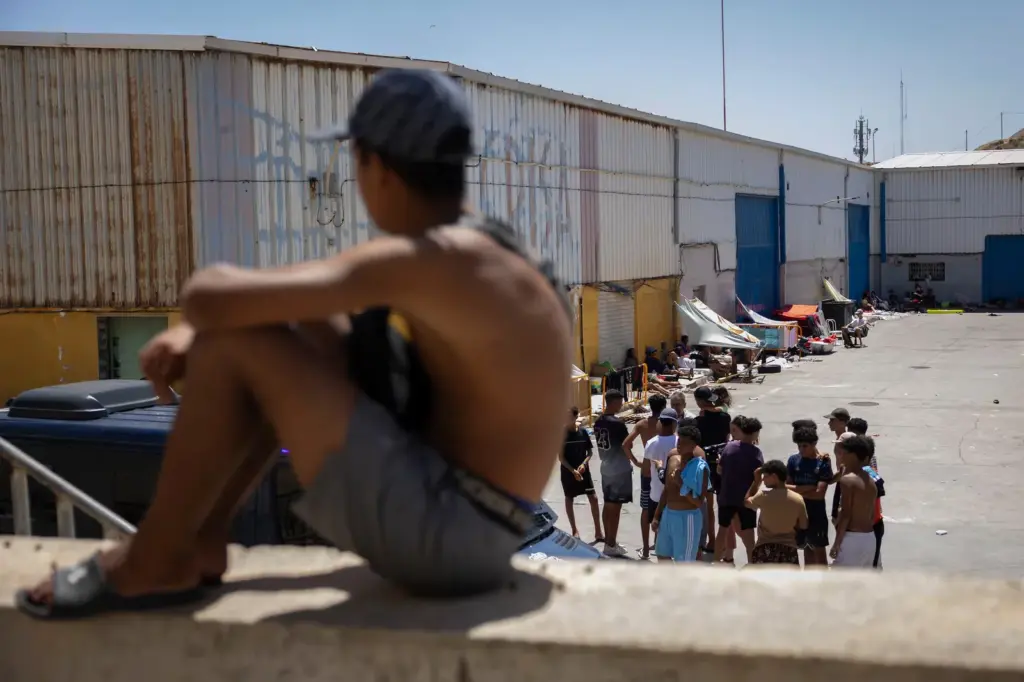
After the outbreak of the crisis, the Interior Ministry reinforced the staff of both forces by sending, on the same Thursday, nearly 350 agents to support the more than 1,000 agents assigned between both forces in this locality, who were overwhelmed that day by the massive entry of migrants swimming from Morocco. Subsequently, the number of reinforcements has increased again. Thus, the National Police initially sent a foreign affairs team composed of six officers to support the identification, registration, and documentation of people who had entered Spain irregularly to proceed with their expulsion. In addition, it deployed five UIP teams (225 agents) from Seville, Málaga, and Madrid to carry out citizen security tasks on the streets. The UIP group and the Prevention and Reaction Unit (UPR) personnel who are part of the autonomous city’s staff, and whose members have doubled shifts to maintain a significant police presence on the streets, joined this same function. Finally, it incorporated another 45 UIP agents and six from the General Information Commissariat, responsible for counterterrorism.
For its part, the Civil Guard sent three platoons (a total of 60 agents) to reinforce border surveillance for the personnel of the Reserve and Security Group (ARS) permanently stationed in Ceuta. Another 160 civil guards from different units in Andalusia joined citizen security tasks, supported by 2,000 members of the Armed Forces stationed in the autonomous city.
For sea and coastal line control, since entries have occurred by swimming around the El Tarajal breakwater, the armed institute sent two diver groups (eight personnel) from the Special Group of Underwater Activities (GEAS) and the Duque de Ahumada ship, the largest of the armed institute, with a crew of 12 civil guards. In Ceuta, the Maritime Service permanently has two medium boats and four zodiac-type boats assigned. Later, five boat captains, three sailor-mechanics, and drone pilots joined. The Air Service was reinforced with a helicopter.
Read more The orchestra of biodiversity that only sounds in the dark