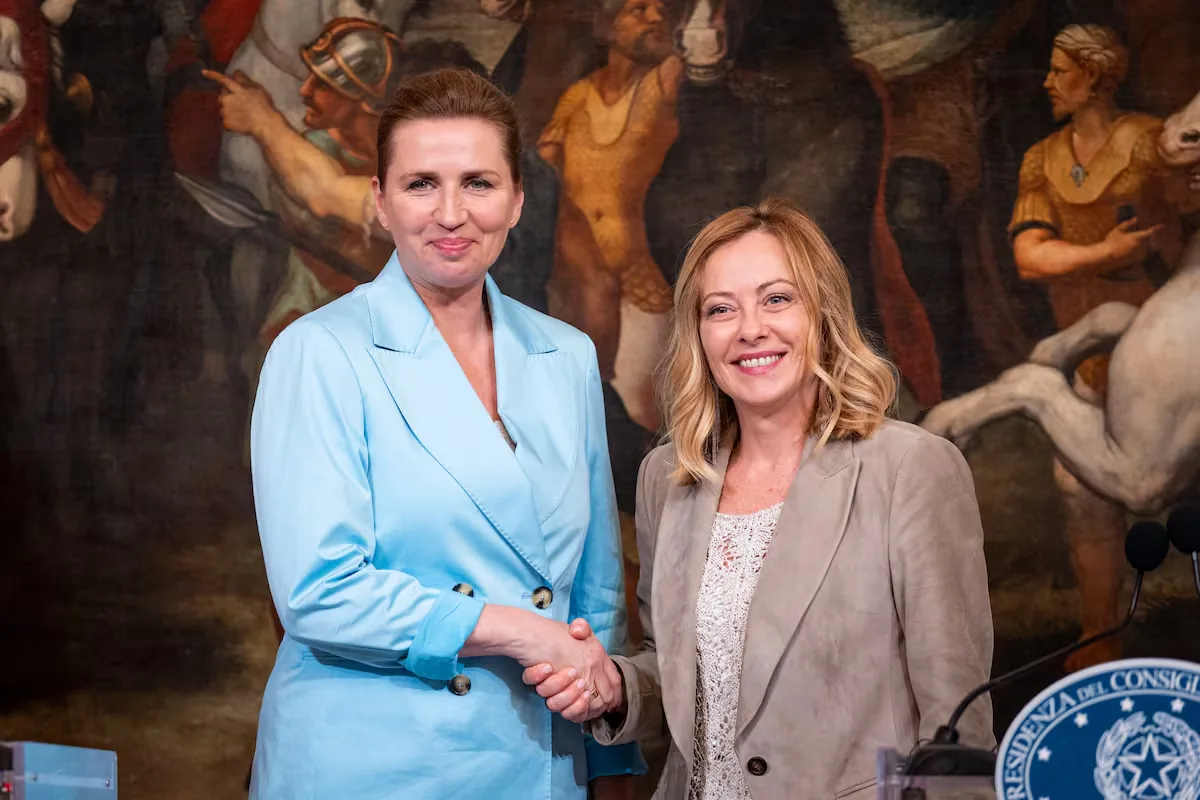
Italian Prime Minister, far-right Giorgia Meloni, and her Danish counterpart, social democrat Mette Frederiksen, have launched a new joint push to toughen European migration policy. In a letter signed by both leaders and published on their social media, they explicitly link irregular immigration with the rise in crime and use this argument to demand more expulsions and the creation of deportation centers in third countries.
Read more The UNAM scandal exposes the cracks in Mexico’s higher education system
“No one can deny the negative effects of illegal immigration on our societies,” Meloni and Frederiksen argue. Without providing sources, statistics, or studies to support their claims, among these effects they cite the increase in crime, pressure on public services, and the loss of citizens’ trust in institutions.
The two heads of government have long shared a striking political harmony, especially on migration matters, intensified after the crisis triggered in Ceuta, despite coming from very different ideological traditions. Meloni and Frederiksen were among the first leaders to call for the temporary suspension of Spain from the Schengen area after thousands of citizens entered Ceuta territory from Morocco on July 31.
Now, they have again shown that connection to once more defend a tightening of EU migration policies and demand new measures to facilitate the expulsions of migrants in irregular situations.
The two leaders place special emphasis on irregular migrants, “who lack the right to remain in our countries” and who “commit violent crimes, traffic drugs, or are perpetrators of sexual assaults.” This link between immigration and security has become one of the pillars of their respective political speeches, although they often make these claims without providing concrete data or studies to back them up.
“We are aware that many might question our collaboration. We come from very different political positions and, undoubtedly, we do not agree on everything. We are the only two women leading a government in the EU. One of us leads a large southern country; the other, a small northern country. But we are united by our desire to defend Europe,” they justify. And they clarify: “We do not accept uncontrolled immigration to Europe, and we have promoted a rigorous migration policy, both in our countries and in Europe.”
Read more The orchestra of biodiversity that only sounds in the dark
In a letter presented as “a set of reflections on the future of Europe, the security of its citizens, and the need to defend our values and way of life,” both leaders argue that Europe must have more tools to expel those who do not have the right to remain in community territory. In this regard, they claim the progress made to facilitate deportations and call for going a step further with the creation of repatriation centers in third countries, where migrants pending expulsion would be transferred.
The two leaders assert that, acting jointly, they have contributed to “changing the balance in the application of the European Convention on Human Rights regarding foreign citizens who commit serious crimes.” According to them, as a result of this new approach, “expulsions should now increase,” one of the main demands of countries advocating a more restrictive migration policy. “Together we have managed to change the balance in the application of the European Convention on Human Rights regarding foreign citizens who commit serious crimes. Consequently, expulsions should now increase,” they state. And they add: “And what more can we do now? It is necessary to create repatriation centers in third countries, as well as other innovative solutions outside Europe. We are working on this diligently.”
Repatriations
This is one of the most controversial proposals currently circulating in Brussels and which Italy has long been promoting to replicate its model of deportation centers in Albania at the European level, despite it still not working and the Albanian facilities being practically empty for almost two years. Rome has tried to promote this initiative through agreements with non-EU countries, such as Rwanda, Uganda, Uzbekistan, and even Montenegro, although so far it has faced numerous legal and political obstacles.
In the letter, the leaders also include a cultural and identity component and claim Europe’s Christian heritage. “We are both proud of Europe’s Christian cultural heritage and want to protect it. We hope that those who arrive in our countries and decide to make Europe their home respect our values and do not try to impose ways of life that we do not share,” they point out. This is an idea Meloni frequently repeats and which is increasingly echoed in various European countries. “Respect for our laws must go hand in hand with respect for European values. This applies to illegal migrants, but also to the millions of foreign citizens who live legally in our countries and throughout Europe,” add the Italian and Danish heads of government in their letter.
The letter presents irregular immigration as a problem that especially affects European citizens. Meloni and Frederiksen state that “ordinary people have paid too high a price” for “uncontrolled” immigration and thus justify adopting more restrictive measures, which they consider necessary to offer “concrete responses” to citizens, “especially the most vulnerable,” to “guarantee greater security and protection for our communities.”
Read more Mass trials without guarantees in El Salvador: “Judges are afraid, they are condemning them all”