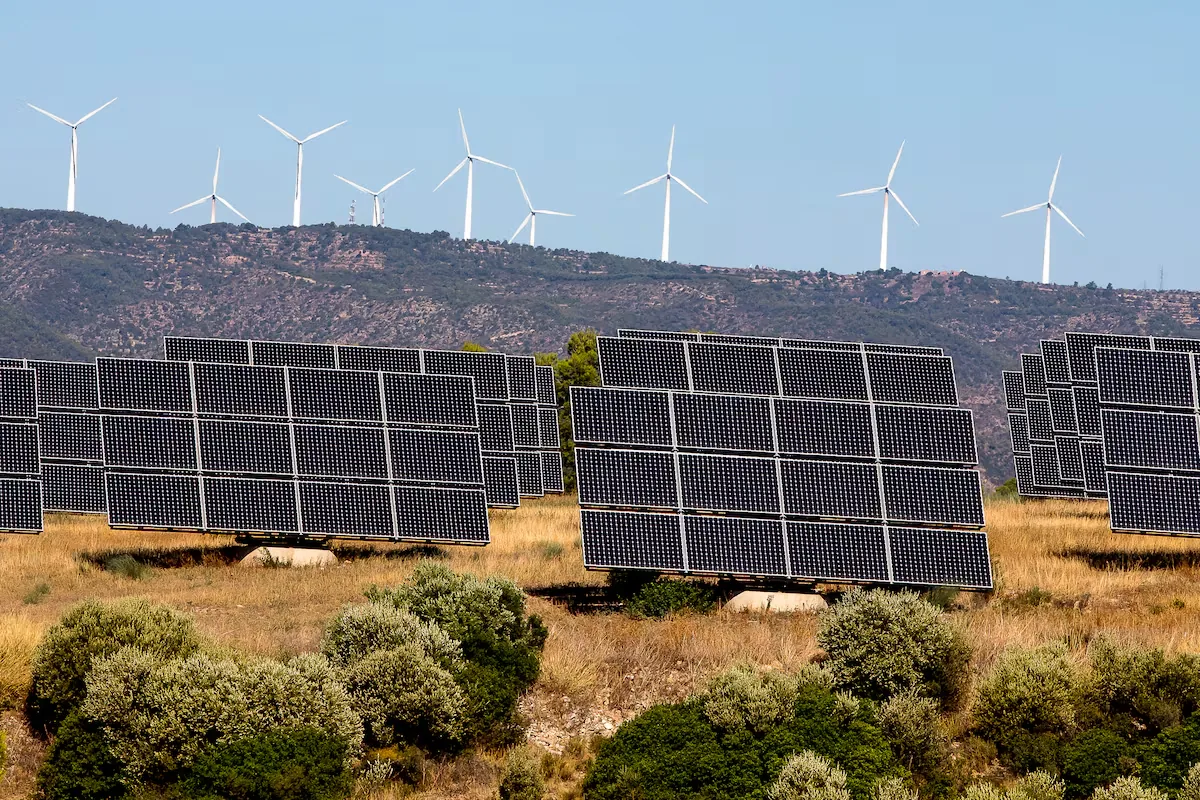
Catalonia has been characterized in recent years by a slow capacity to promote clean energies, a source of regulatory obstacles, territorial opposition, and criticism for territorial grievances. At the end of last year, the Generalitat laid the groundwork for a new plan to overcome these problems and accelerate the installation of solar panels and wind turbines and try to clean a major blemish on its green energy record: the deployment barely reaches 20% of what will be necessary in 2030. The Department of Territory still has a long way to go and it will be, at least, tough: its technicians will only surpass the first phase of allegations imposed on its sectoral territorial plan for the implementation of renewable energies (Plater) after reviewing 12,143 allegations, of which more than 1,300 come from municipal bodies, whether provincial councils, county councils, or municipalities, which have either decided to participate constructively in the regulation proposed by the Govern of Salvador Illa or have outright rejected it due to what they consider the destruction of the territory.
Read more An 83-year-old man drowns while bathing on a beach in Roses
Given the large number of appeals to the plan, which it considers historic, the Xarxa Catalana per una Transició Energètica Justa demanded this Monday the withdrawal of a plan that, they believe, before being finalized should have determined how much energy Catalonia needs, where it should be produced, and which spaces are suitable. They also consider it necessary to extraordinarily halt all projects over 5 megawatts (MW), controlled by the Ministry of Ecological Transition, until a new regional planning is approved.
The Generalitat, however, defends that its plan seeks, based on 141 overlapping information maps, to define a foundational approach to gradually specify the limits of each municipality with proposals coming from the territory, with the capacity to reduce by up to 35% the total area indicated as a priority for locating green energy plants. Territory defends that no municipality will see more than 5% of its surface conditioned by the Plater. From the proposals received in this first period of listening to the territory and a second period of allegations that will likely extend the entire process for about a year, so the plan will still take time to be ready and implemented.
The platform for a just energy transition, which integrates multiple organizations with ecological, agricultural, and municipal profiles, made models available so that its members and individuals could participate in the allegations process opened by the Govern to oppose the Plater. According to their file download data, the Generalitat’s data do not match their statistics, as about 11,800 people would have submitted allegations through their allegation model. In a press conference held this Tuesday, members of associations explained that some of the areas marked by the Generalitat as possible for locating solar panels or wind turbines are areas where there are basic municipal infrastructures or other assets they consider necessary to preserve, such as centenary olive trees. Territory argues that precisely the allegations process seeks to safeguard those spaces that the territory considers essential, but the fear of what will ultimately happen is unstoppable.
Read more Eusebio Cáceres and Moha Attaoui find peace and momentum at the European Championships in Birmingham
One of the examples that has emerged during the press conference was that of Solsonès. Its 17 municipalities have decided to show their disagreement with the Plater in the first call for allegations. That reaction, pending the governmental approach, is not unusual. That county is, along with Alt Empordà and Anoia, the one that will have the greatest impact with the plan to promote wind and photovoltaic energy because it is marked as an optimal area to concentrate that type of installations. Solsonès, along with Alt Empordà, is the only one of 41 Catalan counties that currently does not have any wind turbines generating electricity.
The Plater contemplates that all municipalities contribute a minimum quota of renewable energy production. In La Noguera, 2,000 MW of solar is foreseen, while wind energy will have greater prominence in Ribera d’Ebre, Baix Ebre, Conca de Barberà, Segrià, Garrigues, or Anoia, in addition to those current exceptions that were Solsonès and Alt Empordà. Since its launch, the Govern has defended that its intention is to ease territorial tensions due to accusations of grievance with a redistribution of renewable energy generation and energy in general. 56.7% of the electricity produced in Catalonia is generated by nuclear power, and the two plants currently in operation are in the south of Tarragona.
Read more The most detailed body map of tickling proves Darwin right: we feel it more where we least expect it