









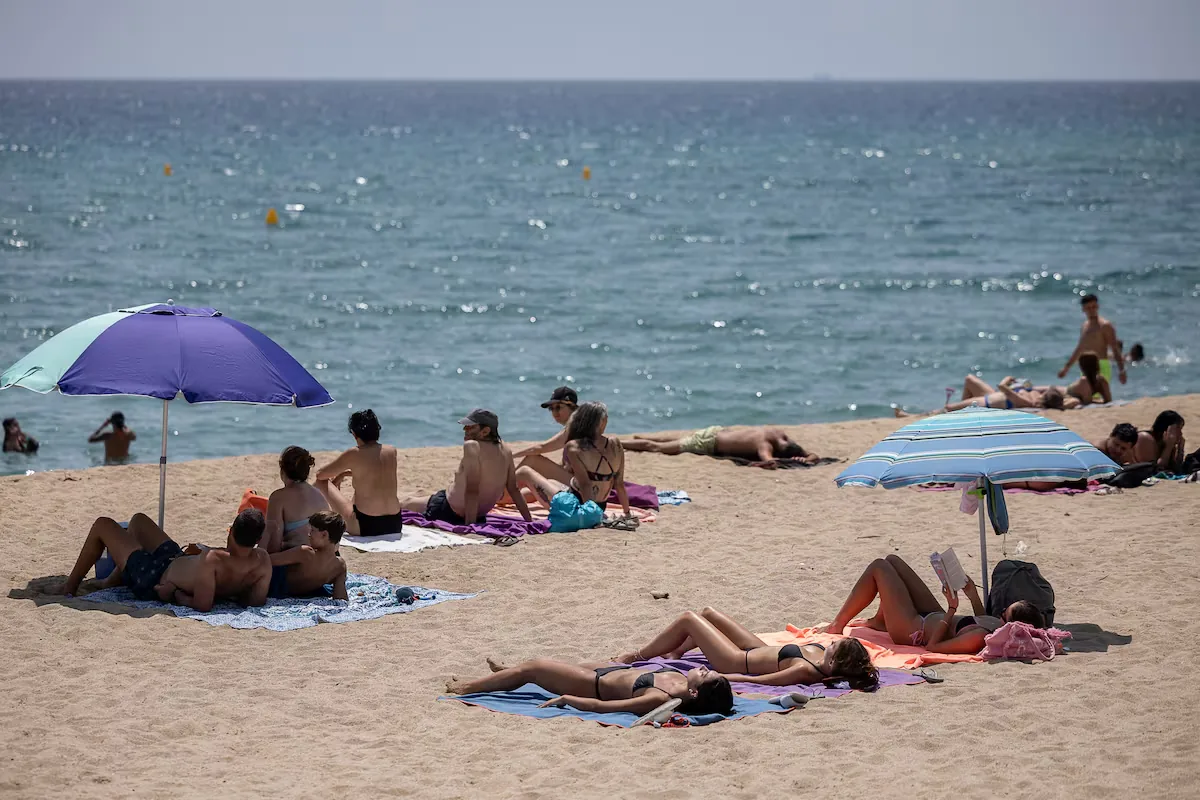
Every day, a community garden and a boardwalk are the only things standing between Carmen Gutiérrez and Sardinero beach. As the director of the Cantabria Film and Television School, she could almost jump onto the sand from the privileged location of its main headquarters in Santander. However, she tries not to do so when an afternoon of work awaits her in front of the computer. “Because the beach is tiring,” she says. In fact, if she returns home after a few hours by the sea, “I don’t feel like packing up the beach bag but lying down on the sofa,” she confesses.
The feeling will be familiar to any vacationer. Although in theory few activities seem more relaxing than lying for hours, towel in hand, at the mercy of the sun, breeze, and waves, it is common to return from beach days with a mix of drowsiness and lack of energy. But how is it possible to end up exhausted after enjoying the temple of summer rest?
An organism without vacations
“People think the body is resting, but it is doing enormous metabolic work,” explains to EL PAÍS Javier Ceballos, a specialist in sports medicine and former doctor of Racing de Santander. Retired for a few years and a personality of the Cantabrian capital, he spends much of his days playing paddle ball on the sand, a typical sport of this coastal region.
Ceballos attributes that feeling to three physiological mechanisms. The first, thermoregulation. “When the ambient temperature rises, the organism’s priority is to keep ours stable around 37 degrees,” he points out. To achieve this, a complex physiological machinery is activated that consumes energy even if we remain motionless under the umbrella. “While we are lying on the towel, the body is working to avoid overheating.”
When the hypothalamus — the thermostat of our brain — detects excess heat, it orders the dilation of superficial blood vessels and activates sweating, whose evaporation helps cool the body. But although these processes go unnoticed, they are not free. “The body is constantly making compensations: it increases blood flow to the skin, makes the heart work harder, and all this ends up producing a feeling of fatigue,” explains the expert.
To this demand is added the loss of fluids. “Even if you are still and lying down, you continuously lose fluid due to heat, breeze, and sweating. Even if it is mild dehydration, the heart has to work harder, and that also contributes to tiredness.” According to the Mayo Clinic, exposure to high temperatures, especially when combined with high humidity, can promote various heat-related disorders, from muscle cramps to heat exhaustion and, in the most severe cases, heat stroke, a potentially fatal medical emergency. Its symptoms include fatigue, dizziness, weakness, headache, nausea, or difficulty concentrating.
Young children and the elderly are the most vulnerable groups, as their ability to regulate body temperature is less effective, warns Ceballos. “In older people, the sensation of thirst appears later, which is why it is so important to drink before feeling it.”
The third mechanism involved is the body’s defense against solar radiation. Even if burns do not occur, ultraviolet rays generate oxidative stress and can damage skin cells, activating an inflammatory response: “The sun acts as an aggressor and the immune system responds.” As part of this process, immune mediator molecules, such as cytokines, are released, also related to the feeling of fatigue that appears during some infections. “They are signals that promote tiredness and force the body to rest to repair the damage,” adds Ceballos.
Read more Six models of eclipse glasses withdrawn due to risk of eye injuries
The Ceballos method
Added to this is that the beach is not as passive a setting as it seems. Even before stepping on it, we can accumulate tiredness: in summer it is common to sleep worse due to heat or schedule changes, and getting up early to find a good spot does not help. Then comes the moving of umbrellas and coolers, an especially demanding effort for those who lead a sedentary life. And there are still walks, swims, playing with children, or activities like paddle ball or frisbee. Even walking on the sand requires much more effort than we imagine.
An Italian study estimated that doing so requires nearly twice the energy of walking on a compact surface. The researchers attributed this difference to the fact that, with each stride on the sand, the body recovers the energy of movement less well, forcing the organism to perform greater muscular work to move forward. “You have to keep pulling your foot out because it sinks, and that requires much more energy,” recalls Ceballos, who experiences this with particular intensity during his games.
Precisely because he knows this physiological cost well, he adjusts his beach time himself. “I stay two hours, two and a half hours at most.” His routine consists of playing paddle ball for a little over an hour, hydrating while playing, taking a swim, and getting some sun, always protected, before leaving.
To reduce that wear, his recommendations are simple. The first, hydrate before feeling thirsty. “A sip of water every hour is essential.” He also advises avoiding some false solutions: “Alcohol and sugary juices dehydrate more. I would drink water and some electrolyte drinks, with sodium and potassium, but without sugar or not excessively sugary.”
And he emphasizes another basic rule: avoid the hours of greatest solar intensity. “The worst are between 12 noon and 4 in the afternoon.” To this, he adds not eating heavy meals — “which divert more blood to the stomach” — proper sun protection, and taking periodic breaks in the shade.
Everything points to beach consumption needing to be done in moderation. “It’s not a psychological issue; the body is constantly working,” he summarizes. In fact, many people say they feel even more exhausted the next day, which Ceballos justifies by the fact that cellular repair processes, hydration recovery, and the restoration of internal balance take time. “It’s the bill the body charges you.”
Perhaps that is why Carmen Gutiérrez has ended up establishing that personal rule. Although Sardinero is just steps from her work, she does not go near it if another afternoon at the office awaits her afterward, because “it tires you, and it stains.”
Read more The Government maintains its support for the Chinese factory in Ferrol despite Defense alerts