









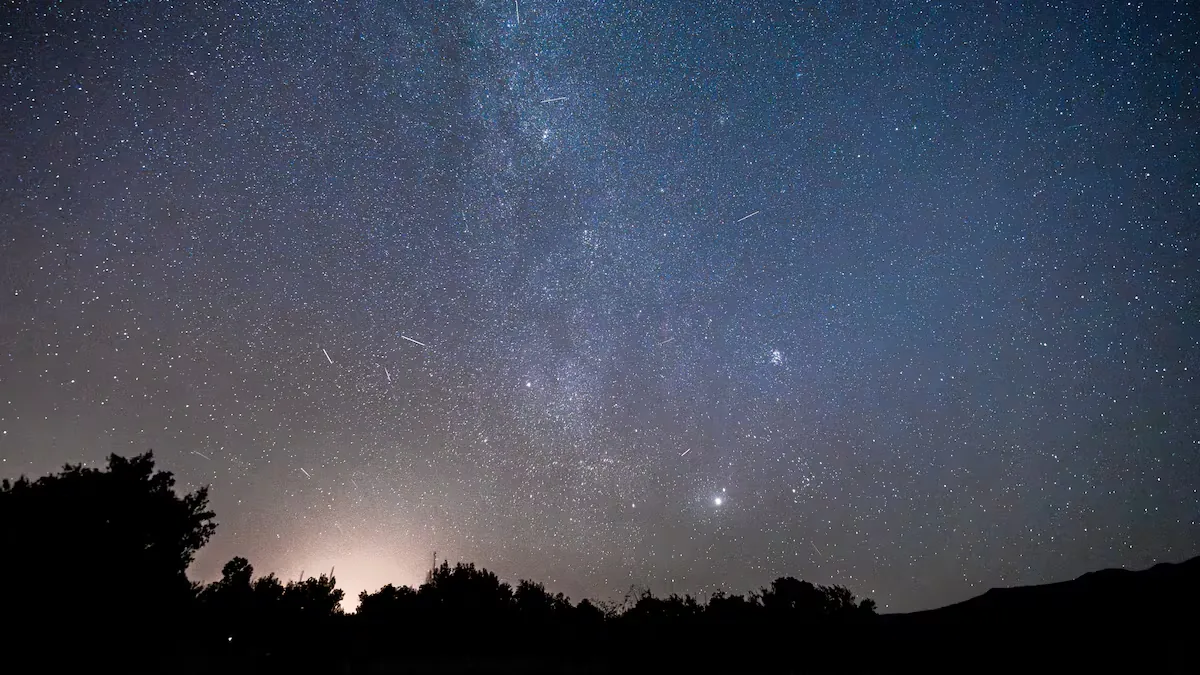
The summer of 2026 gives us a historic and unrepeatable astronomical event: the night of maximum activity of the Perseids coincides with the total solar eclipse that will darken the Iberian Peninsula this August 12. Just a few hours after the Moon completely covers the Sun in an unprecedented spectacle, the night sky will take over to display the peak of the ‘Tears of Saint Lawrence’ under unique darkness conditions. We tell you everything you need to know so you don’t miss a doubly magical day in the cosmos.
Read more Rafa Jódar — Arthur Fils live, the quarterfinals of the Canadian Masters 1000 live
When is the best time to see the Perseids
Although the activity of the Perseids spans from mid-July to late August, the peak moment occurs on the night of August 12 to 13. During that early morning, the maximum meteor peak is reached, where it is possible to count up to 100 shooting stars per hour under ideal darkness conditions.
To optimize observation, experts recommend waiting between midnight and dawn, when the constellation Perseus is positioned higher relative to the horizon.
Why the Tears of Saint Lawrence occur
The phenomenon popularly known as the Tears of Saint Lawrence —due to its proximity to the saint’s feast on August 10— is caused by a comet. As the Earth orbits the Sun, it comes into contact with the swarm of rock and dust particles released by comet 109P/Swift-Tuttle.
Read more The Trump Administration has revoked more than 175,000 visas amid its immigration crackdown
Upon entering the Earth’s atmosphere at speeds approaching 210,000 kilometers per hour, these fragments (many the size of a grain of sand) disintegrate due to friction at more than 80 kilometers altitude, generating the characteristic flash of light known as a meteor or shooting star.
Where to position yourself to see the meteor shower
The determining factor to enjoy the spectacle is not the instrumentation, but the quality of the night sky. Light pollution from large cities can make the vast majority of the faintest shooting stars invisible.
- Stay away from urban centers: look for natural spaces, mountain areas, or municipalities with sky quality certification (such as Starlight Reserves).
- Look for clear horizons: avoid areas surrounded by tall trees, buildings, or mountains that reduce the field of view.
- Pay attention to the lunar phase: in years when the Moon is near full phase, its natural brightness acts as light pollution. In those cases, it is advisable to direct your gaze toward parts of the sky farthest from the lunar disk.
Practical tips to enjoy the Perseids
To experience it optimally, you don’t need telescopes or binoculars. In fact, optical instruments reduce the field of view and make locating meteors more difficult.
- Observe with the naked eye: the human eye offers the widest panorama to catch flashes anywhere in the celestial vault.
- Acclimate your eyes to the dim light: the eye takes between 20 and 30 minutes to adapt to total darkness. Avoid checking your mobile phone or using white light flashlights during observation.
- Lie down on the ground: The most comfortable posture to avoid straining your neck is to use a mat, a deck chair, or a blanket and look toward the darkest areas of the sky, preferably in the direction opposite the Moon.
- Dress warmly: early mornings in the countryside or mountain areas, despite it being summer, usually record notable temperature drops.