









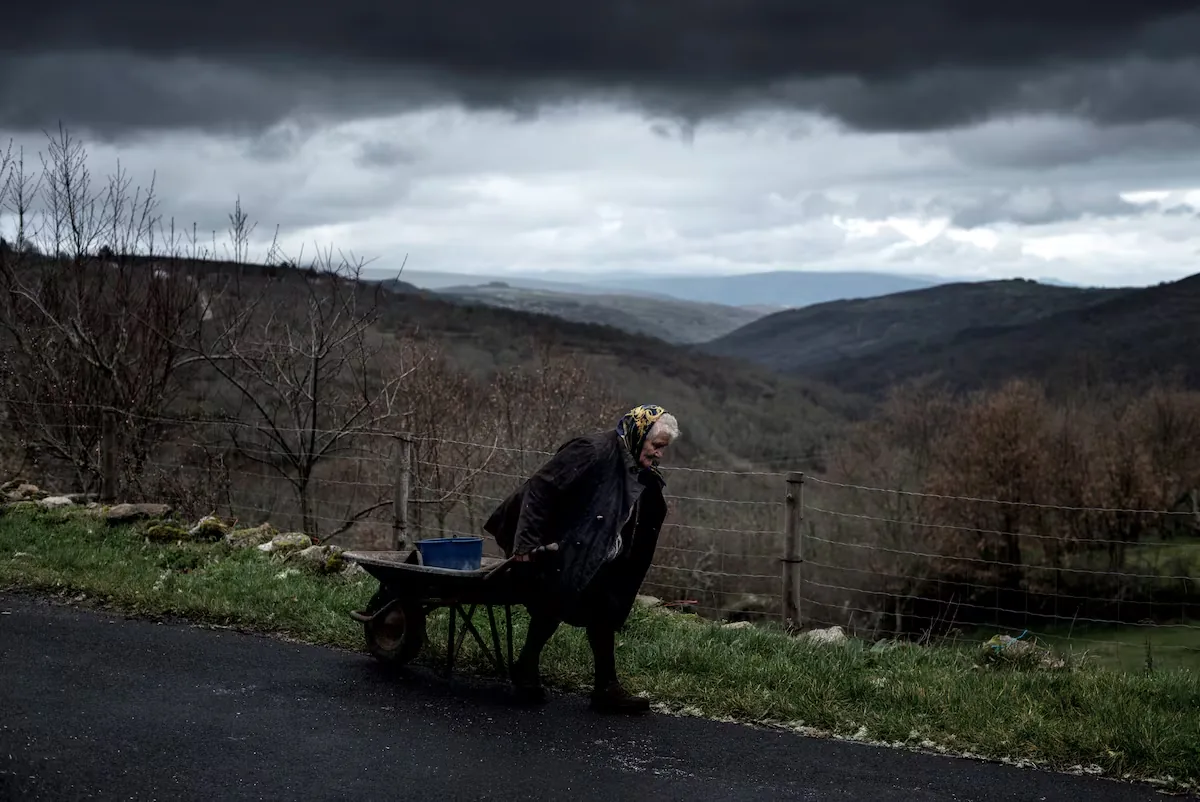
They are a generation that emigrated, that lived through the war, and that was decimated by diseases for which there were no drugs or vaccines. A generation that worked the land tirelessly, that fed on its scarce fruits, and that got ahead with what they had. And they are the men and, above all, the women, who have the highest life expectancy in the entire history of their territory. And no, medical advances “are not what has contributed most to extreme longevity” in Galicia, says psychologist and gerontologist José María Faílde.
Read more Nakashima ends Jódar’s dream at the Canada Masters 1000
This professor at the Universidade de Vigo presides over the Sociedade Galega de Xerontoloxía e Xeriatría and directs the Aging and Longevity Research Group at the Ourense Campus, one of the two provinces, along with Soria, with the highest rate of centenarians in Spain. His group, in collaboration with the Epidemiology department of the Universidade de Santiago, the Galician Institute of Statistics, and now also with the Galician Genomic Medicine Foundation, has been pursuing the elixir, or rather the cocktail of factors, of Galician extreme longevity for four years.
And it focuses on two large areas on the map where prevalence is very high, sharing the podium with Martinique and Sardinia, the so-called “blue zones” defined by Belgian demographer Michael Poulain. These are ZEL-G South (Extreme Longevity Zone-Galicia South) and ZEL-G Center. The first is already delimited to 34 municipalities (28 in Ourense, five on the eastern edge of Pontevedra bordering Ourense, and one in Lugo, also adjacent) and the second has been identified more recently and is still “to be explored,” but it extends from the south of Santiago and advances through Lugo to the Os Ancares mountains. The specific results will be known when the next articles by these researchers are published.
The university team defends the “scientific evidence” gathered in their “ant work,” through protected microdata from the National Institute of Statistics and the Galician Institute of Statistics for which they require special research permits, as well as the tracking of civil registries for which they also need judicial authorization.
Once people over 100 years old are identified — always, at least, three times more Galician women than men, depending on the municipality — they visit them at home, interview them, and propose taking a saliva sample, in that still incipient search for genetic and epigenetic patterns (the mechanisms of gene expression) that help understand the phenomenon. “These people carry within them a health heritage that must be preserved like artistic heritage,” reflects the project director.
In their previous work on the subject (Is Galicia a possible blue zone?, Spanish Journal of Geriatrics and Gerontology, 2025) José María Faílde, María Dapía, and Miguel Ángel Álvarez-Vázquez published some of the first statistics about extreme longevity in Spain. “In absolute numbers,” they wrote, “five communities account for 62.2% of the total centenarians”: “Andalusia, with 2,925, ranks first; followed by Catalonia (with 2,836), Madrid (2,615), Galicia (2,039), and Castilla y León (1,884).”
“If we analyze the data taking into account population figures and calculate rates based on 100,000 inhabitants, we find that two communities in the northwest of Spain, Castilla y León and Galicia, with rates of 79.41 and 75.79 centenarians per 100,000 inhabitants, occupy first and second place,” they concluded, “almost doubling the national average, which stands at 41.37.” At the opposite extreme, scholars placed the Region of Murcia with 17.88 centenarians per 100,000 inhabitants and “the autonomous cities of Ceuta and Melilla, with rates of 27.67 and 24.65, respectively.”
The researchers were then working with 2022 data, and Galicia ranked second in centenarian rates per 100,000 inhabitants. But they warned: “If we study the evolution of this population from 2000 to the present, we can see that, from 2008 onwards, Galicia experiences a greater relative growth than Castilla y León, a greater acceleration.”
Read more Las Ketchup: “We were very poorly advised. No one cared that your whole body hurt”
By provinces, also in 2022, Soria and Ourense occupied first and second place in Spain, “with practically equal rates of 127.81 and 127.18 centenarians per 100,000 inhabitants.” Of the 2,039 centenarians registered in Galicia, 503 were men (24.67%) and 1,536 women (75.33%), and although Ourense was ahead overall, the high rates of centenarians in two regions of Pontevedra stood out: A Paradanta (501.89) and Deza (250.60).
Approaching 110 at the end of the year, Esperanza Cortiñas is today considered the grandmother of Galicia. She has held the title since 2025, when she was only 108, after the death of Lola González at 111 in the Lugo municipality of Monforte. Cortiñas lives in the city of Ourense but was born in Carballedo (Lugo), one of the Galician municipalities with the highest centenarian prevalence, on December 3, 1916, in the midst of World War I.
These hot days she does not frequent, as is her custom, the Rúa Concello social community center, where she has spent years playing brisca in the afternoons from Monday to Saturday and attending the dance, very dressed up and in heels, every Sunday. Cortiñas was widowed still young, with three daughters in her care, and emigrated to Paris. She likes to have a daily shot of coffee liqueur and believes her longevity is related to her love of work, physical and mental activity, and eagerness to see the world.
This sustained physical activity over time, which in the case of elderly people in rural areas lasts “until the end,” is one of the keys to extreme longevity pointed out by Faílde. Other elements that repeat in this kind of vital resilience are “social bonds,” moderate climates, optimism, and “low stress levels.” “Today there are many gyms, but a lot of sedentary behavior, and many processed foods are consumed,” he contrasts, “something that did not exist in the traditional lifestyle” of centenarians.
Furthermore, he adds, today’s society fosters “superficial relationships” while “undesired loneliness” is increasing, about which “there are already studies” that say it “shortens life” by more than a decade. The trend toward very long lives, based on what these researchers observe in elderly people now in their 90s, may be sustained “for the next 15 years,” estimates the team director.
But one of the most striking facts is that all these municipalities with a high concentration of centenarians are mid-mountain territories, away from the coast. “We have found research linking altitude with longevity,” says the professor at the Universidade de Vigo: “Metabolic syndrome is more prevalent below 200 meters, but living between 400 and 900 meters above sea level can cause mild hypoxia, which activates a cellular defense mechanism.”
When asked how living single or as a couple influences longevity, Faílde does not hesitate for a second in his answer. In the case of men, “living as a couple helps.” But that evidence has not been defined in women. The vast majority of people over 100 years old are, in fact, widows.