









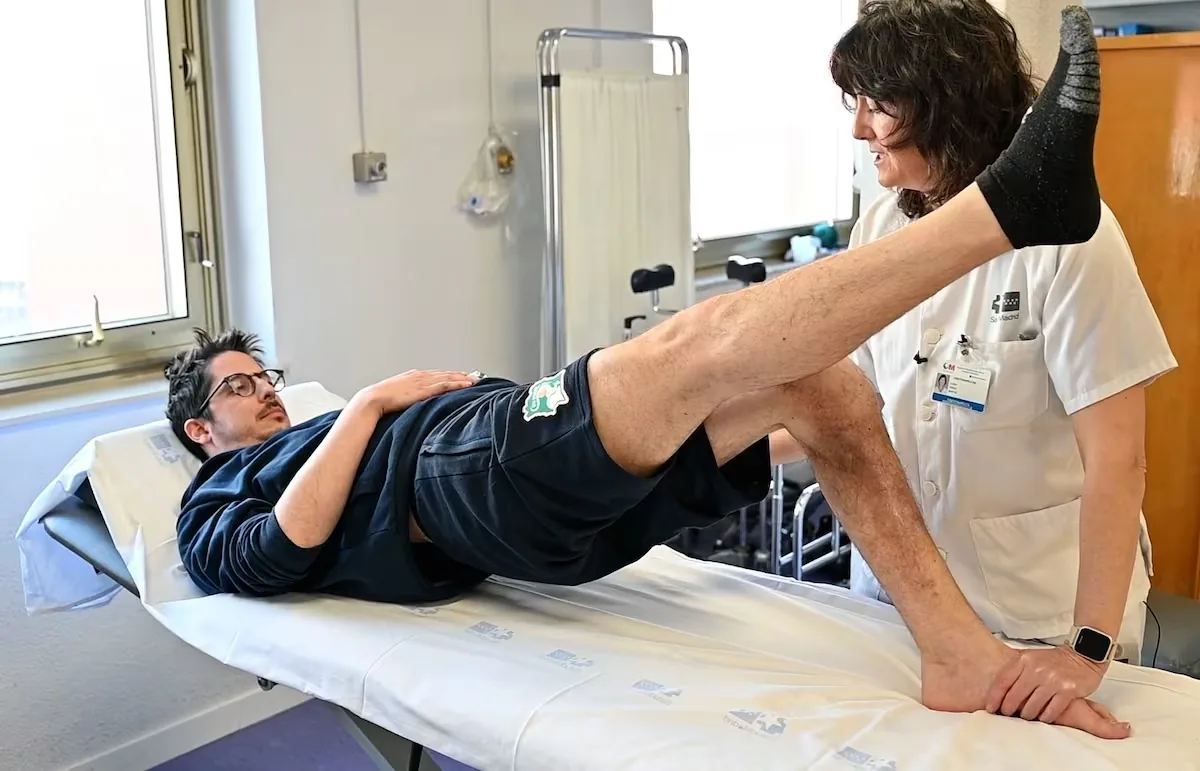
A few years ago, Pierre, a 38-year-old young Frenchman, was diagnosed with cancer. After an X-ray and a biopsy, doctors were able to identify it as a high-grade bone sarcoma in the tibia, an aggressive tumor that had grown rapidly. Pierre was treated at the Gregorio Marañón Hospital, a national reference center for musculoskeletal sarcomas. The surgeons managed to remove the tumor while he kept his leg and joint, but removing it was only the first step. The missing bone still had to be reconstructed and that leg had to be able to bear the weight of his body again. The solution came from an alliance between the hospital and the Polytechnic University of Madrid. They made him a personalized bone metamaterial prosthesis, the first of its kind in the world to be implanted in a patient.
Read more Morante ‘reappears’ on October 12 at Las Ventas after his mournful farewell a year ago
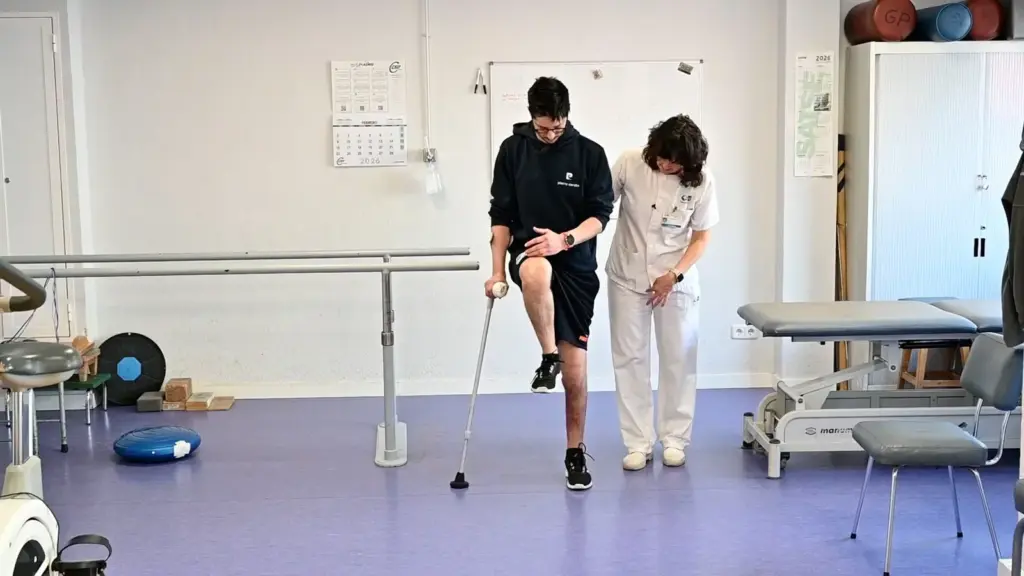
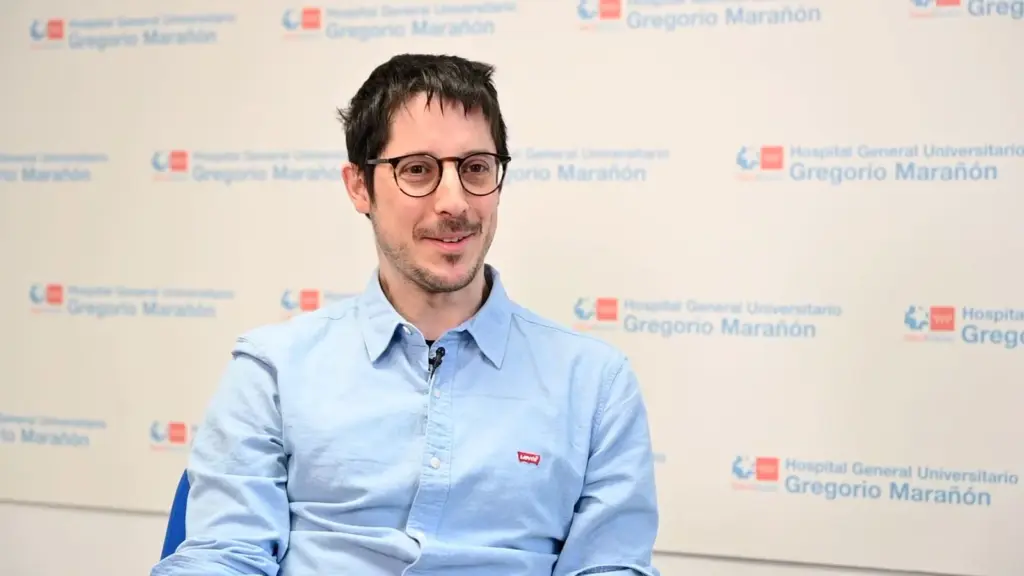
“I have put weight on the leg again after two years and I will finally be able to walk again without crutches,” Pierre says. He neither sees nor feels the prosthesis: “It’s what I have and it turned out well.”
The piece that supports his leg was calculated from his own bone and manufactured by 3D printing at Gregorio Marañón Hospital. Its internal structure, made of titanium, is formed by a network of small bars whose geometry has been calculated so that the implant supports loads in a way similar to how a bone would.
The prosthesis, which the Madrid hospital presented this Friday, is the result of years of collaboration between both centers. They have been developing for more than a decade a structure that allows doctors, engineers, researchers, and other professionals to participate in the design and manufacture of this type of solution.
According to Rubén Pérez-Mañanes, scientific deputy director of the Gregorio Marañón Health Research Institute, the hospital has been a pioneer in the use of 3D printing applied to medicine. “This hospital was the first to implement a unit of this type. When 3D printers were used to make models and toys, here they were used to make anatomical models and replicas of patients,” says the coordinator of the Advanced Planning and 3D Manufacturing Unit (UPAM3D).
An implant for a unique patient
In Pierre’s case, there was no commercial solution that met his needs. The prosthesis had to be designed specifically for him. “Prostheses work by sizes and it is the surgeon who has to adapt the patient to the prosthesis. And here we do the opposite,” explains Pérez-Mañanes. “It has been designed for a unique patient. We place the patient at the center and develop a culture of personalized medicine,” the doctor states.
The hospital’s Health Research Institute maintains agreements with various universities, including the Polytechnic University of Madrid. From that link came the contact with the team of Luis Saucedo-Mora, researcher at the Higher Technical School of Aeronautical and Space Engineering. This work group had been studying structures whose internal geometry allows modifying the mechanical properties of a material for years.
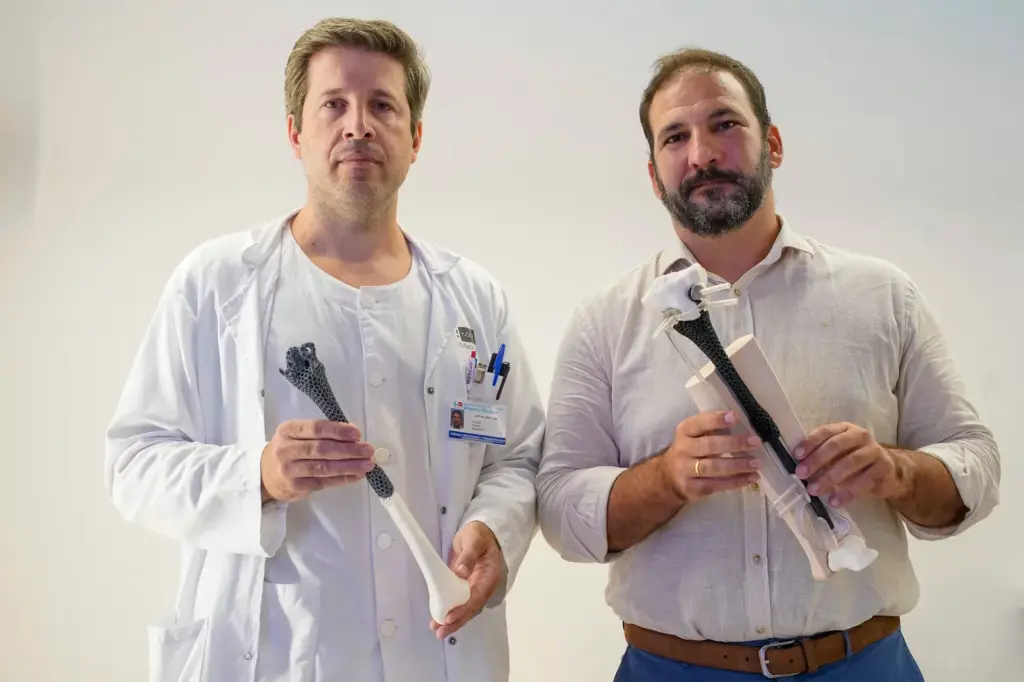
“We have achieved, through research and development, a methodology by which we can adapt the shape to have the same mechanical function that the patient had before having the problem in the body,” Saucedo-Mora details. What his team achieved was to increase the strength, with the same stiffness and distribution that the healthy bone has in the patient.
Almost a year after the surgery, Pierre keeps his leg and knee mobility. He has had to go through a long rehabilitation and continues under oncological follow-up, but he has started walking without crutches. During this time, he suffered a fall during recovery. The opposite leg fractured, but the implant of the reconstructed tibia resisted and remained intact.
For Pérez-Mañanes, despite all the technology surrounding this prosthesis, the goal is the same as traditional medicine: “What we want is to humanize the work. Work as a team. Without that, there is no medicine, no health.”
Read more The Ebola outbreak has already surpassed 2,000 deaths and is spreading to six provinces of DRC