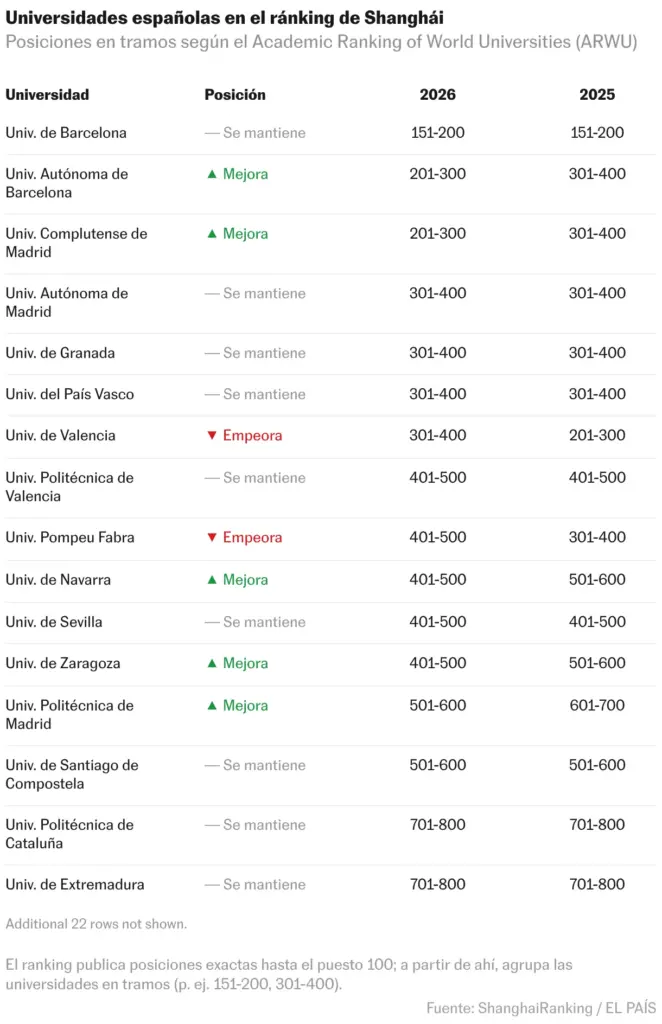
Eight Spanish universities have dropped out of the Shanghai ranking, the most prestigious in the world, published this Saturday, and two new ones have joined. Research output carries great weight in this list, in which 30 national centers still remain. The ranking publishes positions up to 100 and, from there, groups them into ranges. The first local one to appear on the list is the University of Barcelona, which is ranked between 151 and 200. Spain is losing ground with each new edition: last year there were 36 universities and the year before, 38.
Read more “She leaves it like new”: this gel removes the accumulated dirt on the washing machine rubber
The consultancy analyzes about 2,500 centers and selects the top 1,000. Among its criteria are: the number of alumni and professors who have won the Nobel or Fields Medal, the number of highly cited researchers, the total number of articles published and the number of them published in the academic journals Nature and Science in the last five years, and these indicators weighted by the number of professors. The positioning is not merely honorary, as many institutions grant scholarships or money for research stays in another country thanks to appearing or not on the list.
For the Economics professor at the University of Castilla-La Mancha Julio del Corral, the country’s sharp drop in the list “was something that had to happen at some point” and is the result of low investment. “If we are not able to increase the push we give to science, it will be very difficult for us to maintain ourselves,” he points out. It is not a race against the mirror, and although Spanish centers maintain their level, if those in other countries improve, they lose positions. “Chinese universities are taking science very seriously; this means many are rising and, if they rise, others have to fall,” explains the researcher, who studies the factors to improve positions in international rankings.
“The number of Nobel prizes seems reasonable to see the top 100, but universities beyond 200 do not have Nobels; going from zero to one in that indicator means making a very big leap,” Del Corral elaborates. The professor points out that the ranking was devised at the beginning of the century to rate a small group of universities, and now that it has grown, it has not changed its indicators since then. He considers that the criteria are not the best to compare the top 1,000.
“These are indicators designed for the best in the world and, unfortunately, we are not at that level,” concludes the specialist in Applied Econometrics and Efficiency and Productivity Measurement. The sharp rises and falls of Spanish universities often come from having or losing professors on the list of highly cited researchers, published by the consultancy Clarivate every November.
The University of Zaragoza has precisely leveraged an increase in highly cited authors. Its rector, Rosa Bolea, welcomes this leap with pride and highlights that, in addition to strong research, it is essential to row in favor of internationalization. The institution has received European funds from the Advanced Grant 2025 call, one of the most prestigious research grants in Europe. After Germany, Spain is the country with the most projects awarded in the latest call, reflecting recognized science being done. “Our researchers fight to get those highly competitive international projects, but structurally a stronger base would be required,” says the scientist specialized in Animal Health. However, she points out that they miss more technical staff to support these researchers.
Read more No counter space? This double-height microwave stand is a great solution
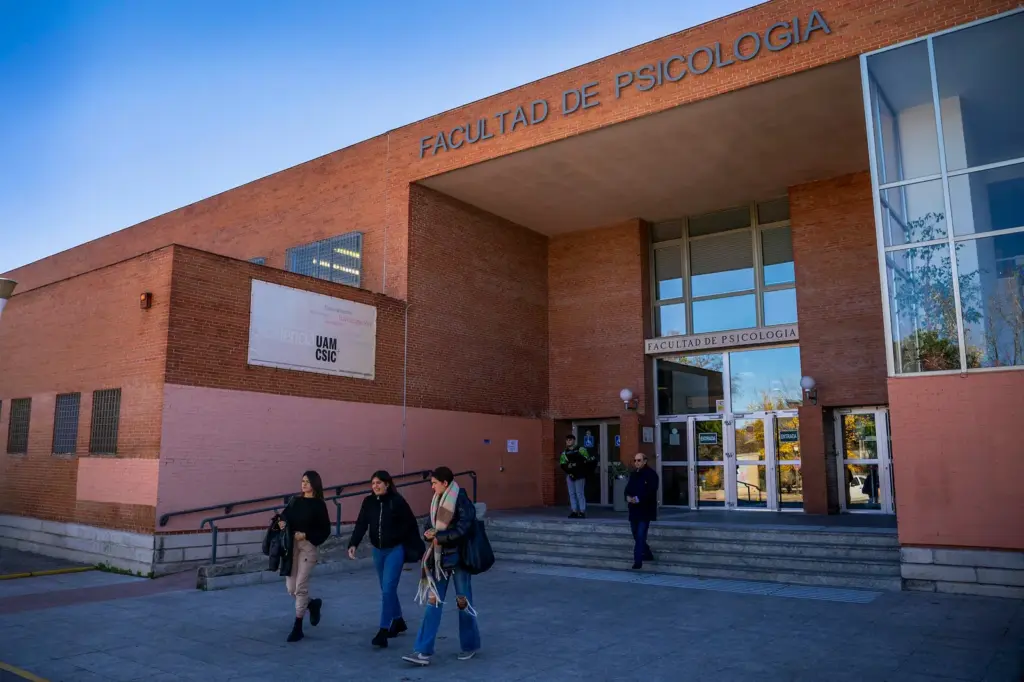
Among Spanish higher education centers, eight have improved their position and nine have fallen in this edition of the Shanghai ranking. After the University of Barcelona come the Autonomous University of Barcelona, Complutense University of Madrid, Autonomous University of Madrid, and University of Granada. The University of Navarra is the only private one that has improved its position. Among those left out this year are the University of Cantabria, the University of the Balearic Islands, and the University of Córdoba. Carlos III University of Madrid, chosen by Princess Leonor to study Political Science next academic year, also failed to appear.
The rector of the University of Barcelona, Joan Guàrdia Olmos, attributes its leadership to years of effort in a “complex and fragile” scenario and in an environment “of scarce funding and much pressure.” He asks to “remember that 70% of Spanish science is done in universities and of that percentage 95% in the public system.” “Without high-level research there is no university,” he emphasizes, and for that he calls for a stable budget, reduction of bureaucracy, an update of project evaluation systems, and “that research be the object of a true political commitment that lasts.”
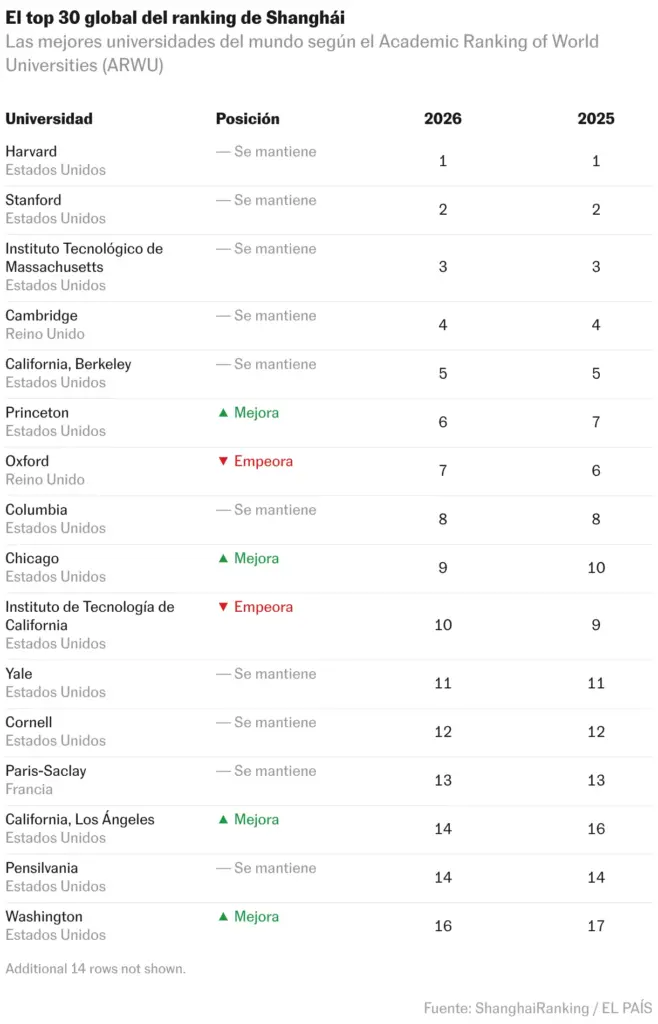
It is not that Spain’s level has abruptly declined from one year to the next; the collapse reflects the continued decline in funding in recent years. Most of the money comes from the autonomous communities, then from the Ministry of Science, Innovation and Universities, and also from European funds, for which there is competition. There is little investment and entry into science is unattractive.
For this reason, Del Corral calls for more FPU (University Teaching Training) and FPI (Research Staff Training) scholarships and of greater amount, so that those who are hesitating to dedicate themselves to it can afford to live. “They earn practically minimum wage, we cannot tell our best students to join science under those conditions,” he comments. He also asks to increase the money for projects from the Ministry’s national research plan.
Rey Juan Carlos University and the University of Valladolid are the two that have returned to the list in this edition. Pilar Garcés, rector of the latter, celebrates being part of this ranking again, and acknowledges that it is hard to compete with institutions that can afford to hire awarded professors. The English Philology professor agrees with the other interviewees that what is urgent is sustained investment, to have materials and experiments that sometimes fail and need support and time to try again.
Read more The Cantu foam that is winning over curly hair: on Amazon for less than 7 euros