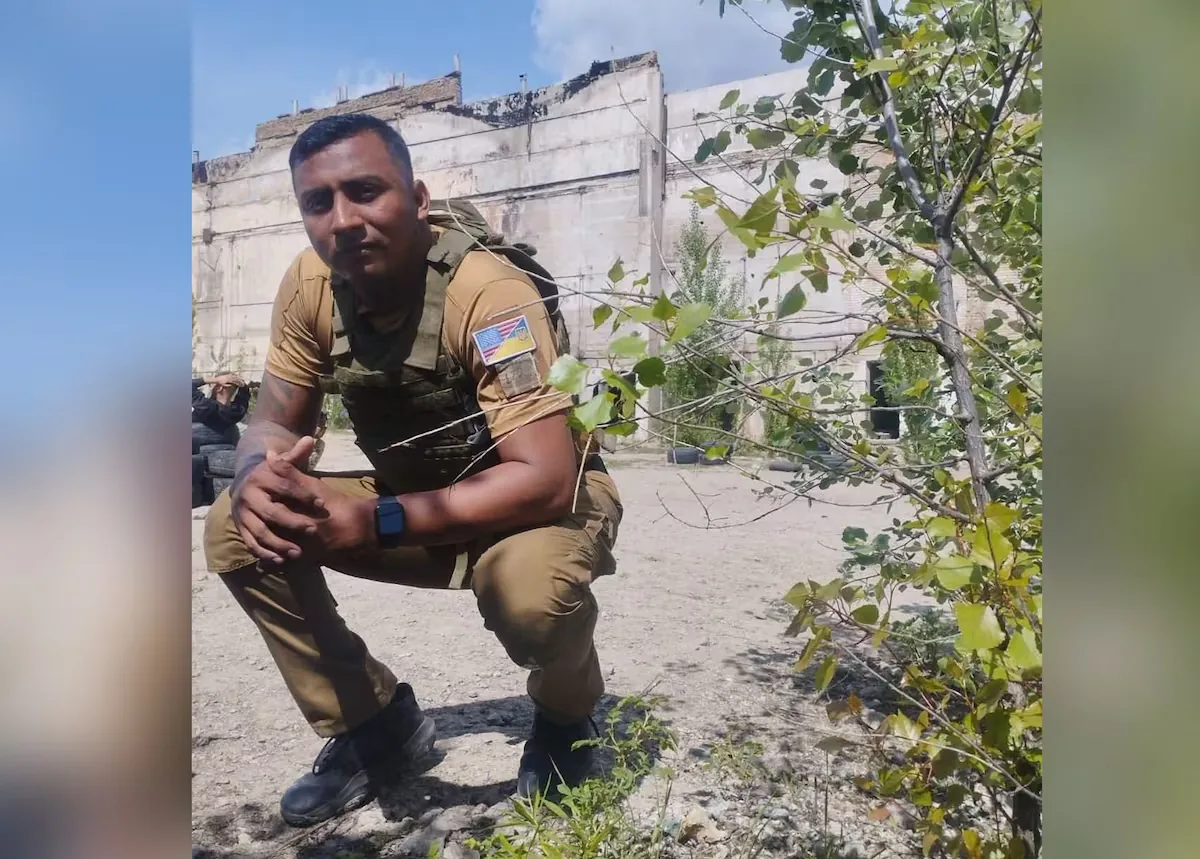
The last time Mario Alberto Lover Martínez communicated with his family was around June 7, 2025. He called from the battlefield to Ciudad Ixtepec, Oaxaca, for his mother Amalia’s birthday. He was an elite soldier of the now-defunct Federal Police who enlisted in February of the previous year with the foreign volunteers of the Ukrainian Armed Forces for the war with Russia. His family had a WhatsApp group that notified them every time he was going into combat. Ernesto Zárate, his cousin, says his report on that occasion was brief. He said he would return and sent videos of his unit saying a joint prayer before the mission. However, two days later they received a notification from his commander, a Colombian named Dante, who informed them that their relative died in a border area between the two countries due to a simultaneous attack with drone bombings and bursts of gunfire. More than a year after his death, the official report is that he is “missing in action.” His body remained on the ground. It is unknown if it was recovered, and his family still awaits the repatriation of his remains with no certainty that this will happen.
Read more Elísabet Benavent: “I write entertainment and I am proud of it”
Although there are no official figures, Lover’s case is one more added to the list of former members of this corporation, eliminated during Andrés Manuel López Obrador’s administration, who decided to enlist as mercenaries in the Russia-Ukraine war, which began more than four years ago. Jesús López Zamora, leader of Police with Dignity, Valor, and Justice, was aware that in 2025, at least 18 members of this division were fighting as part of the Ukrainian Territorial Defense International Legion — known as the Foreign Legion — and that 35 were waiting for the green light to move to that country, according to what he told El Universal.
Lover was 37 years old when he decided, in February 2025, to travel to Ukraine. His career began at 18 when he joined the Army, specifically in a military zone in Chiapas, where he stayed for a little over eight years before joining the now-defunct Federal Police, a unit in which he remained for five years. During his time in that corporation, Lover sought to join the Gendarmerie, the elite division created during Enrique Peña Nieto’s government. To do so, he specialized by obtaining a law degree through an internal program and received intensive training, including training with the United States Marines in Monterrey, Sonora, and Sinaloa, as well as training in military strategy and technology with instructors from the Middle East.
With the arrival of López Obrador’s administration and the transition from the Federal Police to the National Guard, a conflict arose because seniority and benefits of the members were not respected. Lover became a key figure in this discontent, and his name stood out after a viral video in which he directly confronted Omar García Harfuch, who at that time — July 2019 — was head of the Mexico City Secretariat of Citizen Security, during a protest that blocked the capital’s airport.
Sophia Huett, a security specialist, states that the Federal Police developed capabilities that were internationally recognized and respected. She says that, in addition to that training, there was the hardest to acquire: real field experience. Members who for years were deployed in places as complex as Michoacán, Guerrero, Chihuahua, or Tamaulipas, facing criminal organizations and working under conditions of enormous risk.
“After 10, 15, or 20 years of living like that, you not only have technical knowledge, you have a professional identity. That is why Ukraine seems to me an extreme expression of something much broader: when the Federal Police disappeared, Mexico allowed a human capital that had taken years and many resources to build to disperse,” the consultant elaborates.
Due to the lack of labor agreements and economic needs, Lover worked for a time as head of security for public servants and senators. Eventually, he decided to accept a job offer in Ukraine circulating among former federal colleagues, which promised good salaries, life insurance, and residence after a six-month contract.
Lover traveled to the US to undergo psychometric, physical, and weapons tests. He told his mother it was a training trip. Zárate says they do not know for sure who received him for his evaluations. After inquiries with other family members, they suspect these are elite military groups without direct contact with governments. “They operate as clandestine recruitment networks. Mario returned to Mexico and, apparently, it was the Foreign Legion that shortly after notified him that he was fit to travel to Ukraine.” His cousin says Lover flew to Germany and then took a train from Poland to enter Kiev.
Read more When 100,000 adults dress as Disney princesses: D23 showers Southern California with millions
According to Zárate, his relative did not go to Ukraine just because there was a higher salary than in Mexico, but also because since he was a child he always showed “fascination” for military matters. The monthly salary promised ranged from 16,000 to 20,000 pesos (between 900 and 1,200 dollars), although Jesús López Zamora, leader of former federal police officers, says the promised amount can rise to 70,000 pesos (more than 4,000 dollars). “The salary increases depending on the front where they are, the danger of the missions, and bonuses for rescuing comrades,” adds Lover’s cousin.
“We are talking about crossing half the world to enter a conventional war, facing drones, mines, artillery, and bombings, with a real possibility of being injured or dying. It is hard to think that a decision of that magnitude is explained only by receiving 20,000, 50,000, or 70,000 pesos. For many police officers, this is a vocation and a way of life. For years you have a mission, a team that depends on you and on which you depend, discipline, structure, risk, and a very concrete sense of purpose,” Huett adds.
However, the contract, although for six months, is compulsory. “If you try to leave early, they treat you as a deserter with prison sentences. Mario already wanted to return because things were not as they painted them, but he had to finish his contract,” Zárate recounts.
The Mexican embassy in Ukraine, which has followed the case from the beginning and supported his relatives, has told them that all that remains is to wait. The recovery of the remains is considered complicated due to the time elapsed and the climatic conditions of the place, due to the past winter. Also, to claim any financial incentive, a relative must travel directly to Ukraine to perform DNA tests, which represents an unsustainable economic burden for his relatives.
Arcelia Lover, sister of the former federal police officer, explained that since there is no official confirmation of death, the repatriation process is stalled. “They have told us that all the paperwork we submitted must wait until the Ukrainian government makes a truce with the Russians so they can deliver the body.”
“Another problem is that Mario joined a Foreign Legion from the US and they ask recruits not to report to the Mexican consulate upon arrival. In his photos, Mario wears the uniform with the United States flag on the arm; he was not registered as Mexican as such,” adds Zárate.
The Mexican government has not reported how many of its citizens participate in the conflict in Ukraine. According to media information and unofficial sources, at least seven compatriots have died in combat in Kiev’s ranks between 2024 and 2026. For about two years, the Russian and Ukrainian embassies in Mexico have been embroiled in accusations about this situation. From Moscow’s diplomatic representation, they consider the recruitment of Mexican and other nationality fighters a violation of the Vienna Convention. Meanwhile, the Kiev mission has denied the existence of “mercenaries” and indicates that those who fight do so voluntarily.
Read more Robert Crumb, the leap to the stage