
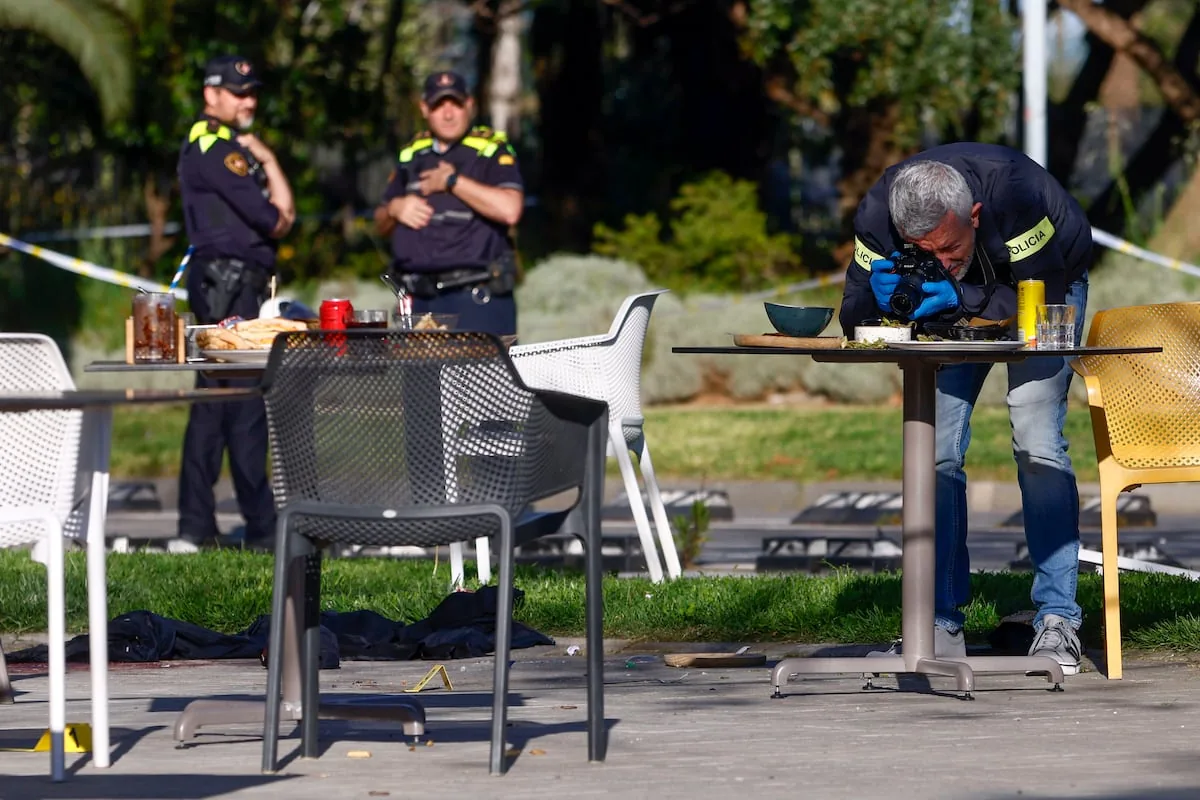
When a Skaljari hitman shot Filip Knežević from the Kavac clan in Barcelona, a rocket party broke out in Kotor. That city on the Montenegrin coast is the cradle of a war that has claimed between 60 and 70 homicides across Europe, according to sources from the Mossos d’Esquadra. And every time it happens, the fireworks echo. “There is a desire to display the dead, to publicize it,” explain those same specialists. In less than a year, the Catalan police are investigating two murders and two other attempts in the Barcelona area. The latest victim is Krsto Vujić, an alleged member of the Skaljari. The 44-year-old man remains hospitalized in serious condition after receiving two shots in the back while having a drink on a terrace with his wife and baby.
Read more The black eyes of Beatriz de Moura
The Kavac hitmen wanted to kill Vujic, just as they tried to kill Predrag Vujosevic in August. Both survived, a luck that another man shot in Castelldefels in December did not have. “But it’s not about cocaine, there’s a market for everyone. It’s pure revenge,” explain police sources. And they do so without sparing resources: from firearms used in Spain to explosives, like limpet bombs, used in Serbia. “If they want to kill someone, and locate them, they have the capacity to send people and enough money to cover all travel, hotel, and car expenses until they find the right moment to do it,” add the police sources, referring to “snipers.” This also complicates the investigation: “They leave no trace. These are very difficult investigations that require a lot of international information.”
Both organizations — which owe their names to the place of origin of their members — went from collaborating to killing each other across Europe in just three years. Their business is importing cocaine from South America. At first, they worked under a superior brand, the Kotor clan, like the city, and after 2011, with the fall of one of their leaders, with their own autonomy: the guys from each neighborhood — separated by a mountain and connected by a tunnel — formed the Kavac and Skaljari clans. The alliance worked until 2014. “The problems arise with a shipment of 200 kilos of cocaine, coming from South America and going to Valencia. The drugs were left in a place the Skaljari did not expect, and it was interpreted as a betrayal,” explain those same sources. The Serbian press delves into the fact that the drugs were deposited in a warehouse, and when the Skaljari discovered it, they took them away disdainfully. That sparked a war, which claimed its first victim in 2015: Goran Radoman, from the Skaljari.
Read more Bad Gyal confesses to Rosalía on an ordinary Friday in Barcelona
Although most victims are executed in the Balkans area, their dispute has spread to Germany, Austria, the Netherlands, Greece, Ukraine, Turkey… and also Spain. The international ties between the Serbian police and the Mossos d’Esquadra allow outlining the current scenario in Catalonia, where criminals do not only shelter from justice or war in their country. “Ports are very important,” explain the specialists. “Drugs enter through them. Then they have to be distributed and moved out. And this is controlled by the criminal structure,” they elaborate. That is why they settle in the territory, with false documentation, and even weave a family life and a minimal social network, with which they try to go unnoticed. An operation they repeat in Valencia or Andalusia.
The Mossos d’Esquadra locate their first investigations against the Skaljari and Kavac clans in 2017, which have led to the dismantling of some of their factions. Last October, the Mossos and the National Police, in an operation with the Serbian police, arrested 13 people linked to the Kavac. “There is not a year without incidents,” explain police sources about the criminal activity of both groups. And despite the four homicides (two attempted) in less than a year, they do not consider that the war between them has intensified. It is a sustained conflict over time, heated, in which “a friendly end is not foreseen.”
Read more A cable theft cuts the R3 Rodalies line between La Garriga and Ripoll