




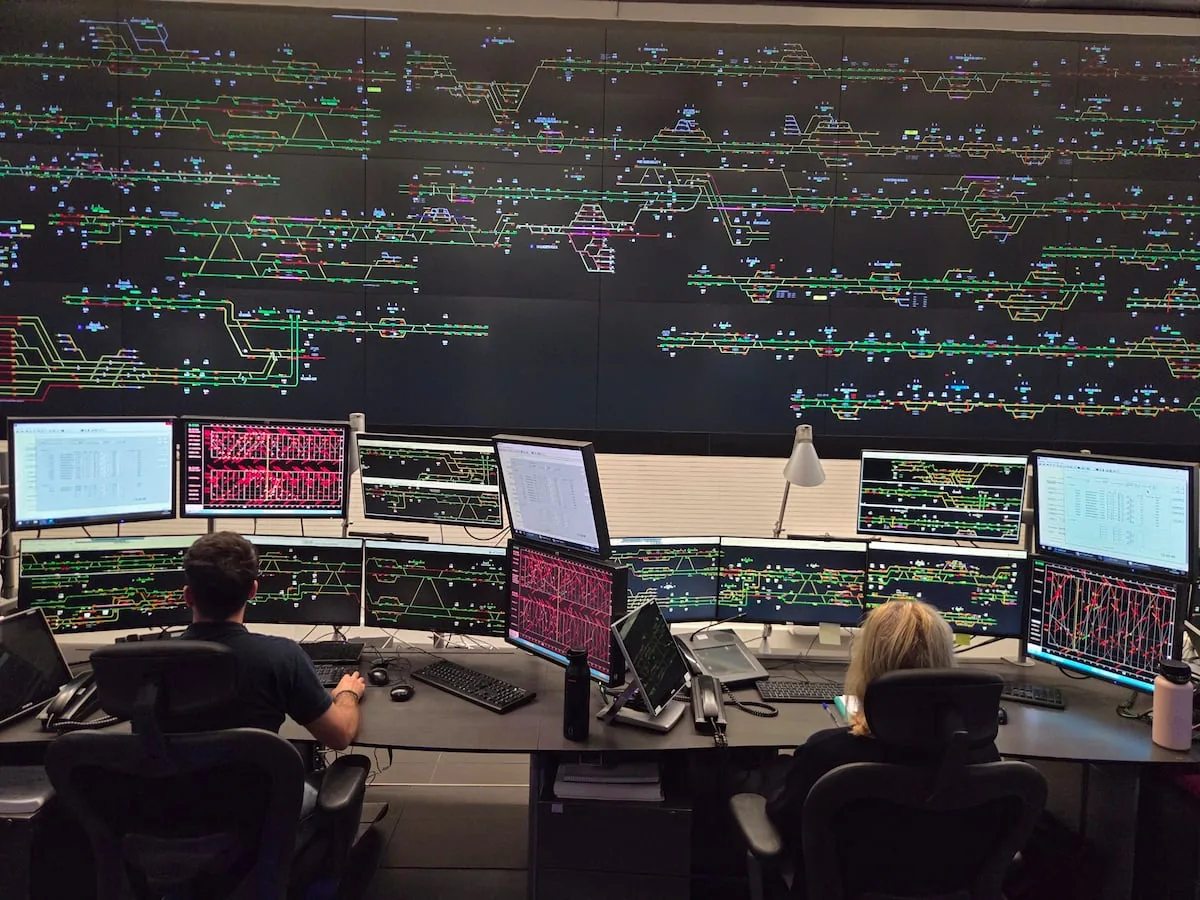
The Traffic Regulation Center (CRC) is a high-security building located at Barcelona’s Estación de Francia from where Adif controls the infrastructure, signals, tracks, and catenaries of the Rodalies de Cataluña network. There, in a kind of windowless bunker and in a high-security space, 20 people – per shift – supervise train traffic and are responsible for prohibiting train circulation on certain sections of the lines and activating signals and traffic lights. Among these people are 14 traffic managers who oversee the Centralized Traffic Control (CTC). Each of these technicians supervises a part of the network and is the top person responsible for that section. Supervision is carried out through a computer system created by Siemens, which is also used by Metro and Ferrocarriles de la Generalitat. The Rodalies CTC system has failed on three occasions – September 2022, July 2025, and last January 26 during a crisis – the last time due to a failure in the software update. Each time the system fails, all trains automatically stop for safety, leaving the entire network paralyzed. Adif cannot guarantee that the Siemens software system failure from last January will not happen again, although it supervises the software company that created it. In the midst of the Rodalies crisis, the public railway infrastructure company showed the media on Friday the operation of the CRC that controls commuter trains. One of the problems of this operations center is that the systems do not detect (unless the catenary is broken) if trees have fallen on the tracks or if a landslide has occurred until the driver directly encounters the obstacle. A dangerous incident, especially when authorities have admitted a lack of track maintenance.
Read more 091 transcend that 20th century they declared dead
The Rodalies network exceeds 150 temporary speed restrictions this Friday as three months pass since the Gelida railway accident. Many of these restrictions are caused by slope repairs or tree felling. Maintenance work that was not carried out when it should have been, causing the network to collapse, especially considering there are no detectors for these types of objects on the tracks, making circulation very dangerous.
While tunnel and infrastructure repairs are underway, Adif has launched a new transparency process and showed the media on Friday the inner workings of its Traffic Regulation Center. A center that has another identical facility at Sants station but remains closed. “If one day there is a fire or an attack, the technicians here will go to Sants and there we will be able to continue operating the tracks and trains,” warns an Adif source. On January 26, when the system failed, they did not manage to move to Sants. Initially, the Minister of Transport, Óscar Puente, did not rule out a cyberattack. Later, it was discovered to be a software failure. The problem was that this failure caused the control center to lose visibility of how and where trains were moving, so circulation was automatically stopped.
Read more Stephen Curry’s Warriors miss the playoffs and foresee the end of an era
The system could fail again at any moment, but Adif assures that systems are updated daily and the software company continuously supervises the programs. The problem of trees, rocks, and landslides on the train tracks is currently undetectable by the system unless they take down the catenary. Cable thefts are detected, as they cause a system cut and directly stop train circulation.
Read more The Kavac-Skaljari war: killing and celebrating it with fireworks