









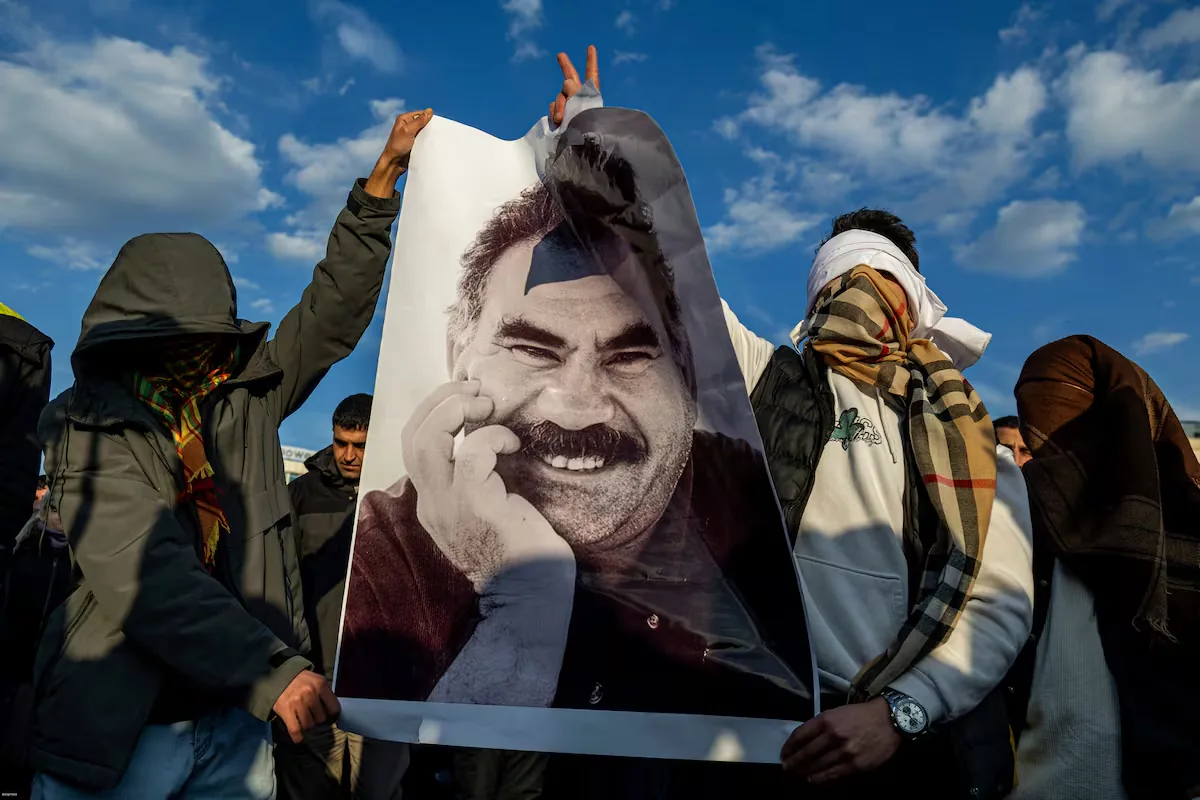
Although slow, the peace process between Turkey and the Kurdish armed group PKK is advancing with steps that, until a few years ago, were unimaginable and that put one of the bloodiest conflicts in the Middle East on the path to resolution. The latest of these steps — and one of the key ones in the roadmap — was the entry into force last night, through its publication in the Official State Gazette, of the law that will allow the return and reintegration into Turkish society of the thousands of fighters of the Kurdistan Workers’ Party (PKK) who are imprisoned, in the mountains (in Turkey, Iraq, or Syria), or exiled in Europe who do not have blood crimes. It is not an amnesty, but almost.
After endorsing the law, President Recep Tayyip Erdogan called it an “important step for Turkey’s peaceful, prosperous, and secure future,” and explained that his government will continue “managing the [peace] process” taking into account “the sensitivities of the entire nation, especially the families of the martyrs and veterans,” referring to the dead and wounded in the fight against the PKK, a group still included in the list of terrorist organizations of Turkey, the United States, and the European Union.
“We believe this law will have enormous effects on Turkish politics in the medium and long term, and that it will strengthen the foundations of democratic politics,” said Tulay Hatimogullari, co-president of the Peoples’ Democracy and Equality Party (DEM, pro-Kurdish) in an interview with the online media Bianet.
More than four decades of fighting, since the PKK took up arms against the assimilation policies of the Kurds in Turkey and the Turkish security forces responded with harsh scorched earth policies and dirty war, have caused more than 40,000 deaths and thousands of disappearances, plunging much of the southeast of the country into violence and poverty.
After the failures of previous initiatives in 2009 and in the 2012-2015 period, which led to a worsening of the conflict, these negotiations began behind the scenes in autumn 2024 after a handshake between the leader of the Turkish nationalist far-right, Devlet Bahçeli, an ally of President Recep Tayyip Erdogan, and the representatives of the main Kurdish party in the Turkish Parliament. This was followed by an unexpected speech by Bahçeli himself — until recently the most aggressive politician against Kurdish nationalism — proposing improvements in prison conditions or even the eventual release of the founder and ideological leader of the PKK, Abdullah Öcalan, imprisoned on the prison island of Imrali for almost three decades and considered the country’s “number one terrorist.”
They continued, during last year, with Öcalan’s historic statement in which he renounced armed struggle and called for the dissolution of the PKK, which the group approved at a Congress in the Kandil mountains in northern Iraq, where it has its central bases, and with the symbolic start of disarmament in July. After many delays and postponed debates, Parliament approved on August 10 the so-called “Framework Law” (officially “Law for the strengthening of national solidarity and social integration”), with the affirmative vote of 467 of the 561 deputies present.
The new law will allow the return home of PKK militants accused of being members of a terrorist organization, participating in terrorist activities, and even financing a terrorist organization, as long as they have not been involved in homicides or attempts thereof (including those currently serving sentences).
Crimes will not be directly pardoned, but members of the armed group will have to appeal to the courts, which will postpone the judicial process between 5 and 10 years depending on the severity of the charges they face. After this period, if the former guerrillas do not commit any crime included in the anti-terrorism legislation, their cases will be dismissed.
The implementation of these provisions will, however, be subject to the supervision of a committee chaired by the Turkish vice president, and composed of the ministers of Justice, Foreign Affairs, Interior, and Defense, as well as the heads of the secret service and the National Security Council. This committee must certify that the PKK is disarming as promised to authorize further advances and will begin operating next Monday.
Hopes and political calculations
Excluded from this law are crimes committed before June 1, 2005, that carry life imprisonment, a way to exclude Öcalan and the historical and active leaders of the PKK from the benefits, for whom a separate arrangement will be sought, given the thorny nature of the matter. Precisely because of this, one of the commanders of the armed group, Murat Karayilan, said in statements to the Kurdish media Mezopotamya that while “this law is a new and valuable step, it has many deficiencies,” such as, first, not addressing Öcalan’s situation, and second, that “not even the word Kurdish is mentioned in it.”
According to the PKK leaders themselves, they were surprised that Öcalan, in his directives to the group, renounced not only independence or autonomy solutions — something he had already given up years ago — but even claiming cultural rights in exchange for ending the armed struggle. In fact, within the framework of the negotiation, rights that have traditionally been a battleground for the Kurdish nationalist movement, such as the official status of the language or education in the mother tongue (in Turkey, an extremely nationalist and centralist country, only the official use of Turkish is allowed), have not been addressed.
Nevertheless, the new law has raised great hope among the Kurdish population of Turkey, since, in addition to the return of relatives who have been in the mountains for decades, it opens the possibility that thousands of people — political militants, activists, journalists, artists — convicted under the accusation of belonging to or propaganda for a terrorist organization will be released from Turkish prisons after the review of their sentences, including the popular political leader Selahattin Demirtas, about to complete a decade behind bars despite the rulings of the European Court of Human Rights in favor of his release.
Already during the last year, hundreds of Kurdish prisoners, especially those who are ill — including former PKK fighters — have been released through various legal maneuvers, although it has almost always been done quietly to avoid raising an uproar, according to a source close to the Kurdish movement who spoke to this newspaper.
No one fails to see that behind this peace process there is a careful political calculation by Erdogan, who in the last ten years has had to incorporate more and more political groups (usually to his right, but also some to his left) into his governing coalition to counteract the erosion he has suffered in popular support. And now that his government’s repression is targeting the main opposition party (the social-democratic CHP, intervened by the judiciary, which has caused one of the most serious splits in its history), he has extended a hand to the Kurdish movement, until recently the main target of arrests, imprisonments, and removal of their elected officials, in order to co-opt their voter base.
PKK leaders are aware of this. “Yes, it may be a tactical game [by Erdogan’s government]. We do not rule it out […]. However, even if it is a tactical move, does it open the way to political changes? Does it create the opportunity to do new things? That is how we see it,” said PKK leader Duran Kalkan in an interview with the Turkish media Medyascope at the end of July. “We have made a strategic turn. I can say: there will never again be a war [against Turkey] like the one in the past, unless we are attacked again,” Kalkan emphasized.
Read more A new 4.8 magnitude earthquake shakes Granada and leaves three people with minor injuries