









The Ministry for the Ecological Transition is tendering the works for the main section of the adaptation of the La Saleta ravine, one of those that overflowed during the tragic DANA of October 2024, with the aim of preventing flooding in several municipalities of l’Horta Sud, in the province of Valencia. Companies will have until September 22 to submit their bids, and the first works on the ground could begin before the end of 2026, according to calculations by the Júcar Hydrographic Confederation (CHJ), the project drafter.
The action will allow progress in solving a historic problem affecting municipalities such as Aldaia, Alaquàs, Xirivella, Quart de Poblet, and Valencia. The overall intervention will involve an investment of about 150 million euros and will provide a hydraulic outlet for the ravine’s floods towards the new channel.
The tender corresponds to the main section of the intervention, between Aldaia and the greenway, with a tender budget of 132 million euros, VAT included. This project concentrates most of the planned works to channel the ravine’s flows towards the Turia.
The project foresees a four-kilometer underground conduit, which will run through the northern area of Aldaia and will be formed by large reinforced concrete frames. One of its most complex points will be the crossing under the Valencia-Utiel railway line, which will be resolved by underground piling to avoid interrupting train traffic.
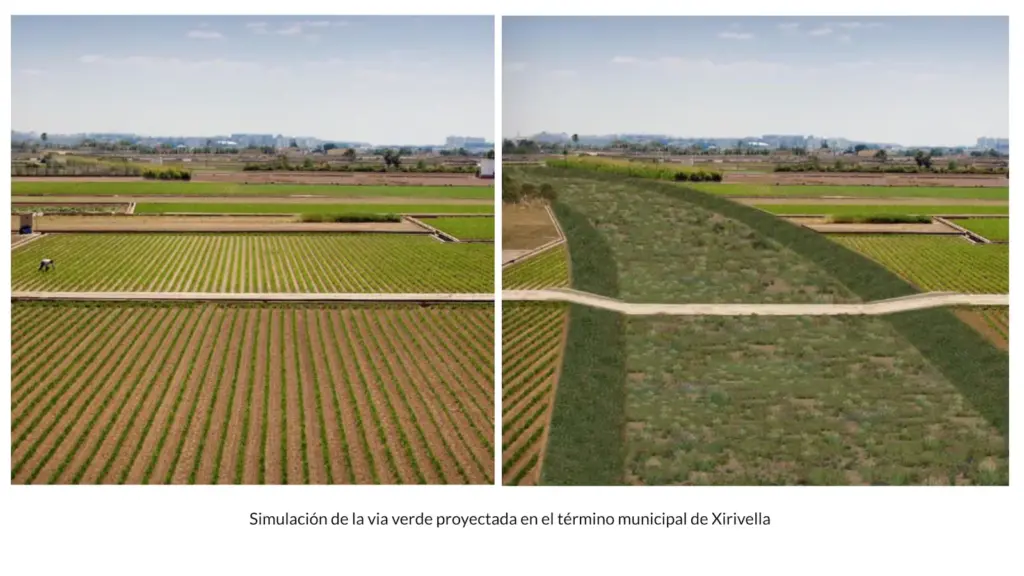
The flows will continue their course through a hydraulic greenway of nearly three kilometers, an open section integrated into the agricultural landscape of the orchard that will allow water to be channeled to the vicinity of the new Turia channel.
The overall solution for the La Saleta ravine has been structured into two separate projects. To the main section now being tendered is added another aimed at executing the definitive connection with the new Turia channel under the V-30. This second project has an approximate budget of 14 million euros, has already been technically approved, and its tender is expected soon.
The independent execution of this last section is due to its special technical complexity, as it will be necessary to cross the V-30 to safely incorporate the flows into the new Turia channel. For this, the action is being developed in coordination with the State Road Demarcation of the Ministry of Transport and Sustainable Mobility.
Over the years, the La Saleta ravine has lost much of its natural channel due to urban growth and various infrastructures built over time, leaving it without an effective outlet to the Turia River, its natural outlet, which has caused frequent and severe flooding in the urban areas of Aldaia, Alaquàs, Xirivella, Quart de Poblet, and Valencia, the most recent being the DANA of October 2024.
Although the proposed solution had been developed for years, this last episode of extraordinary flooding advised a complete review based on new hydraulic studies carried out by the Center for Studies and Experimentation of Public Works (CEDEX).
The data obtained through hydraulic modeling techniques have allowed verifying the infrastructure’s behavior under extreme scenarios and improving the initially planned design. In fact, the capacity of the main conduit was increased from the initially planned 80 m³/s to 100 m³/s, also allowing the incorporation of another 30 m³/s from the urban section of the ravine.
The first piece of the system will be a diversion structure located around the CV-410 and the accesses to Aldaia and Bonaire, responsible for regulating and distributing the flows from the ravine towards three infrastructures: the CV-410 ditch itself, which has a capacity of over 15 m³/s; the channel that crosses the urban core of Aldaia and whose expansion is being carried out by the City Council of this municipality; and a new underground conduit that subsequently leads to the greenway, with a capacity of 100 m³/s.
This project constitutes the first major action against flood risk in the Poyo ravine basin, which will be complemented by a series of upstream projects that will reduce circulating flows and will provide a comprehensive solution for the basin, as set out in the Plan for the Recovery and Improvement of Resilience against Floods in the territory affected by the DANA in the Valencian Community.