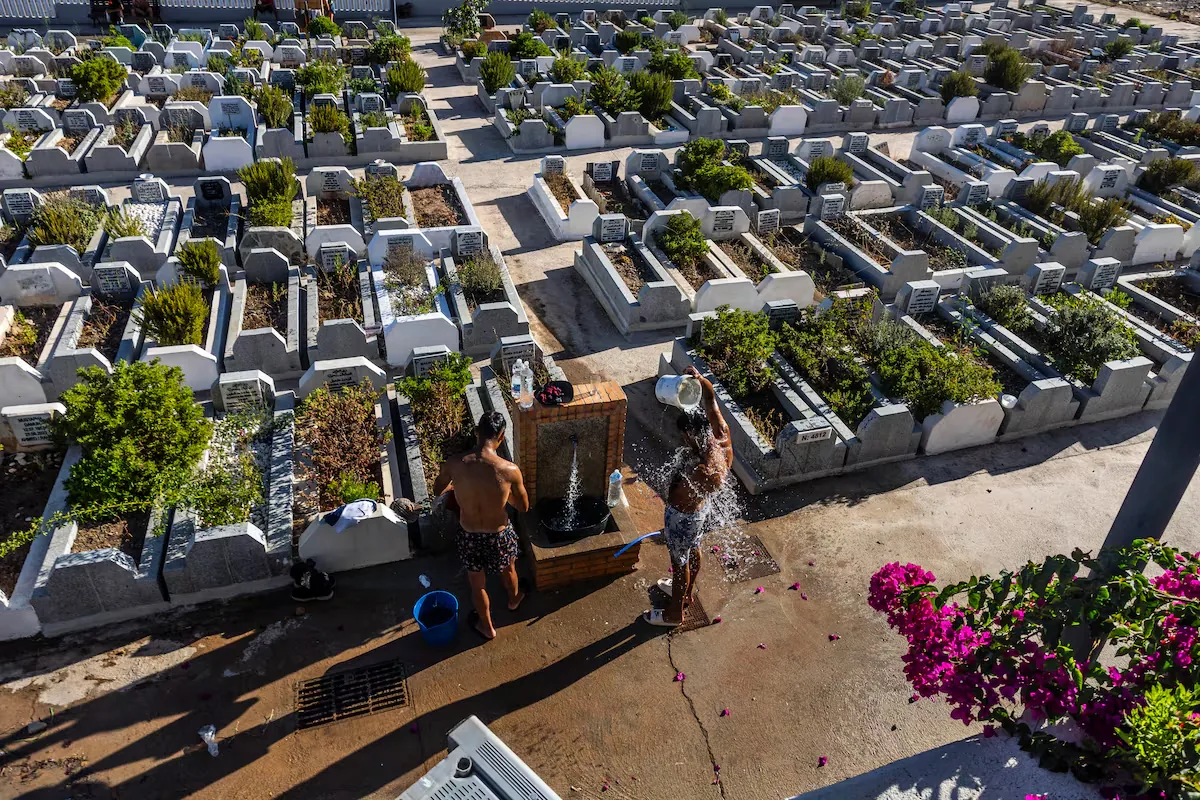
The burials of the 76 unidentified victims from the mass arrival of immigrants to Ceuta through the El Tarajal border, recovered from the sea between July 30 and 31, are expected to begin this week. Ceuta’s Minister of Health and Social Services, Nabila Benzina, is finalizing preparations these days to give a dignified end to the migrants who have not yet been identified and who can no longer remain in the large morgue that was urgently set up in the old military hospital of Ceuta, where autopsies were performed. The plan is for them to occupy a designated area of the Sidi Embarek Muslim cemetery, which has already undergone several expansions, and to be buried in batches, depending on resource availability, Benzina details.
The influx of migrants that overwhelmed the autonomous city 20 days ago caused the death of 82 people trying to swim from Morocco, most of whom drowned as a result of that same stampede, between the attempts of many who did not know how to swim and their desperation to climb the border breakwater and reach safety. Of the 82 victims, mostly middle-aged men and one woman, six have been identified and procedures are underway to repatriate their bodies to Morocco, the minister says.
The rest will be buried, identified by a number containing the little history known about them, such as the date and place where they were found, the clothes or belongings they carried, or their most relevant physical characteristics. The mortuary health consensus guide recommends that bodies be kept refrigerated for a maximum of six days and frozen for 21. The large chamber built from scratch in the old military hospital to house the bodies has refrigeration that keeps them between two and five degrees, but does not reach freezing; therefore, this situation cannot be delayed any longer. The burial orders have already been issued.
There is little expectation that, if the victims are identified, an exhumation will occur and they will return to their countries of origin. From the experience in Ceuta, families of deceased Moroccans or sub-Saharan Africans who died trying to reach the city by swimming usually do not claim their remains, although there have been cases of victims of Algerian origin who have been repatriated.
The burials will follow the Muslim rite, which includes washing the bodies and shrouding them in clean cloths, something already practiced during their autopsies, and burial oriented towards Mecca.
“The beach water is fine”
The arrival of such a large number of migrants, 80,000 according to the latest figures, and the refusal of about 7,000 people who live in the streets to leave the city has led Benzina’s area to also increase its efforts in public health care in recent weeks. “Healthcare personnel from other areas are supporting public health to carry out all epidemiological efforts,” the minister details. “By royal decree, we have to analyze the waters of bathing areas (…) and to date, they are fine.”
The city has expanded the examination of the ten or eleven beaches considered bathing areas and also analyzes other coastal areas not included in that registry, such as El Trampolín beach, where one of the main settlements of irregular migrants has been established, located on the outskirts, or Fuente Caballo beach. “We are also checking all the irrigation parts in the city, where I am informed there may be contamination, any irrigation system they might drink from. We are analyzing everything,” she details.
Public health personnel work on the street, together with Médicos Mundi. “We have bought more vaccines, more tuberculin to administer to people. We are reinforcing everything within our capabilities.”
The minister acknowledges complaints about infections but emphasizes that while migrants are not located in a resource, it is very difficult to carry out health control. “Until we have a located place for these immigrant people, we cannot provide treatment, especially for infectious diseases,” she justifies. Regarding scabies cases, 24 military cases and one police officer case have been reported; she notes it is something “common in overcrowding situations,” like the one occurring in the city. “It is not a deadly disease, but it is very annoying and contagious. It spreads from one to another, but it is very treatable,” she reassures.