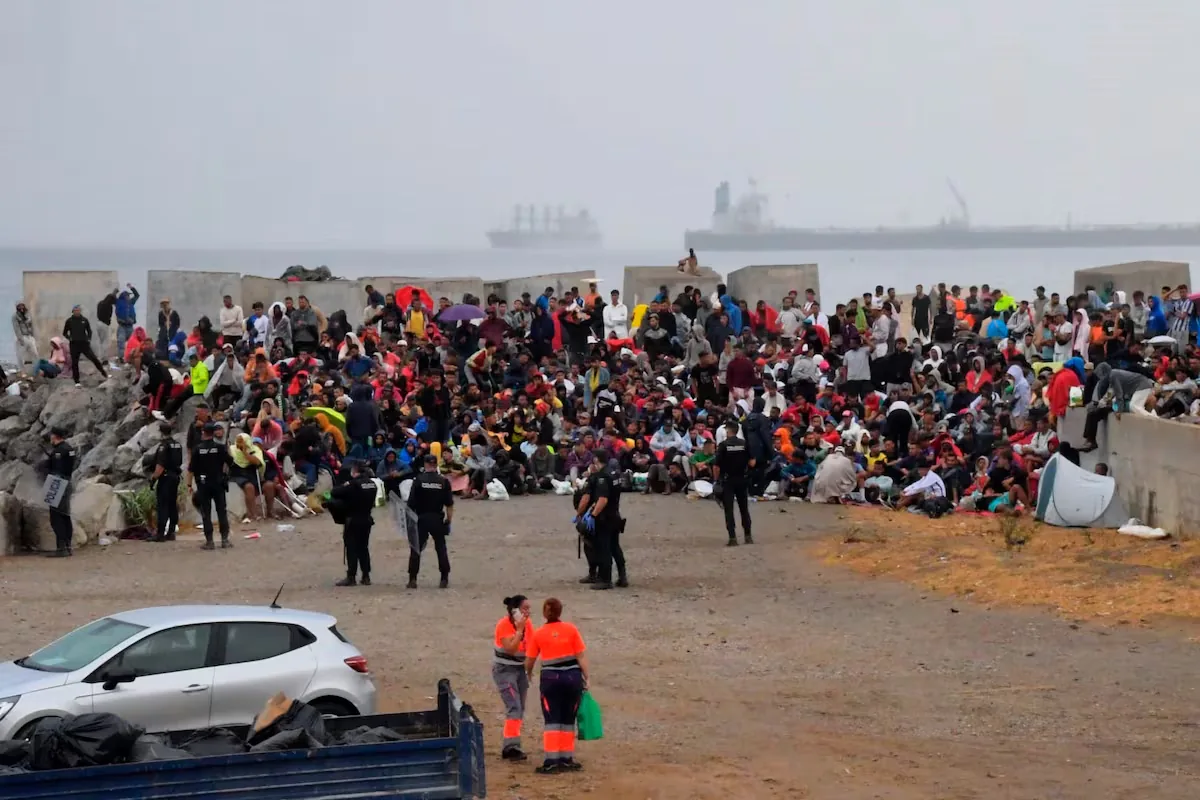
Hours-long journeys in small boats, at night, overcrowded and without life jackets or safety measures. A painful and dangerous trip, but also very expensive to go from Ceuta to the peninsula. Human trafficking mafias have found in the massive entry of thousands of migrants in Ceuta on July 30 and 31 a goldmine to increase their already lucrative business. The National Police have arrested in recent days five alleged members of two criminal groups who charged up to 9,000 euros to those irregular migrants who want to clandestinely cross the Strait of Gibraltar to reach the Andalusian coasts, according to the Ministry of the Interior on Friday. The latest official estimates put the number of migrants remaining in Ceuta at 5,000 out of more than 80,000 at the end of July. Of these, more than 2,000 are minors.
Read more The US Drug Enforcement Agency joins the investigation into the death of actress Hayden Panettiere
In one of the operations, agents arrested two people in Ceuta and two others in La Línea de la Concepción (Cádiz), all male and Spanish nationals, according to police sources. They are charged with crimes of criminal organization and facilitation of irregular immigration. The fifth arrested is accused of participating in the transfer on the night of August 14 of seven people in a boat only five meters long and two meters wide that ran out of gasoline halfway through the journey and barely reached a beach near the same town in Cádiz. The judge has sent this last one to provisional prison due to the serious risk to the victims’ lives.
The investigation that led to the dismantling of the first organization began after the police located a boat known as a “speedboat or hull,” also used for drug trafficking, stranded on a rocky outcrop in the coastal area of Benzú, just across from where the El Tarajal breakwater is located, where the massive entry in July occurred. The inquiries revealed that the boat, which showed marks and damage characteristic of high-speed navigation, had recently been used to transport immigrants, although the damage caused by running aground had rendered it unusable.
The Police confirmed that the boat belonged to a human trafficking organization operating since before the massive entry in July between the autonomous city and La Línea de Concepción. The town in Cádiz was, in fact, its operations center, from which it sent shallow-draft boats to Ceuta to pick up irregular migrants and take them to the peninsula. For this, it had members in the African city responsible for recruiting those people who, coming from the massive entry, were willing to pay significant amounts of money ―up to 9,000 euros― to cross the strait.
Read more Russia raises tension with Japan by confirming missile tests in the Kuril Islands
The migrants who accepted were taken to homes, garages, and other places of the organization while waiting for a network member to transport them by vehicle to the coastal place where they were to be boarded. In these transfers, the network took security measures, such as avoiding police surveillance areas, which have been heavily reinforced in recent weeks due to the migration crisis. Once the boat that had left the Cádiz coast arrived, the migrants boarded and were immediately taken to the peninsula, where other members of the organization were waiting for the victims for their subsequent dispersal on land. To drive the speedboats, the network hired specialized pilots “in fast navigation” with experience in “performing evasive maneuvers and avoiding police controls,” according to the National Police in their statement. For this role, they charged “high” amounts of money.
The second investigation began on August 14, when at 4:00 a.m. a small boat carrying seven people crowded together arrived at El Burgo beach, near La Línea de la Concepción. According to what they told the agents, they had started the trip before midnight and had spent about five hours in a sea covered by dense fog, with intense cold and clothes soaked by the waves entering the boat. The journey became even more painful after drifting when the fuel ran out. They did not have life jackets on board despite almost none knowing how to swim. For all these reasons, the only detainee is accused of a crime against the rights of foreign citizens aggravated by profit motive, the special vulnerability of the victims, and the danger to their lives.