









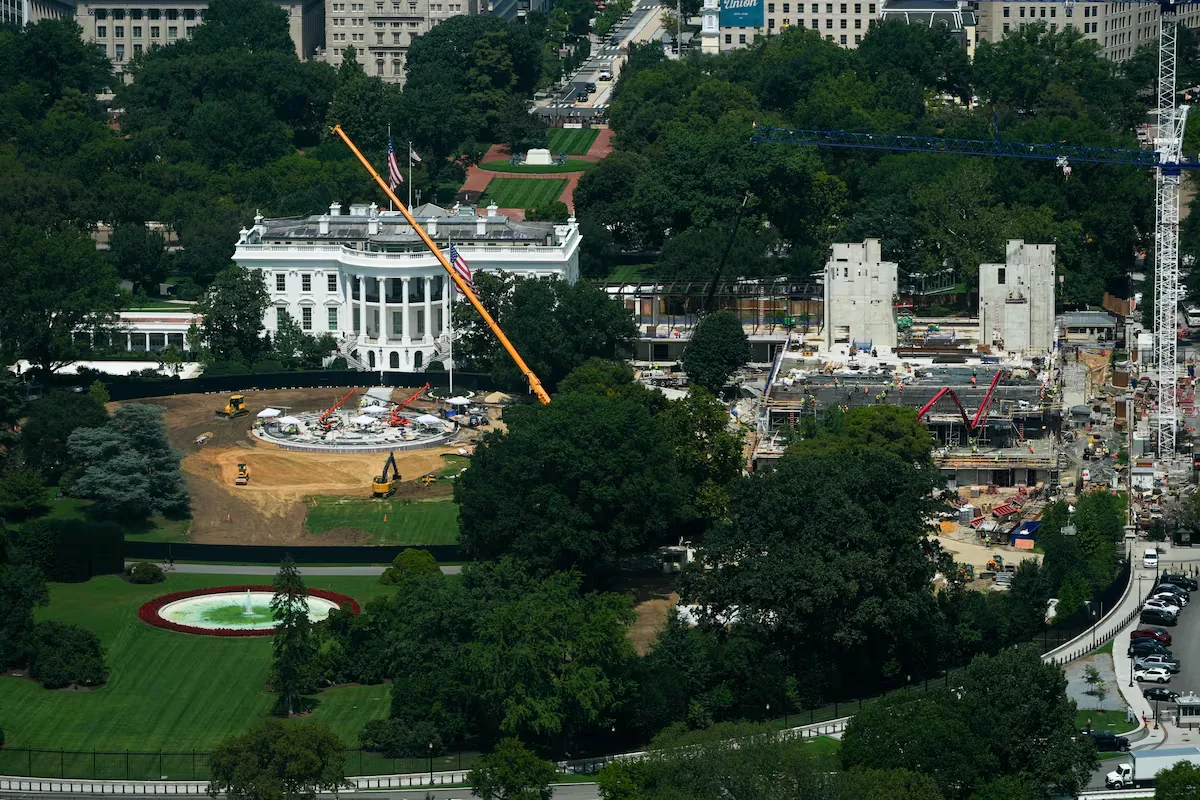
The Supreme Court has allowed, for now, the advancement of the construction of a ballroom so large that it would exceed the size of the presidential residence in the White House. The decision comes after the Government accelerated the works at a dizzying pace with the aim of bringing them to a point of no return despite the litigation over whether the president exceeded his authority by circumventing Congress’s approval.
Read more Paz dismisses his Minister of Economy under pressure from the Bolivian Assembly
“After considering the request of the applicants’ attorney (…) it is ordered that the preliminary injunction issued on April 16, 2026, by the District Court for the District of Columbia be paused until further order from the Chief Justice of the Court,” wrote John Roberts.
The determination was brief, as the matter was heard in the high court’s so-called emergency docket, where judges usually do not offer extensive reasoning for their decisions. The matter escalated to the Supreme Court when the Government asked it to pause a lower court’s block, which was scheduled to take effect this Friday.
The judicial controversy began when Trump demolished the East Wing of the White House last year to build the approximately $400 million activity hall, and the National Trust for Historic Preservation, a non-profit organization whose mission is to protect historic buildings, sued to try to block the new construction.
Amid the litigation, the Administration added a military complex to the project, on which Attorney General John Sauer focused much of his arguments before the Supreme Court. He said the bunker would extend for the equivalent of five stories underground with missile-resistant columns and beams; and that it has the “most resistant cement available, the type used in nuclear power plants: waterproof and virtually impossible to remove.”
Citing Secretary of State Marco Rubio, the attorney insisted that what the Government considers an “absolutely critical” project must be allowed to continue, not only for the physical security of guests, but also so that the United States can advance its diplomatic relations and interests. Sauer also reinforced his position with words from the Director of National Intelligence, Jay Clayton: “Any delay substantially increases the risk of malicious actors collecting intelligence on the complex,” which would allow them to “destroy the facility more easily in the event of armed conflict.”
The White House is “property of the American people”
On the other side of the controversy, the National Trust for Historic Preservation urged that work be stopped until the Government obtained Congress’s approval to so significantly modify what “is perhaps the most revered place in our country. (…) Property of the American people.”
It argued that Trump “has no unilateral legal authority, given to him by the Constitution or any law, to build an enormous ballroom where the demolished East Wing once stood. And every court has told the petitioners [i.e., the Government] in clear terms that they must halt their illegal construction unless they have received express approval from Congress.” “The petitioners, however, insist on continuing construction no matter what anyone says,” the organization added.
The trust emphasized that the appeals court’s halt contemplated stopping the construction of the ballroom, but not that of the military complex. That is, it applied only to what was built above ground.
The appellate court’s determination “expressly allows petitioners to continue building their underground military facility to protect the president, his family, and his staff, and to maintain the security of the White House complex,” it specified in its brief to the Supreme Court. It is a bunker that would replace the Presidential Emergency Operations Center (PEOC), which was built during World War II and was located beneath the East Wing.
“Even fully accepting the petitioners’ security claims, any harm that a delay of weeks or months (while this court resolves the matters presented) of a project that will not be completed for years may cause is vastly outweighed by the irreparable harm that the completion of a structure in the White House that the petitioners themselves assert will be ‘virtually impossible to remove,’” it noted.
Read more Why is a man being tried for the murder of rapper Tupac Shakur 30 years after his assassination?