









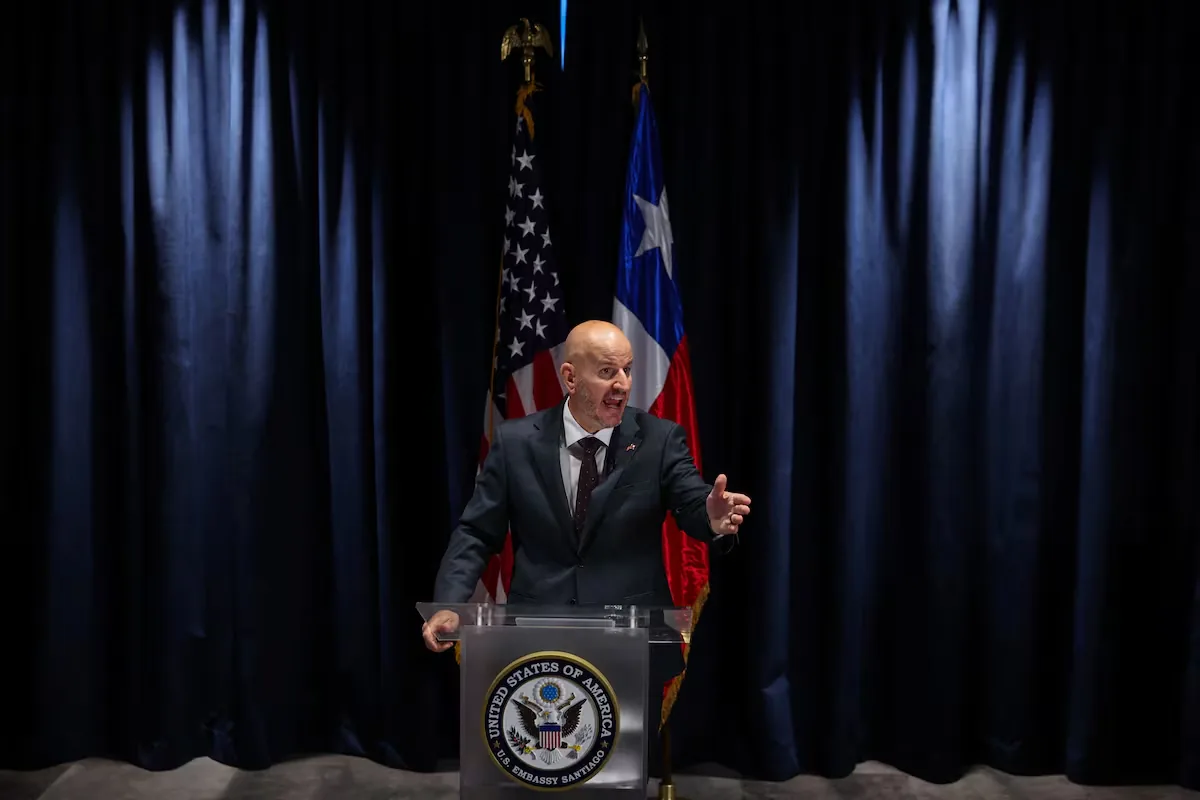
The United States ambassador to Chile, Brandon Judd, released this Friday the Joint Security Declaration of the Conference of the Americas against Cartels, promoted by the Donald Trump administration, signed by the Chilean Minister of Defense, Fernando Barros. The document, previously unknown, reveals that the Secretary of State of José Antonio Kast’s administration signed it just one day after taking office. The publication comes amid Washington’s pressure for Chile to formally join the Shield of the Americas initiative and the Western Hemisphere Joint Task Force (JTF-WHEM), and just days after Barros himself responded to the US that Chile “is not the backyard of any country.”
Read more Three personal postcards and a postscript from wounded Venezuela
The text released by Judd does not correspond to the original agreement signed in Doral, Florida, between March 4 and 5, during the Inaugural Conference against Cartels in the Americas, led by the United States Secretary of War, Pete Hegseth, and attended by defense representatives from 17 Latin American countries. Barros participated then as a future minister—he took office on March 11, when Kast came to power—and the Gabriel Boric government was not considered. Since it was not an official representation of the Chilean state, he did not sign the document at that time. However, one day after taking office, Barros signed the same text, according to the document now made public by the ambassador.
The declaration commits Chile to “expand multilateral and bilateral cooperation” in border security, narco-terrorism, drug trafficking, and protection of critical infrastructure, as well as to promote the formula “peace through strength” and “join a coalition to combat narco-terrorism and other shared threats” in the Western Hemisphere, the latter being its fourth and most controversial point due to the constitutional rules governing the Armed Forces. “Chile’s signing, on March 12, of the Americas Counter Cartel Coalition (A3C) Declaration reaffirms our commitment to deepen bilateral and regional cooperation against threats affecting our hemisphere,” Judd wrote this Friday in a message in which he described the evolution of the bilateral relationship in the fight against organized crime as positive.
The Ministry of Defense ruled out that the signature implies Chile’s incorporation into the coalition’s military operations and insisted that the document constitutes a “declaration of good intentions” or “interests,” not a binding agreement. The possible adhesion to the Shield of the Americas, according to the Foreign Ministry to local media, is still under evaluation. However, this was not the only precedent linking Chile to the security architecture promoted by Trump: on June 5, the South American country participated, along with 11 other countries in the region, in another joint declaration of the Shield of the Americas that supported the Bolivian government of Rodrigo Paz against blockades and protests.
International lawyer Paz Zárate warned on X that the publication of the document by Ambassador Judd is a “pressure” on the Chilean government, mixing two different categories: signing a political declaration of intent does not equate to legally committing to the Americas Counter Cartel Coalition, which would obligate Chile to participate in operations or modify its military spending.
Read more The Vatican bets on renewable energy with a large solar plant for self-sufficiency
The revelation comes after Barros publicly distanced himself from the Trump administration. The minister rejected in mid-August the Monroe Doctrine claim made by Hegseth by stating that “we are not the backyard of any country,” and defended that “sovereignty, legislation, both the Constitution and the laws of each country, are respected first,” specifying that the fight against drug trafficking in Chile falls to the police, the Public Ministry, and the corresponding state agencies.
The episode also adds to the trade dispute between the two countries: Washington applied a 12.5% tariff on Chile under the argument of insufficient monitoring of forced labor, a measure that affects about 40% of Chilean shipments to the United States and generated public criticism from Barros and the Minister of Agriculture, Jaime Campos, to which Judd responded by accusing them of ignoring the Free Trade Agreement in force between the two countries.
In Congress, deputy Gonzalo Winter (Broad Front) requested the Foreign Relations Commission to formally ask the Foreign Ministry to clarify the true scope of Chilean participation in the Shield of the Americas, while socialist deputy Nelson Venegas warned that if the explanations from Foreign Minister Francisco Pérez Mackenna are not satisfactory, the opposition could move towards an interpellation.
Read more A federal judge annuls the US visa ban on citizens of 75 countries