









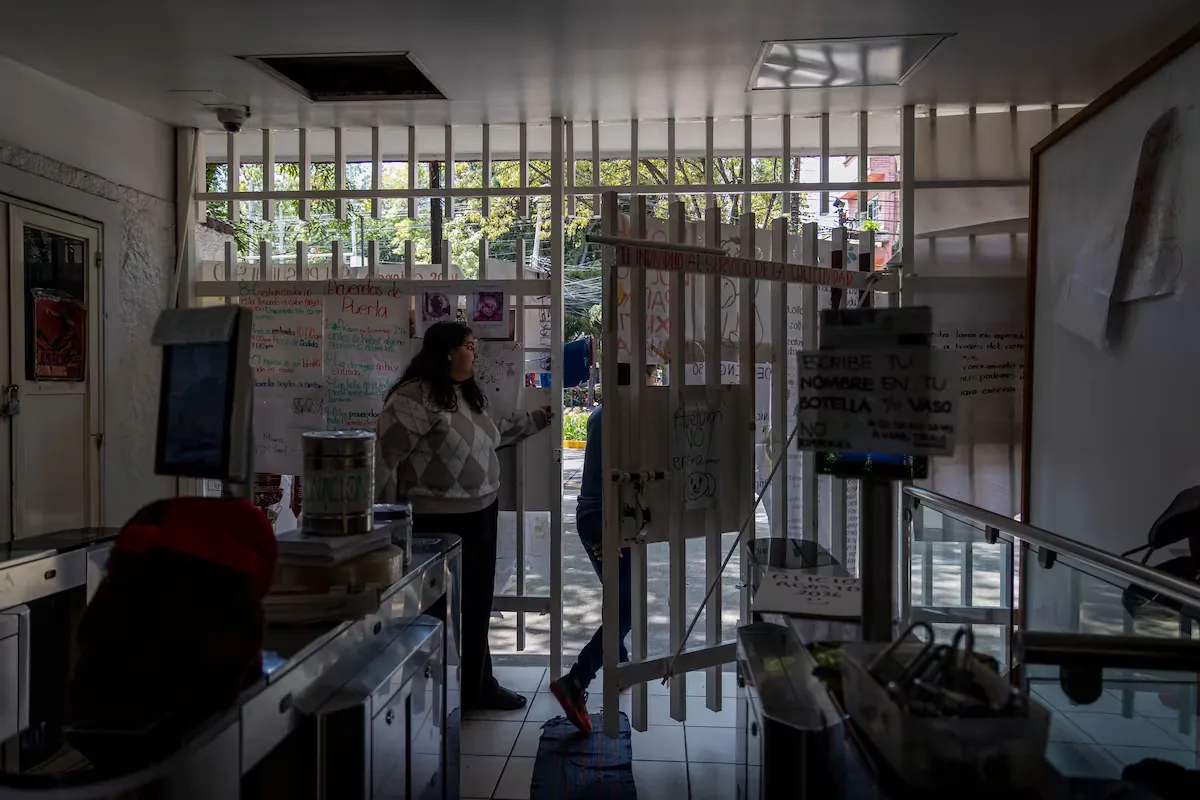
Janet Rodríguez was the first in her family to go to university. Originally from Hidalgo, she moved with great effort to Mexico City to study at the National Polytechnic Institute (IPN). She chose to be a Chemical Bacteriologist Parasitologist as soon as she knew something so fascinating existed. She is now 22 years old, in her eighth semester (only two left to graduate), and has been sleeping inside her school, the National School of Biological Sciences, for three months. She demands, like hundreds of other students, more budget for classes, teachers, and scholarships, more transparency in resource management, and the removal of the IPN director, Arturo Reyes Sandoval, and his team. Until the government guarantees them this and that there will be no reprisals against the students who protested, the doors of one of Mexico’s most prestigious scientific schools will remain closed. Not all Polytechnic students will return to classes this Monday.
Read more Fear of ICE hinders the rebuilding of areas devastated by wildfires in California
In short, the strikes at the IPN began in mid-May at eight schools. Students took to the streets, closed Eje Central, and occupied Canal Once for a couple of months. The government has already regained control of the public broadcaster, and only two schools, ENCB and UPIITA, where 12,000 students study, remain occupied. This is now the longest strike in the last decade. The students have endured the hardest part, the summer holidays, when many return home and there are fewer for rotations and shifts. Those who have stayed — like Janet, Yei, Nicole, or Hernán — have gone months without seeing their families, sleep on mats, and shower in the gym. Asked about their reasons for staying, the four mention, separately, the same thing: the importance of defending an education that is dignified for everyone.
“Mexican public universities are the main promoters of social mobility,” highlights Juan Manuel Flores Ayala, an expert in education monitoring and evaluation, who recalls that these institutions are the vehicle for students who do not have the resources for private education to have “well-prepared professional lives.” Thus, the Polytechnic was the great public university for technical and scientific categories in Mexico. “For many years, in the 80s and 90s, it was a benchmark. Currently, it has lost relevance in the center of the country compared to UNAM itself, but also compared to the Metropolitan Autonomous University or even private institutions like TEC,” points out Ayala, who is an independent consultant.
Behind this is the shadow of lack of resources. “There has never been a semester where I could complete all my practices without a but: ‘No, guys, there are no reagents,’ ‘no, guys, the material hasn’t arrived,'” says Nicole Valle, a Biochemical Engineering student. “I felt anger at not being able to have the quality education my parents wanted me to have, entering the lab and not being able to do the practices because there was no material,” Janet recounts from the Biological Sciences reception where she is now recording entries and exits: “I came to the conclusion that the only thing I could do was this, be here, support the movement.”
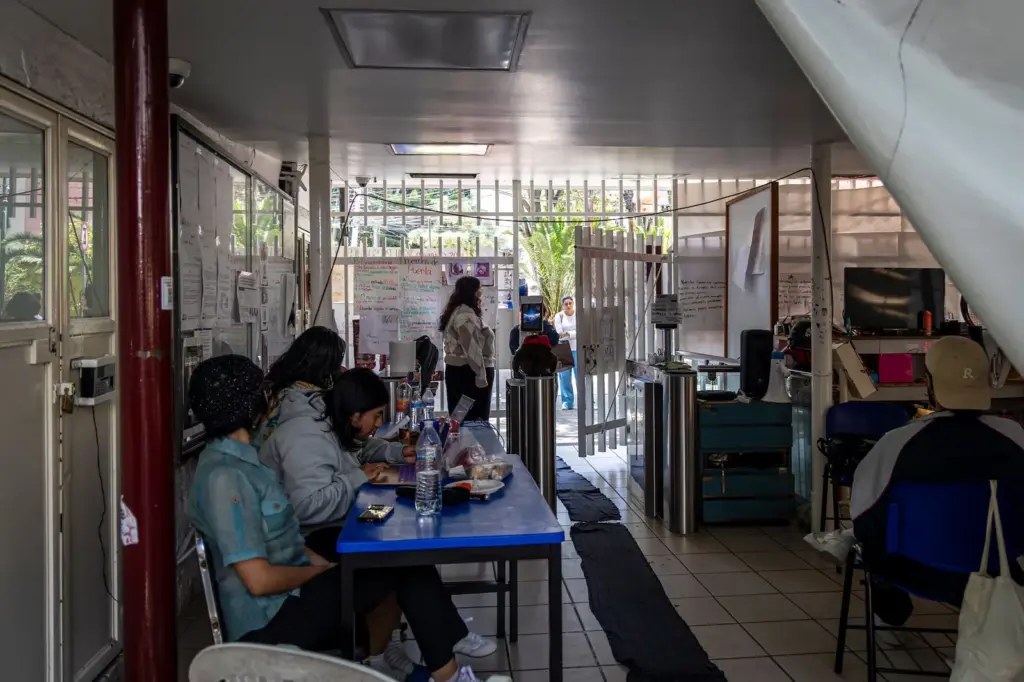
Students have submitted 10 requests to the Ministries of Education and the Interior, including the dissolution of the university’s private security force — called COPS — due to accusations of repression, or that cleaning and maintenance staff belong to the IPN and are not subcontracted, to ensure workers’ rights. However, most demands revolve around the budget. Students claim that the IPN management, led by Reyes Sandoval since 2020, has allowed the school to degrade and run out of resources while committing irregularities with public funds, especially after the creation last year of a board, Corazón Guinda y Blanco A.C., by him and his team to manage donations to the public university.
Reyes Sandoval’s former Secretary of Administration, Javier Tapia Santoyo, who had to resign last December, is linked to a legal process for awarding contracts to a shell company when he worked at ISSSTE. Reyes Sandoval himself faces a complaint at the Attorney General’s Office (FGR) for possible embezzlement, influence peddling, and illicit use of powers, as well as several investigations by the Internal Control Body, which depends on the Anti-Corruption Secretariat, according to Reforma and Contralínea. The Anti-Corruption Secretariat has not confirmed to EL PAÍS the opening of investigations.
The official has not commented on the accusations. President Claudia Sheinbaum supported the academic’s profile in May, calling him an “eminence,” and asked him to explain the management of funds. Reyes Sandoval thanked the president’s words on his X account and stated that his “conviction and commitment to the Polytechnic community is unwavering,” but did not explain the budget movements.
Education Secretary Mario Delgado announced at the end of May that the Corazón Guinda y Blanco Board would stop working with the IPN and that the relationship with the Politécnico Foundation A.C., with which the university had worked for 30 years until Reyes Sandoval dismissed it in 2025, would resume. The end of that link was due to the IPN accusing the Foundation — now chaired by businessman Vicente Gutiérrez — of using donation funds for “dark interests.” The Ministry of Education has not responded to this newspaper’s inquiry.
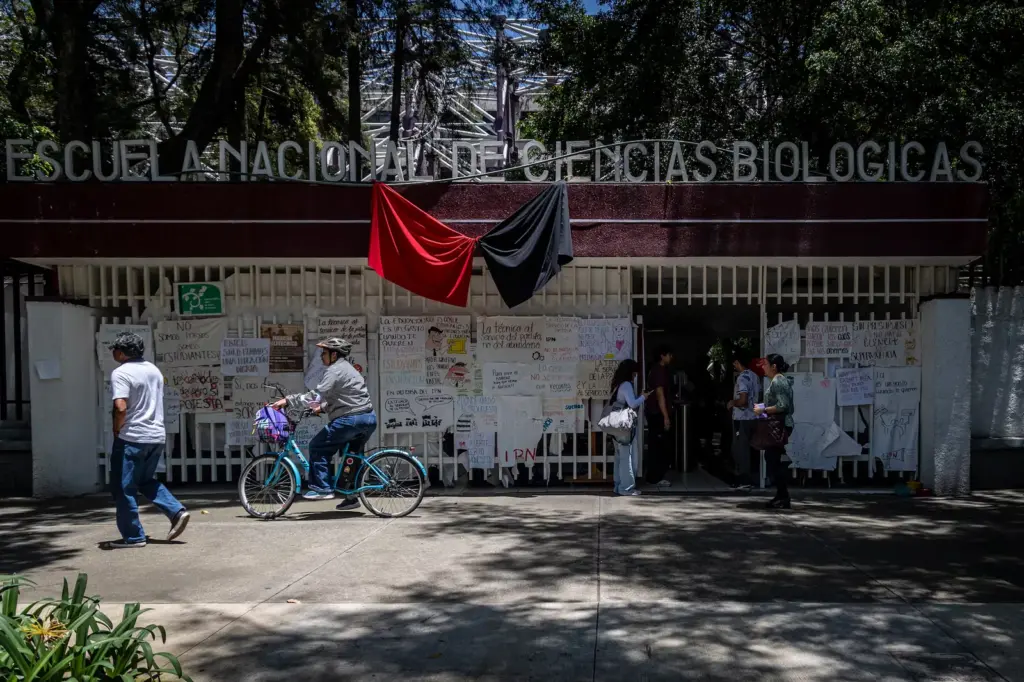
The Biological Sciences Struggle
From the precariousness of one of Mexico’s main technological universities, students give concrete examples. Of 30 microscopes in a class, only five work; there are no reagents, culture media, or cell strains for the labs; much of the material — donated — is expired; extraction hoods do not work; students or teachers have to buy lab coats, gloves, or masks; there is a lack of teachers with permanent positions, so many subjects are canceled even though the course has already started; none of the hundred cameras that should monitor the campus work; bicycles are stolen because entry sensors are not updated; they have to unclog drains themselves when it rains because the drainage does not work and the land floods; cracks still dominate, alongside the Siqueiros mural, the hall of the main building.
“These kinds of things put obstacles in the long term because yes, we are supposed to be learning, but you can’t learn much with material that doesn’t work,” reflects Janet Rodríguez, who would like to do research in a hospital after graduating. “That’s why we are asking for an emergency budget of 10.266 billion pesos: to finish schools, to pay all teachers, to give us scholarships, to get equipment updates, career certification, reagents,” explains 27-year-old Yei Morales.
In addition to that emergency fund, students ask to increase the Polytechnic’s general budget. The public university has more than 211,000 students in total, 18% more than eight years ago, and its resources (about 21 billion pesos annually) have barely been adjusted for inflation, which for students is not enough. “We want it to increase to 32 billion pesos because that would settle everything,” Morales says. “The lack of budget is evident as in all Mexican public universities, but more so at the Polytechnic, since it is not autonomous and that is a big disadvantage,” points out Flores Ayala, who considers that “budget exercise has become increasingly difficult to track.”
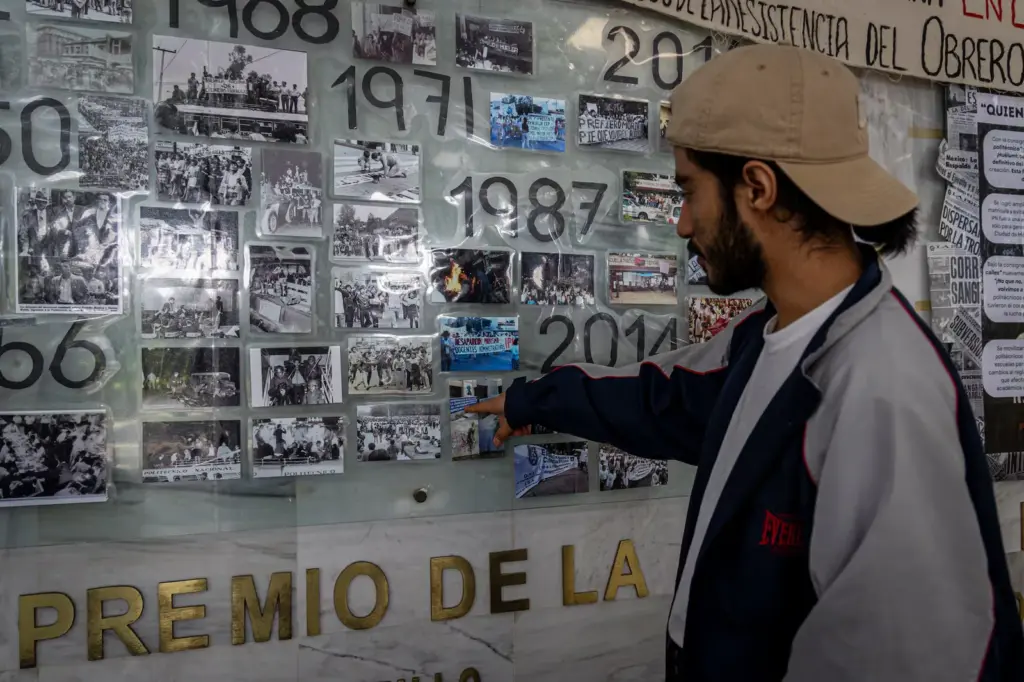
Thus, in the long story, the fight for education at the IPN began years ago. A walk through the National School of Biological Sciences evokes the students’ struggle: in that hallway, students were taken out during El Halconazo in 1971; the 2014 mural reminds that youth must stay awake to watch over tyrants, and this year’s mural values rebellion; from that wall, the names of general directors accused of corruption were torn off (only three remain); those blue tables and chairs are the result of when they demanded authorities that students should have places to gather, debate, and study, and the agora — now still empty — is the central space where assemblies take place in which the community decides the next steps.
Yei Morales reviews some of the fruits of previous protests: in 2024, they went on strike to create permanent positions for teachers because 80% were interim, and they succeeded. In 2025, they occupied the facilities for 25 days because they had gone eight months without paying the staff who checked entries, prepared labs, or fed the school’s animals, and they secured 80 million pesos for them. “Right now, they urgently want us to end the strike,” says Yei Morales, “because Biological Sciences is one of the most fighting schools, even our motto is ‘in battles and historic struggles.’ So they don’t want us to continue the strike on Monday, because that day, if other schools see we continue, others will join too.” The standoff between Reyes Sandoval, the government, and the students continues.
Read more Teleserie