The history of Western music has given us historic moments in which a strange confluence of human talent and favorable external circumstances resulted in a flash of splendor or the arrival of substantial changes that inaugurated a new era: it happened in Paris from the mid-12th century around the Notre Dame Cathedral of Paris, which saw the birth of the first polyphonic compositions; or in Venice in the first half of the 17th century, where the foundations of opera as an artistic form and public entertainment were laid; or in Vienna at the end of the 18th and beginning of the 19th centuries, where the triad formed by Haydn, Mozart, and Beethoven shaped the main genres and brought the classical style to its zenith; or in Darmstadt in the post-World War II period, from where a group of uncompromising avant-gardists from various countries pushed their experimental zeal and destructive fervor of the old established order to the limit; or, going back, in the territory of present-day northeastern France and Belgian Flanders, where that early polyphony of Notre Dame reached in the 15th and 16th centuries an unsurpassed level of complexity and technical and expressive refinement thanks to a series of Franco-Flemish composers who had Josquin des Prez as their prince and beacon.
It is not surprising, therefore, that when Antwerp served as European Capital of Culture in 1993 (just the year after Madrid) it perceived itself also as an ideal candidate to act as a modern disseminator and catalyst of that extraordinary polyphonic legacy. The following year saw the first edition of a festival titled — very appropriately in Latin — Laus Polyphoniae to exalt and perform that gigantic repertoire driven by luminaries such as Guillaume Du Fay, Antoine Busnois, Johannes Ockeghem, Alexander Agricola, Jacob Obrecht, Pierre de la Rue, Josquin des Prez, Nicolas Gombert, Cipriano de Rore, Jacques Arcadelt, Adriaan Willaert, Orlandus Lassus and a very long etcetera. Another crucial moment came in 2006, when one of the city’s churches, Saint Augustine, desacralized, became the permanent home of AMUZ, the institution created to support the festival, which thus had a permanent space with perfect acoustics to offer concerts not only during the festival but throughout the year. In its day, the church’s altarpiece featured three enormous canvases painted in 1628 by none other than Peter Paul Rubens (Virgin on her throne adored by the saints), Anthony van Dyck (Saint Augustine in ecstasy), and Jacob Jordaens (The martyrdom of Saint Apollonia), which can now be admired in the Royal Museum of Fine Arts of the city. In their place since 2018 is a modern permanent installation by local artist Jan Fabre that gives a contemporary touch to this baroque space. And there are small details that underline the desire to have a distinct profile: the festival program book — with more than five hundred pages — looks like a small devotional or book of hours, very much in line with the repertoire mostly heard. And the artists, instead of receiving flowers or certificates for trees planted in a forest (as at the Bachfest Leipzig), receive a small local chocolate bar at the end of the concert.
Strategically placed on the calendar immediately before the Utrecht Early Music Festival, the dean of its specialty, many enthusiasts — mostly foreigners, even from the United States and Australia — take advantage of the circumstance to link one with the other and treat themselves to a feast of early music in the late August and early September period. Under the global umbrella of the Festival of Flanders, which groups seven other events in cities such as Bruges, Limburg, or Kortrijk, and funded by the region, the local city council, and the National Lottery, AMUZ also maintains very close ties with the Alamire Foundation, linked to the University of Leuven, the oldest and most prestigious in the country, a study center that calls itself the House of Polyphony and takes its name from one of the most famous Renaissance music manuscript copyists, Petrus Alamire. And in Antwerp, Christoffel Plantin, the official printer of our Philip II, also had his business, from whose plates music by many active composers in both Flanders and Spain was printed.
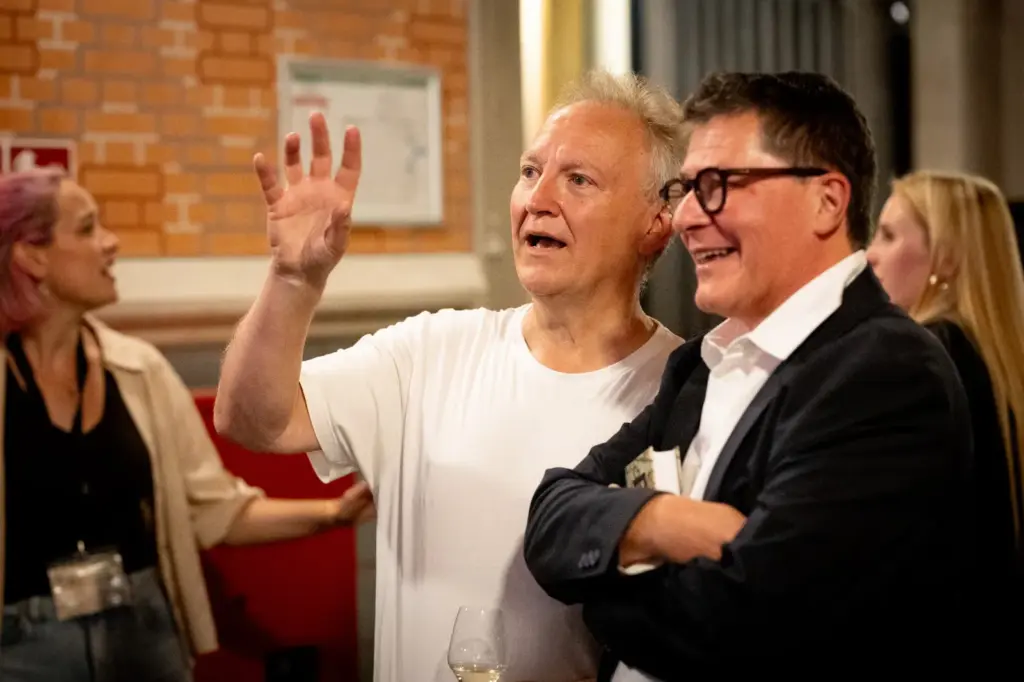
It so happens that the director of the two mentioned institutions (AMUZ and the Alamire Foundation) is the same person, Bart Demuyt, with dual training as a musicologist and singer, which led him to collaborate with several of his country’s flagship groups, such as the Collegium Vocale Gent of Philippe Herreweghe and the sadly defunct Capilla Flamenca of the late Dirk Snellings. He knows very well, therefore, from personal experience, the importance and value of Renaissance polyphony and, as he told EL PAÍS on Sunday morning in his AMUZ office, his goal has always been to build a bridge between theoretical study and practical realization, “because I am firmly convinced that there is, let’s say, a distance between the research field and that of performers, so my idea has always been to bring them closer. And when I was offered to be both the director of Laus Polyphoniae and AMUZ, the opportunity arose to unite the world of research in the context of Netherlandish polyphony with the world of performers: and that is what I have been dedicated to since 2008. That is why we collaborate in practice and many of the results presented at the festival, in collaboration with some musicians, have as their starting point a research project in Leuven. So there is a reciprocal relationship, a constant continuum, and that is how I like it to be.”
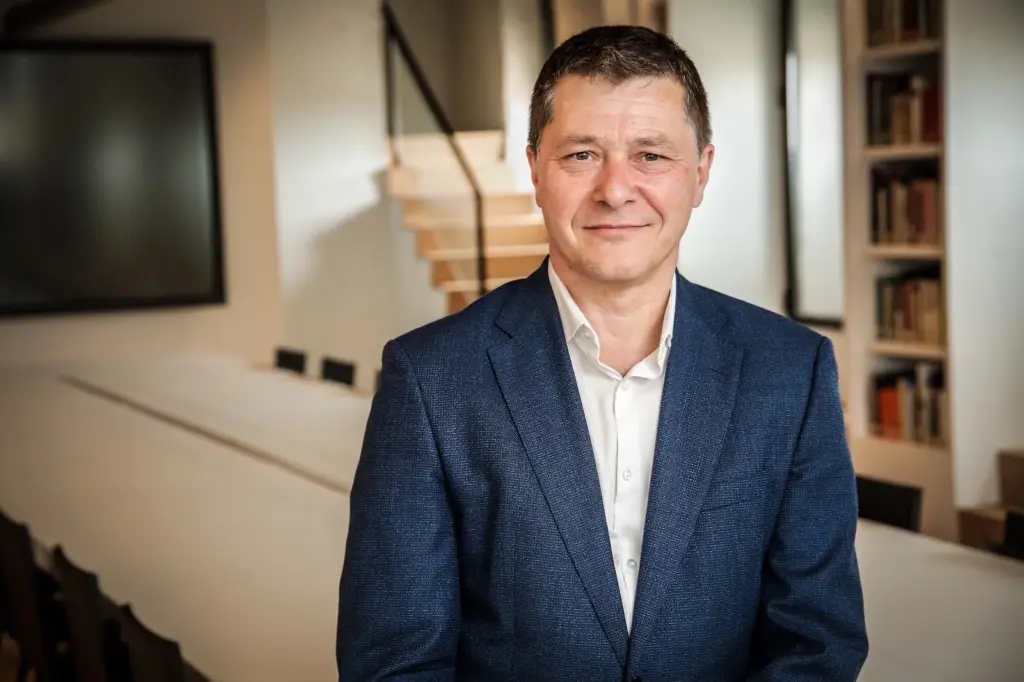
Demuyt feels very fortunate for the funding he receives from the Flemish Government, while admitting that “the French-speaking part of Belgium has it much harder. In recent years — let’s say the last seven — our goal has been to introduce innovation and high technology in our research field in Leuven. That is why we have received much funding from the Flemish Government for innovation. And we have created a sound laboratory, we are working on creating an extended reality (XR) studio, etc. Looking ahead, our focus will be on establishing relationships, and one of the ideas is to strengthen ties between Spain and Flanders, to make them more connected.” He is reminded that, in this field, sadly, our country remains a wasteland, although Demuyt cites the Spaniard Albert Recasens as one of the Spaniards he likes to collaborate with, “because he combines research with musical performance. Albert is now busy with [Pierre de] Manchicourt. He has found many prints with wonderful works by Manchicourt, who is an incredible composer. No one is performing Manchicourt, so we are going to get it going.”
The informal conversation then turns to Bruno Turner, recently deceased and one of the unavoidable references whenever polyphony is discussed, to scholars of Spanish Renaissance music like Tess Knighton, to the greatness of barely performed musicians such as Francisco de Peñalosa, Bernardino de Ribera, Sebastián de Vivanco, or Alonso Lobo and, inevitably, to the complete lack of interest shown by successive governments in Spain in creating an institution that undertakes a similar task to that carried out for years by AMUZ and the Alamire Foundation here in Belgium. At least Bart Demuyt is eager to collaborate if the tide ever changes: “We have to do something and we can do it now because I still have five years left, so let’s go for it. It is never too late.” Whoever wants and can understand, let them understand.
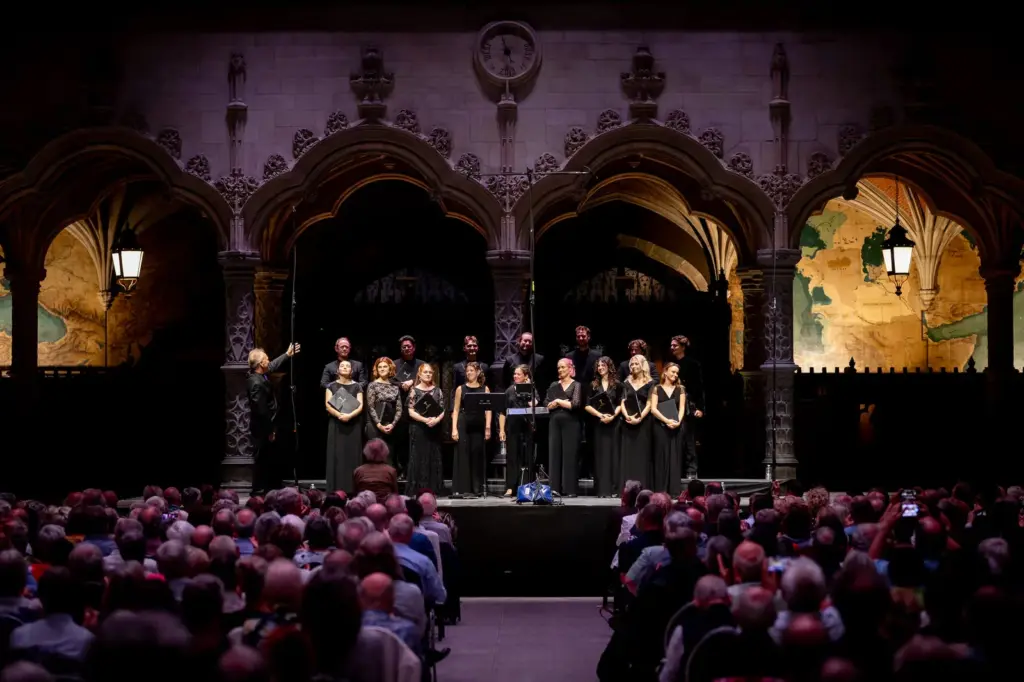
With this year’s motto, Polyphonic Europe circa 1600, it would have been difficult to choose a more symbolic work for last Friday’s opening concert than Tomás Luis de Victoria’s Officium defunctorum. Composed in 1603 for the funeral rites of a woman, María of Austria, whose father, husband, uncle, and two sons were emperors of the Habsburg dynasty for almost a century among them, it was published by the Royal Typography in Madrid two years later, symbolically marking the end of an era. Let us not forget that Monteverdi’s L’Orfeo was first performed in Mantua in 1607 and that three years later the first edition of the Italian composer’s Vespers was printed by Riccardo Amadino in Venice, a work that still has one foot in both worlds, the Renaissance and the Baroque. Victoria’s funeral score is decidedly Renaissance, but, as Bruno Turner wrote in his 1988 edition of the work, what put it on the international map and made it part of the repertoire of professional and amateur choirs worldwide (soon recorded, for example, by The Tallis Scholars and the Westminster Cathedral Choir), “has become as revered as admired, because it seems to be in some way a Requiem for an Era: the end of the Golden Age in Spain, the end of Renaissance music, the last work, in fact, of Victoria himself.” But there is much, much more beyond these symbolic elements and whoever wants to delve into the many layers hidden in this unique composition is lucky to have a model monograph by Owen Rees published in 2019 by Cambridge University Press, The Requiem of Tomás Luis de Victoria (1603). It has long been that the study and performance of the best Spanish polyphony is in the hands of the British, who seem to value and keep it infinitely more present than we do: everything points in the same — and sad — direction.
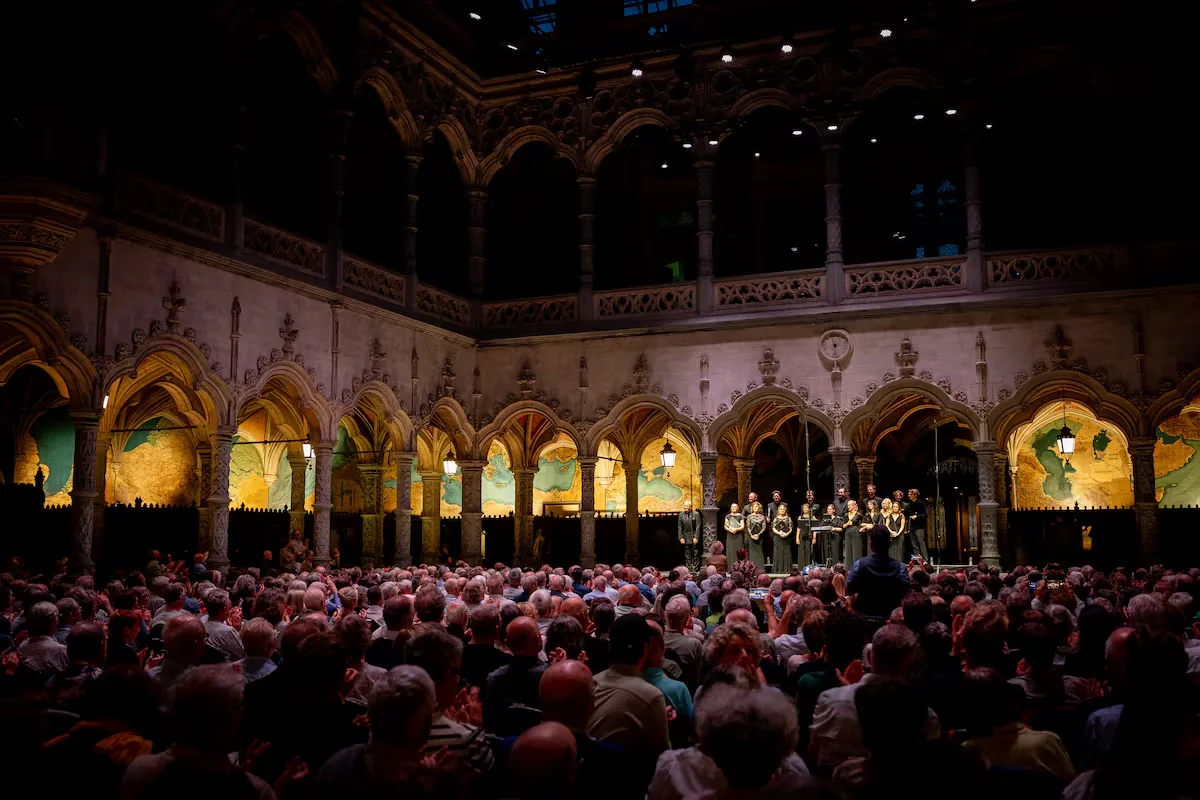
The opening event on Friday was held in the magnificent historic building of the old Antwerp Stock Exchange, the Handelsbeurs, with acoustics much better than its architecture, galleries, and very high ceilings might suggest. The chosen group, Tenebrae, directed by Nigel Short, a former member of The King’s Singers who founded it at the start of this century, recorded the work in 2010 for the Signum Records label, for which Short also works as a producer. It is striking that only two of the singers (two tenors) from then repeated on Friday in Antwerp, but the very high mobility within British groups is well known — except for exceptions — especially pronounced in a field where, due to its secular choral tradition, they produce almost more singers than the market can absorb. And Short’s version was impeccable vocally but too superficial, and if a work like this does not deeply move (or, going further, “does not make you cry at some point,” as Bruno Turner said), something has failed.
Read more Stage 3 of La Vuelta is canceled due to a severe hailstorm 15 kilometers from the finish line
Short emphasizes the extremes — trebles and basses, with three singers per voice — and leaves the two tenor parts, essential in a six-voice score, excessively in the background. In this sense, it was significant that in “Tremens factus sum ego,” from the “Libera me,” the director used his nine female singers. Contrary to what Turner did in his historic performance at the Royal Monastery of the Incarnation in Madrid on November 28, 1993, there was no hint of presenting the work within a coherent liturgical structure, as was undoubtedly done at the time in the Royal Monastery of the Descalzas Reales, where Empress María lived in retirement with her nun daughter, Margarita de la Cruz, dedicatee of the publication. Beyond the plainchant intonations, the initial invitatory, antiphons and psalms, responsories, the tract, all of which support, frame, and give meaning to the polyphonic sections, were missing. Short’s version, which preferred to complete the concert with five of Victoria’s Holy Week responsories (here completely out of place, despite the funeral connection), sounded very directed, very metric, little spontaneous, too predictable, especially in the lesson “Taedet animam meam” and the responsory “Libera me,” where essential fluidity must go hand in hand with intensity. It was also neither liturgically nor conceptually understood that Short began the concert with the motet Versa est in luctum, by Alonso Lobo (composed for the funeral of Philip II, brother of María of Austria, and later repeated out of program), when Victoria also set the same text to music, which on Friday sounded after communion. But this was a concert Requiem, not liturgical; sung, not felt; external, not internal; vocal, not emotional.
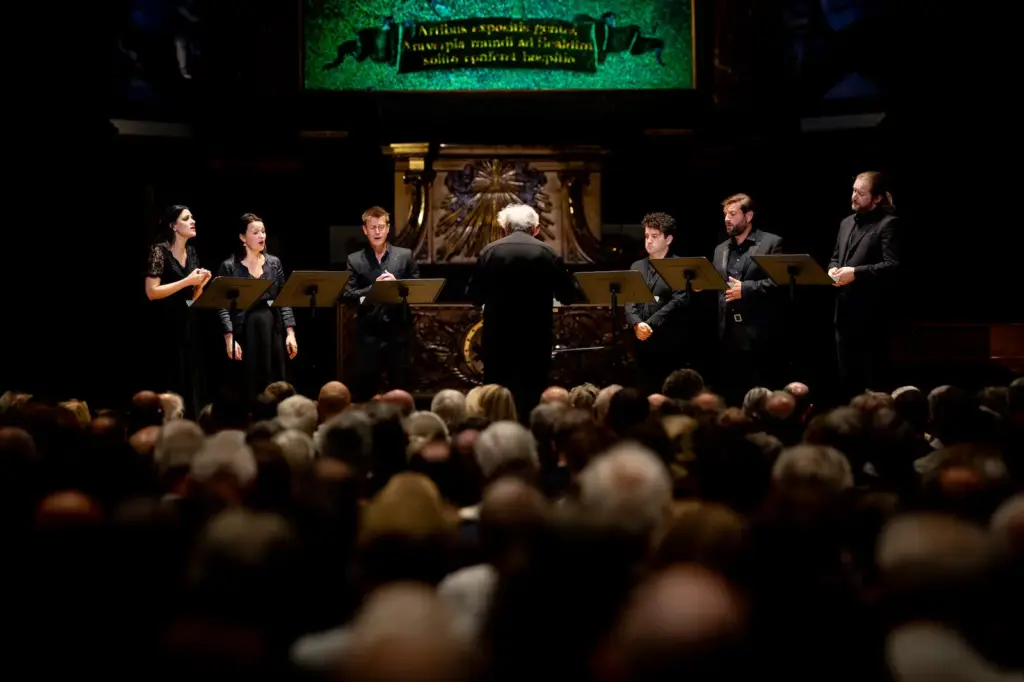
Saturday’s two concerts offered a mixed bag. On one hand, a forgettable proposal by Les Meslanges in the Sint-Andrieskerk, where the best was hearing a six-voice mass by Jean Titelouze discovered in 2016 by musicologist Laurent Guillo in a Paris library. Framed with very good judgment by other works, with instruments doubling the voices at all times, the performance suffered from multiple blending and tuning problems. The most salvageable were the organ solos by François Ménissier and the presence of the great trombonist Claire McIntyre; the most interesting was hearing the peculiar timbre of the serpent, a low instrument very common in France but rarely played nowadays (although it is part of the orchestration of Berlioz’s Symphonie Fantastique). Everything was memorable, on the other hand, on Saturday night at the AMUZ venue, where Philippe Herreweghe led a perfect interpretation of Orlandus Lassus’s swan song, Lagrime di San Pietro, 21 sacred madrigals dedicated to Pope Clement VIII three weeks before his death in 1594. Great, wise music that closes with an absolute masterpiece (Vide homo, quae pro te patior, the only one with a Latin text), sung by seven formidable singers, two Czech sopranos and five British, although under the legendary name of Collegium Vocale Gent. The result would have been very similar, if not identical, without Herreweghe’s presence, because this seven-voice music, with soloists of such stature, requires no direction.
However, the Belgian, about to turn eighty, inspires quite a bit and strove to highlight with small arm movements some prodigious final harmonic sequences in which Lassus concentrates the wisdom of a lifetime: “discepol fiero” (no. 4), “della tua bocca” (no. 7), “piacer ti tocchi” (no. 8), “al fallo antiquo” (no. 11), “la vergogna apparve” (no. 12) or “non chiedo l’ombra” (no. 20). The aforementioned concluding madrigal, Vide homo, a model of austerity and originality, was, from beginning to end, the most moving thing heard at this festival’s start. With considerably faster tempos than in Herreweghe’s old 1994 recording, nothing was missed in a performance marked by fluidity and constant expressiveness, in which the very high quality and ductility of the voices shone at all times: sopranos Hana Blažíková and Barbora Kabátková (who have been singing together for years and both are part of the Tiburtina Ensemble, directed by the latter), tenors Benedict Hymas, Samuel Boden, and David de Winter, baritone Gareth Brynmor John, and bass Jimmy Holliday. A depressed Lassus who already foresaw the end of his life composed this work (for seven voices, as many as the sorrows suffered by the Virgin Mary) perhaps to wipe away his “youthful errors” and ease his own suffering amid a strong depression to prepare for a good death.
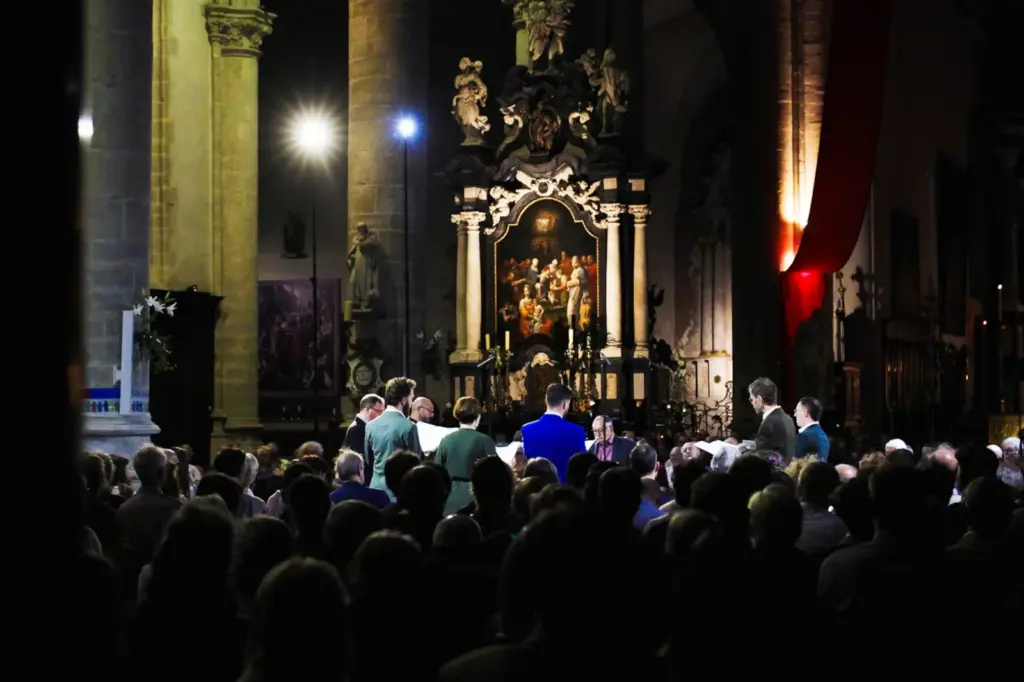
The next day, in the Sint-Jacobskerk, which looks imposing after its recent restoration, we attended another interpretative lesson of the highest school, also with sacred madrigals by the uxoricidal prince Carlo Gesualdo who visited the press just a decade after Lassus’s collection, in 1603, the year of Empress María’s death. It is impossible to recall a bad concert, not even an average one, by Stile Antico. These prodigious British singers have grown up together, matured together, seen their children born together, and learned together since emerging as Sting’s accompanists two decades ago in his project dedicated to John Dowland. They have developed a perfect technique, as complex as hardly visible, to sing without a conductor, despite doubling or tripling voices depending on the writing of each piece. In their selection of Gesualdo’s sacred songs, they used thirteen singers for the six-voice pieces and twelve for those composed for five voices. There are no tortuous dissonances here like in Gesualdo’s last madrigal collections, but when words like “tears,” “death,” “pain,” “sin,” but also “compassion” and “mercy” appear, the Prince of Venosa sharpens his powers and introduces sharper and more penetrating harmonies. Although the entire concert was absolutely exceptional, it left several moments to remember: Peccantem me quotidie, with its unresolved harmonies, without a moment of stability until the final consonance, sung very slowly and highlighting its funeral character; Ave, dulcissima Maria, with silences of enormous eloquence and ascending octave scales rarely endowed with such expressive force; O vos omnes, with its metric changes, internal repetitions, and harsh dissonances; and Hei mihi, Domine, a prime example of how to translate pain into music. The third Ashby sister, Emma, did not sing as listed in the program, and her substitute joined only in the six-voice pieces. Benedict Hymas repeated, having sung with Herreweghe the previous night.
The same virtue that Stile Antico exhibited — giving each piece its just and distinctive character: a small closed universe unto itself — was shown an hour after their concert ended by the very veteran Paul Van Nevel with his Huelgas Ensemble in the Sint-Andrieskerk, only here the music was much less interesting than Gesualdo’s Cantiones sacrae, although it again fit like a glove in the historical period chosen by the festival, since Claude Le Jeune died in the symbolic year 1600 after a life as a Huguenot persecuted for his religious beliefs in his native France. With his usual rotating movement of singers in an imaginary circle (of which he himself is also part), Van Nevel used his eleven soloists (always voices with a very defined personality, and different from each other, among whom some new faces were seen, but also classic members of the Huelgas Ensemble roster in recent years, such as soprano Helen Cassano, tenor Achim Schulz, and bass Tim Scott Whiteley) in constantly changing ways and without repeating formulas: Ainsi qu’on oit te cerf bruire sounded with only three trebles while immediately after, C’est en sa très sainte cité — also for three voices — was performed by nine (2 + 3 + 4), or Helas! Seigneur je te pri’ sauve moy, for five voices, only seven (2 + 1 + 1 + 1 + 2). Le Jeune’s music, who set more than three hundred psalms to music, is simple, direct, and mostly homophonic, without the often intricate counterpoint of Gesualdo (in Assumpta est Maria he writes, for example, in the Quintus a line from which to derive a double canon at the fifth and octave in Altus and Sextus), but sung with voices of this quality, and with that almost pointillist and constantly changing dynamic treatment so characteristic of Van Nevel, there is not a single moment of boredom. Although he announced his retirement last year, it seems the Belgian is still going strong, but before O Dieu éternel mon Sauveur, in which the most pronounced pianissimo of the night sounded, almost a whisper, Tim Scott Whiteley had to bring him a chair so that — exhausted from incessantly moving his baton, drawing the music in the air — he could rest, catch his breath, and wipe the sweat. In barely twenty-four hours, we had witnessed three radically different ways of understanding a cappella polyphonic singing.
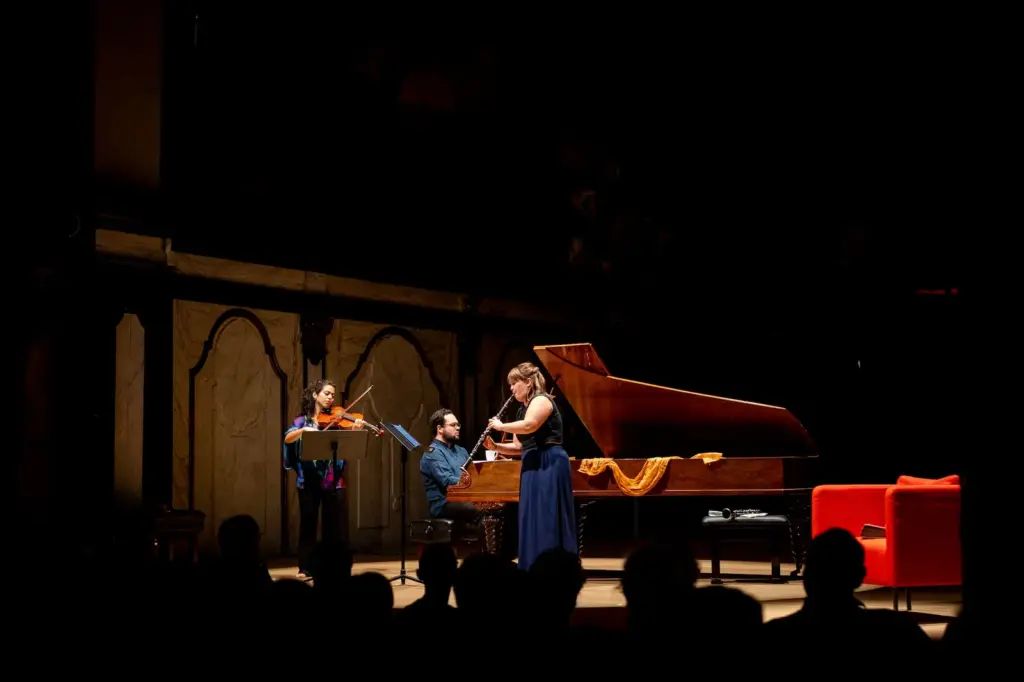
Besides great veterans, the festival reserved Saturday morning and early afternoon to present six young groups who participated in its international young artists training program. After being selected through videos, they stayed a week in Antwerp working with two teachers, who this year were Peter Van Heyghen and Nicolas Achten. There was a strong presence of Spanish musicians, as in the first concert of the doubly awarded group (in Utrecht and York) Ossian’s Dream, which includes clarinetist Claudia Reyes Segovia and pianist Pau Fernández Benlloch, completed by Syrian-Swiss violinist and violist Léa Al-Saghir. They admirably played works by Bruch, Reinecke, Pauline Viardot, and Brahms on historical instruments and with historical criteria, with the addition of a slight and successful theatricalization, more than appropriate if Manuel García’s daughter is involved, a great salonnière in 19th-century Paris. In April 2027, they will perform at the Juan March Foundation in Madrid, and their manners and poise on stage bode well for the group’s future, which is very meritorious for having won their awards in a field overwhelmingly dominated by medieval, Renaissance, and Baroque music. In Il Concerto Intempestivo, two Spaniards also play (violinist Jaume Guri Batlle and harpsichordist Eliot Xaquin Dios), who included compositions by the latter and German violinist Rahel Boell in their concert, as well as Baroque music by various authors. And soprano Ana Parejo Belando ventured with her Trio Turbulences into Renaissance, Baroque, and contemporary repertoire (Io sono amore angelico, by Belgian organist and manager Bernard Foccroulle) with more uneven results, especially in translating the sometimes formidable ornamentations of the period.
Besides Ossian’s Dream, Ensemble Pampinea made an excellent impression, with a very original way of ordering the different blocks of their program, which was left to chance, as someone from the audience had to throw a large fabric cube into the air for Fortune to decide. Magnificent were the three musicians: Lithuanian soprano Emilė Ribokaitė (trained, like others, at the Schola Cantorum Basiliensis), Portuguese recorder player António Godinho, and Hong Kong multi-instrumentalist Fiona Kizzie Lee. In all concerts, the effort to present their repertoire in a different and original way in half an hour was noticeable. Seeking new repertoires in the atrophied classical music life, paradoxically, there is no greater treasure than ancient repertoires, still largely unexplored. Giuseppe Verdi said it long ago, in another context (a letter addressed to Francesco Florimo in 1871): “Torniamo all’antico: sarà un progresso” (Let us return to the old: it will be progress).
Read more The artist Juana Dolores is considering stopping writing in Catalan