









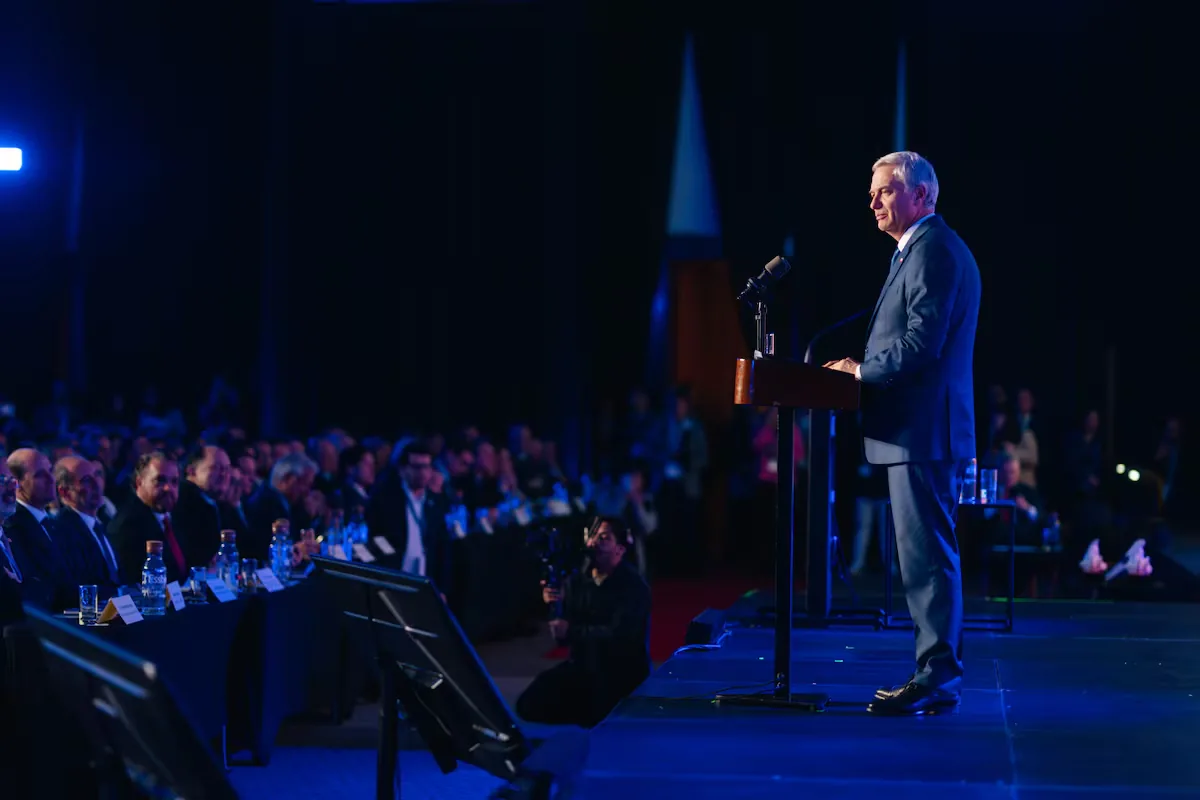
The meeting of international far-right forces organized by Vox and the Disenso Foundation — the think tank of the Spanish party led by Santiago Abascal — will be held next week in Santiago de Chile. Under the motto A new era for Ibero-America, the fifth edition of the Madrid Forum will bring together leaders of the Ibero-American right, neoliberals, integrists, conservatives, and authoritarians from various backgrounds. “Chile is not just a venue. It is a demonstration that the reconquest is possible,” states the event’s website, where President José Antonio Kast has spoken at the last two editions. For this edition, Abascal’s presence is already confirmed, according to EFE, but the organization has not published the attendance of regular figures at these meetings such as Argentine President Javier Milei, Honduran Nasry Asfura, and Italian Prime Minister Giorgia Meloni.
The holding of the far-right meeting in Santiago “is not accidental,” the organization points out. “It is an act of recognition towards a nation that has stood up twice — at the polls and in the referendum — against those who sought to impose a model that other peoples in the region know and suffer from,” it adds, referring to Kast’s victory in the presidential elections and the 62% rejection of the constitutional proposal led by the left in 2022.
Each Madrid Forum meeting ends with a declaration. At the IV edition, held in Paraguay under Santiago Peña, they signed that “for the first time in many decades, there is a real possibility of opening a new era of freedom and prosperity with the defeat of socialism in the region and throughout the West.” A year later, the organization states, “the political reality of the region confirms the change in trend that began with the victory of Javier Milei in Argentina and Donald Trump in the United States: patriotic forces have prevailed in various electoral contests in Argentina [Milei], Bolivia [Rodrigo Paz], Chile [Kast], Colombia [Abelardo de la Espriella], Costa Rica [Laura Fernández], Honduras [Asfura], and Peru [Keiko Fujimori].” It also highlights the capture of Nicolás Maduro by U.S. forces in Caracas on January 3. The organization links this episode to the leadership of Venezuelan opposition figure María Corina Machado and the “three-phase plan” that the Trump Administration announced for Venezuela.
The forum, which will take place on September 3 and 4 at the Casa Piedra San Carlos de Apoquindo Event Center with dozens of speakers from more than 25 countries, is organized around four pillars — democracy and freedom, economy and prosperity, security and rule of law, and defense of the West. The summit’s goal is “to reflect on the new era that has opened in the region, but also in Europe and the U.S., as well as to analyze threats and coordinate a response aimed at recovering rights and freedoms where they were taken away, and to guarantee the integrity of electoral processes.” “Santiago de Chile will be the stage to consolidate that hope and advance in the reconquest of Western values and principles that define the civilization that unites us,” they add.
Read more Macron announces three “Disneyland-like” parks in Paris funded by Saudi Arabia
The event occurs as Kast’s government has proposed a constitutional state of public security exception decreed solely by the president of the Republic. The legislative initiative has sparked a debate about whether it is an illiberal action. The criticism has mainly come from the left, but also from moderate right-wing authorities. Senator Luciano Cruz-Coke, for example, president of Evópoli, from the ruling coalition, said this Sunday in La Tercera that “the reform borders on illiberalism,” and Chilean sociologist and political scientist Alfredo Joignant stated this Monday in EL PAÍS that such suspicion is “legitimate” considering Kast’s international trajectory. A “reactionary transnational,” he suggested, which gathers at Vox festivals and recalled that Kast presided over the Political Network for Values, an ultra-conservative network connecting politicians and activists from Europe, Latin America, the United States, and Africa, opposed to “radical feminism,” what they call “gender ideology,” homosexuals, and especially abortion.
Kast defended this Monday that “any law can undergo changes and that is what the Legislative Power is for. I don’t see it as a big deal.” Asked on Radio Infinita if he considers himself illiberal, he replied: “Not at all. If I were illiberal, I wouldn’t be here [in the interview]. There are other presidents who were not illiberal but did not give interviews for a long time. And I believe I have been different from other presidents who claim to be very liberal but got upset with the press.”
Like previous editions, it will conclude with the so-called Santiago de Chile Declaration, a document that, according to the organization, will set “a common roadmap” for the political cooperation of these forces in the coming years. The origin of this summit was in 2020 following the Madrid Charter, a manifesto presented as a defense of “Freedom, Democracy, and the Rule of Law” against the São Paulo Forum, the Puebla Group, and the Progressive International. It labels all of them as “criminal projects that have infiltrated centers of power and institutions to impose their totalitarian and freedom-killing agenda and hijack democracies.”