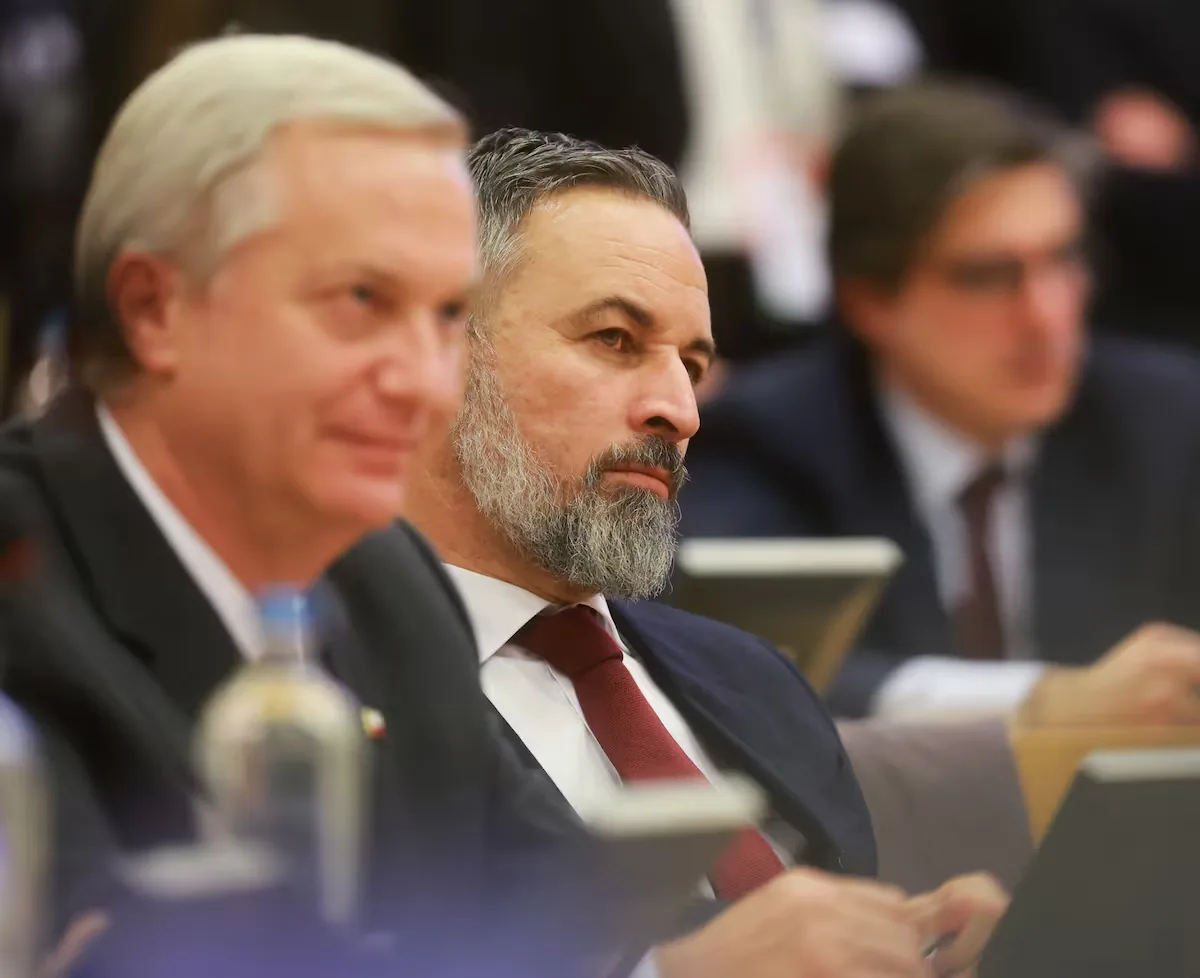









Friday afternoon. Only 24 hours have passed since PP and Vox announced their pact to make the popular María Guardiola president of Extremadura. José María Figaredo (Gijón, 37 years old) and Carlos H. Quero (Madrid, 35 years old), two members of Santiago Abascal’s negotiating team, receive EL PAÍS at Vox headquarters to detail an agreement that marks their return to a coalition government with the PP after the July 2024 breakup and sets the path for those being negotiated in Aragon, Castilla y León and, perhaps tomorrow in Andalusia and the rest of Spain. However, they warn in this two-voice interview, the Extremaduran pact is the floor and not the ceiling of Vox’s demands.
Read more Marrero crowns Real Sociedad in an epic Cup final against Atlético
Question. It’s been almost four months since the people of Extremadura voted, and it seems the mountain has given birth to a mouse.
Carlos H. Quero. I wouldn’t judge it by how long it took, but by what was achieved. In housing matters, it proposes faster construction, administrative and urban simplification. There are guarantees for down payments and deferred tax payments so that young people can buy a home. Tax deductions, with reduced rates for lower incomes, will make [Extremadura] the place in Spain where the least taxes are paid. There is free education from 0 to 3 years, an investment of 500 million more per year in healthcare, the prohibition of photovoltaic and wind farms on productive land. Faced with mass immigration, national priority is safeguarded. The main concerns of the people of Extremadura and Spaniards are addressed. We believe this time has been worthwhile to get to where we are.
Q. Are we going to see this same agreement in Aragon and other communities where the PP depends on Vox?
J. M. Figaredo. The agreements will not be identical, as the representation of each party is not the same, but the line is what it is, which is nothing more than Vox’s line. We have a percentage of votes and according to it, we want Vox’s proposals to be reflected. This pact represents Vox with 17% and the PP with more than 40%.
C. H. Q. Therefore, we can understand that it is the floor for future programs.
Q. Do you demand more in Aragon?
C. H. Q. That’s what the Aragonese decided when they went to vote.
Q. Is this pact what Vox wants for Spain as a whole?
C. H. Q. We would like to have more than 50% so that many more things could be applied. But when two parties have not obtained the strength they would like, they must gauge what is more important, what they are more comfortable with. And an agreement has emerged with which we are reasonably satisfied.
Q. The pact commits to four budgets. Will Vox not abandon the government as it did in the past?
J. M. F.. Marriage is for life, and if your husband systematically cheats on you, then there comes a point where you have to leave him. Vox does not wish for that. We have the conviction and hope that this agreement will come to good terms. There is good harmony.
Q. Initially, there wasn’t with Guardiola, whom Abascal called “the new Irene Montero”.
J. M. F. More important than how it starts is where you’re going.
C. H. Q. If one looks at the agreement, there are few things Irene Montero would endorse.
J. M. F. In fact, she has explicitly criticized it.
Q. Abascal has said that the agreement guarantees national priority, but the Immigration Law prohibits a foreigner from being discriminated against a Spaniard in access to public aid. Do you have the commitment that the PP will promote the reform of the law?
J. M. F. We have the commitment from the PP of Extremadura that it will urge the Government of Spain to carry out a modification of the immigration law. That is the commitment.
Q. And the national PP? Because Genoa has supervised the pact.
J. M. F. When we sign an agreement with the national PP, we will have to see what clauses are included and signed. At this moment, it is an agreement between the PP of Extremadura and Vox.
Q. And while the law is being changed?
C. H. Q. There are two different paths. One part already has practical application since there is a regulatory development for the allocation of protected housing. A minimum of ten years of historical registration is required because Extremadura is a region that has been expelling people due to lack of opportunities, and this is also a return plan. An Extremaduran who studied in Madrid returns, and their last years in Madrid are not counted, but rather their historical time in Extremadura. And then there are weighting criteria. The usual ones are age, family type, vulnerability, income. Now points will be awarded if you have been schooled in the region, if your family lives there. The basis of housing policy is to root people, and effective and emotional ties are fundamental. We understand that a Spaniard without a home, who pays their taxes, should be a beneficiary of social aid.
Q. The pact states that irregular immigrants will be excluded from structural social services, except in cases of vital emergency. What does that mean?
C. H. Q. There are social services that are periodic, structural, that involve years of care, and others that are immediate. A beam has fallen on my head, I’m dying… that’s a vital emergency. No one here is heartless, and there are issues that need to be addressed because they are circumstantial, specific. Basic, structural care, that which is for years, cannot be like that, because otherwise, the pull factor is strengthened.
Q. From which benefits will they be excluded?
J. M. F. That will have its development. But this is a declaration not only of intentions, but programmatic, which implies that everything within social services that is considered a continuous, periodic, structural benefit, which is monthly visits to a specialist, all those issues…
Q. They are left without healthcare.
C. H. Q. Healthcare, for an irregular immigrant, I insist, specific healthcare… have you been hit by a truck? then obviously you will receive care. That is written exactly as it is in the agreement.
Q. To remove healthcare for irregular immigrants, you have to change the General Health Law.
J. M. F. That remains to be seen.
Q. Without changing the law, you cannot remove it.
J. M. F. No, it cannot be removed. It’s not a question of removing it or not. It’s a question of whether you can have services that apply the law to the minimum or the maximum. In this case, we are going to ensure and the objective is to send a message that the services of the Extremaduran Administration are primarily provided to nationals, of course, to those who reside legally. For those who reside illegally, what will be carried out is a stimulus and promotion for remigration and repatriation. We are not talking about healthcare, and we are not talking only about healthcare, nor is it excluded. Everything that can be done will be done. The irregular immigrant will have more incentives to leave than to stay.
Q. Again, a state law must be changed.
J. M. F.. They have told us: this cannot be done because it is illegal. We are not going to do anything illegal, everything will be legal, and once we are within the Administration, we will prepare all legal reports and do everything with total scruple for legality, but always tending in that direction. [An immigrant staying] will not be stimulated with public aid.
C. H. Q. The minimum vital income, regional supplements…
Q. The General Health Law enshrines universal healthcare.
J. M. F. The national law writes, and then those who have to execute and interpret that law are the regions. Universality has not yet been applied, it is not known how it will be applied, the necessary economic endowment assigned to this precept has not been guaranteed. When all this arrives, we will interpret it and do so in the direction stated in the agreement.
Q. The agreement states that not a single unaccompanied foreign minor will be admitted. The law obliges their acceptance in case of a migratory emergency.
J. M. F. The vast majority of regions are at 120% of their reception capacity. Like Extremadura. Not one more. And when the Government comes and says: “We are going to send you 20”, we will respond: “There are no places”. Strictly adhering to the law.
Q. Who will assume responsibility for rejecting a legally mandated distribution? The Vice President of Vox?
Read more ‘Dark blue, sky blue’, a ‘true crime’ behind the rise and fall of Guillermo ‘Billy’ Álvarez
C. H. Q. The Extremaduran Government. This is a government of two partners, and both of us have signed.
Q. Not a single euro for NGOs that host immigrants, the agreement says. Does that also affect those of the Catholic Church?
J. M. F. To all those who collaborate [with illegal immigration].
C. H. Q. Regardless of their confession. The objective is not who they pray to, but the effect they are causing on Extremaduran society.
J. M. F. To those of the Church or those of the Socialist Party.
Q. The Junta de Extremadura has agreements with Cáritas Diocesana. Are they going to be broken?
C. H. Q. We value the social action of the Church, but we cannot accept taxpayer money going to promote invasion and mass migration.
Q. Has the PP accepted this?
C. H. Q. We have not muzzled anyone. The pact was made by two political forces sitting down, talking for a long time, exchanging papers. Yesterday [Thursday] I saw a smile from Ms. Guardiola. This is a pact between the two parties.
Q Abascal said that the Church’s attitude towards immigration is explained by some bishops doing business with it.
J. M. F. It’s a very interesting analysis, but it goes beyond the pact in Extremadura, which is clear: no NGO that promotes illegal immigration will be subsidized.
Q. Caritas hosts irregular immigrants and refugees and receives public subsidies.
C. H. Q. You said “hosts”, don’t say “will host”.
Q. The agreement foresees creating a unit to pursue fraud in registration and the collection of benefits, what will its role be?
C. H. Q. Fraud in registration is the entry point for obtaining social aid. It is about preventing those in an irregular situation and fraudulent registration from being able to apply for them.
Q. They request the modification of the Law of Bases of Local Regime, which regulates registration, and that unit raises doubts regarding the Personal Data Protection Law, which limits the use of census data.
J. M. F. They are simultaneous and different things. Our ultimate goal is for the law to be toughened with a stricter regime for registration. Before that, there is work that can be done: to be registered in a municipality, you have to reside there. No one has said that data will be transferred. This inspection unit will cooperate with municipalities that do not have administrative resources for that examination. EL PAÍS has fantasized that it is a para-police unit.
Q. The pact says it will be responsible for “identifying and dismantling immigration mafias”. That is a police task.
C. H. Q. Because we know that behind 50 people registered in an apartment, there is a mafia. They don’t do it motu proprio.
Q. Vox will lead the Ministry of Deregulation. Is it [Milei’s] chainsaw?
J. M. F. Of course.
Q. What exactly will it do?
J. M. F. We have identified a series of regulations. We believe that the Extremaduran economy can be streamlined with simple regulatory changes. We are talking about administrative silence, responsible declaration, one-stop shop. A series of bureaucratic simplification measures that allow the Administration to be streamlined and new industries to be established.
Q. Vox proposed a cut in political spending that involved reducing the number of regional deputies. Why has it given up?
C. H. Q. It hasn’t given up. It’s just that Vox’s strength is 17%.
Q. Neither is the repeal of the Extremaduran LGTBI Law nor that of the registry of doctors objecting to abortion in the pact, are they no longer important?
J. M. F. If Spaniards want 100% Vox, let them give us 100% of the vote. Meanwhile, we will not be able to apply our entire program.
Q. Minister Sira Rego has said that this agreement will be dead letter and that the Junta cannot apply national priority.
C. H. Q. I understand that, from the alternative left, when one is governing and achieves nothing, one aspires for the same to happen to other minority government partners. When one negotiates well, and the details are visible in the agreement, it is guaranteed that everything important will be put into practice. National priority will not be dead letter. The agreement itself outlines the path of requirements, evaluation criteria, and the final goal, with the reform of the Immigration Law. From the very specific to the general. If others have not had the capacity to pressure their partner, I understand their frustration, but they will not see themselves reflected in us.
Read more The road to the Colombian presidential elections 2026, live