Every so often, news is published about how the number of pets — especially dogs and cats — continues to increase. Often, this data is accompanied in the headline by the decline in birth rates. Not surprisingly, when the Government published an advance of the future national animal protection statistics at the beginning of last June, confirming that there are more than 15 million pets in Spain, a large percentage of the news focused on it, taking data from the INE, due to the sorpasso over children: there are seven and a half million dogs compared to five million children under 12 years old.
Read more Listen to Europe and forge its future
These are two figures that draw attention, but placing them together gives the impression that there is some causality, something experts reject. “The decline in birth rates started much earlier. That is, the demographic transition is older and, therefore, we cannot say that the dog is the cause of the decline in birth rates,” says Eduardo Bericat, professor of Sociology and social researcher at the University of Seville. “What is true is that both things are expressions of a society that has a hyper-individualistic culture,” he adds. In other words, both respond to the same reality, but one is not the consequence of the other.
There are no statistics showing how these animals are distributed in households, or whether there are more dogs or cats living in homes with children than without them. “I cannot understand how we have fallen into that division that seems to say you are either a dog person or a child person. Almost all of my children’s friends have animals at home,” explains Marina Gómez, 47, who lives with — in order of arrival in her life — a cat, a partner, two children, and a dog. Gómez always wanted to be a mother and delayed it to ensure some economic stability before doing so. “It seems like science fiction to me that someone truly believes that a person who wants to have children does not have them because they prefer a dog. I think the fundamental question is why someone who wants children settles for a dog instead of having both,” Gómez concludes.
“It’s a simple, easy comparison, but what lies behind it is much deeper. Instead of analyzing why we are a country where most people would like to have more children than they do, we settle for saying they replace them with a pet,” says Luis Ayuso, professor of Sociology at the University of Malaga.
Bericat also highlights the fact that there are significant generational differences when it comes to bonding with a pet: “In young couples, they sometimes act as a substitute for a child who comes later; in older people, they serve to alleviate loneliness, while the dog in the family serves as a condensation of emotions. In each generation and at each stage of the life cycle, the dog takes on a function and position that can be different,” he maintains.
Family members, not substitutes
Although experts point out that animals are not replacing children, what is clear is that dogs and cats have become family members, whether or not there are minors in the household. According to the study Redefining Parenting and Family: The Infantilized Role of Dogs in Western Societies, from the Hungarian university Eötvös Loránd (ELTE), this role change is largely — though not only — due to the so-called second demographic transition. This transition emphasizes isolation, the decline of social trust, and the weakening of community ties as the main — though not sole — cause of the changing roles of dogs in the West.
Read more Tell me how much truth there is
“Individualized society generates loneliness and in the face of that loneliness, the dog is one of the potential alternatives with a strong emotional bond and high loyalty on one hand and low cost and commitment on the other,” points out Bericat. That could be the definition of the reasons that led Pablo Morante, 36, to adopt Balto. “I work from home and spent many hours alone. Now I am always accompanied, even if he is just lying on the sofa with me, the difference is huge. Also, having Balto forces me to go out, even to socialize; it has been one of the best decisions I have made,” Morante recounts, who considers his dog a family member. Although he is not currently planning to have children, it is something he has in his plans “in three or four years.”
Ayuso also points out that in modern societies there is an important change in bonds that further deepens the role of pets as emotional support; there are fewer strong bonds based on lasting relationships, such as the traditional family, while weak bonds multiply. “We are moving towards societies where family is our friends. In that sense, the family bond, as we consider it, fades,” assures this professor of Sociology.
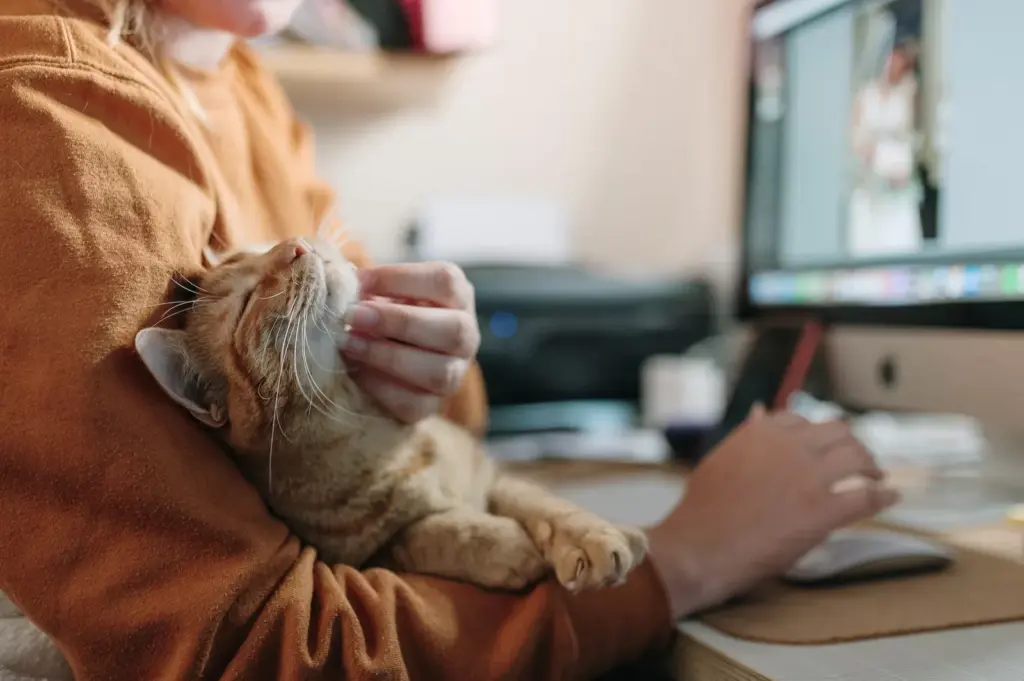
Experts point out something increasingly obvious: we live in times of hyper-individualism, but we feel lonelier, while society is increasingly emotional. “We are societies in which, while we individualize, paradoxically we get emotional or value emotion more. The politician who moves you, the news that awakens something in you, I need to have it, I need to live it, experience it, feel it,” explains Ayuso. In this context, an animal becomes the ideal companion: they are solid, loyal relationships with a low emotional cost. “That need to project emotion we project onto pets because they reinforce that positive bond; they are always happy when they see us, they always reinforce the bond. And that emotional need is what we project onto pets,” Ayuso clarifies.
The fact that this emotional projection onto dogs and cats is increasingly common does not mean that possible connections with others are canceled out. “I don’t think bonding with a dog takes away love for bonding with other humans. I think it’s like polyphony, you can use many instruments to generate a structure of sociability that in an individualized society is complicated,” Bericat concludes.
Read more Six bids compete for the Generalitat of Catalonia’s telecommunications megacontract