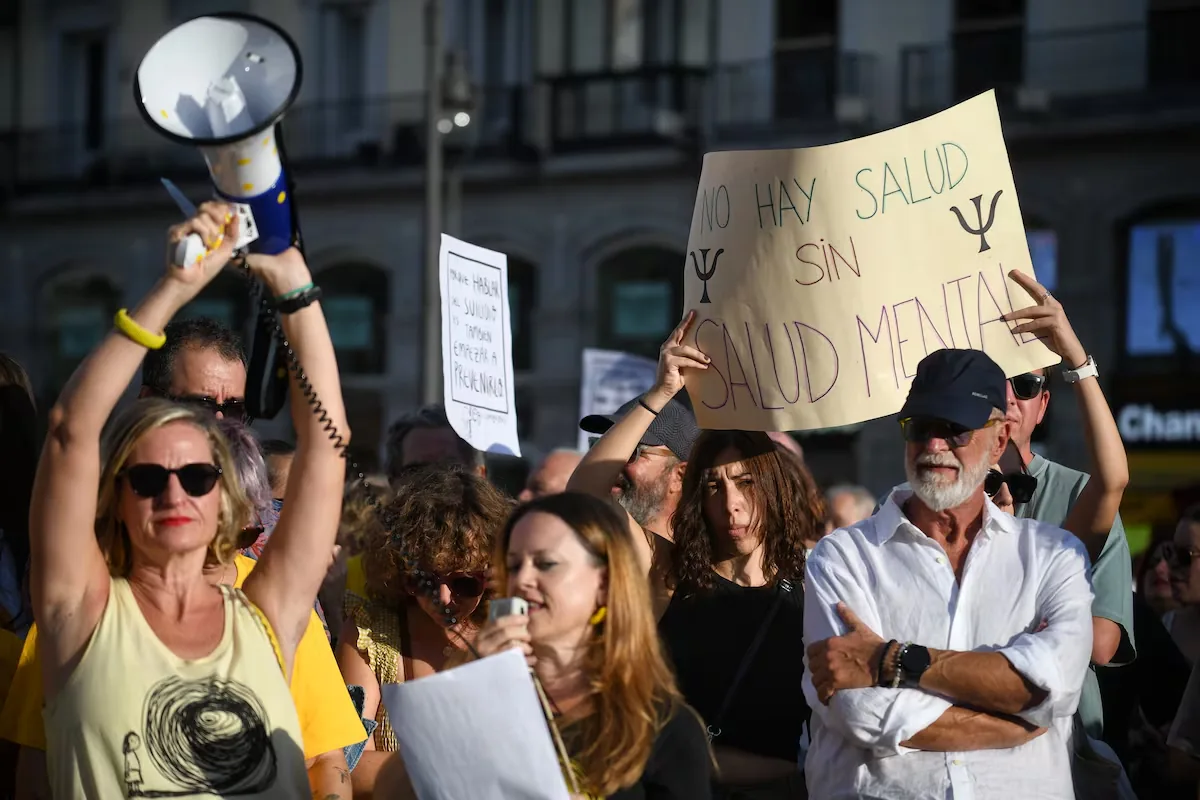
A typical day in the hospital: there are no free beds in Psychiatry and four people are waiting in Observation after a suicide attempt. A sixteen-year-old girl is calm and brings the explanation ready: she posted a photo of herself in a swimsuit and was showered with mockery and cruel comments about her weight (there are always wonderful people ready to do that). She limits herself to repeating three words, “I can’t take it anymore,” and looks laconically at the wall. When I unexpectedly ask her what she does on Saturdays, it takes her much longer to answer. She used to swim. She quit in the third year of secondary school. She spends Sundays scrolling on her phone. She doesn’t mention a club, a group, a task, or anyone waiting for her anywhere at any time.
Read more Dogs vs children: why is the increase in pets related to the decline in birth rates?
Let me say something upfront: a suicide attempt does not have a single cause. The explanation the patient brings — bullying, a breakup, failing a class — is usually the last link in a chain built over months or years. Those comments mattered, but because there was almost nothing else. And what was missing was not one thing, but three, which we usually lump together, even though they get lost separately. The bond answers who is waiting for me; the purpose, what I have to do tomorrow; the meaning, why it is worth having a tomorrow.
The bond is the most obvious of the three and the one that can save the most lives. Motto and Bostrom randomized, in San Francisco, 843 patients who had refused to continue treatment after admission for depression or suicide risk; half were sent a brief letter, without an appointment or request for a response, at least four times a year. During the first two years, fewer people died by suicide in the contacted group. There was no therapy, only the periodic proof that someone was still there. Combating loneliness and isolation is a form of prevention.
Life purpose does not necessarily refer to a vocation or a colossal enterprise, but to the feeling that one’s own existence is going in some direction and that there is something, no matter how small, that depends on oneself. It is one of the few things that stands between facing adversity and concluding that there is no way out. A systematic review places the association between meaning in life and suicidal ideation in young people around —0.50 in rich and individualistic countries like ours. An individual participant data meta-analysis of nearly half a million people associates purpose with a 30% lower risk of death, which is quite impressive. But it is advisable not to push it too much: re-analyzing one of those cohorts, two researchers found that, with better baseline health measures and excluding those already seriously ill, the advantage shrinks to almost disappear. Physical deterioration extinguishes purpose as much as purpose protects against deterioration, so the arrow goes both ways.
The link that connects all these losses is called hopelessness. Beck followed nearly two thousand outpatients for years and those who scored high on his scale had eleven times the risk of dying by suicide. It did not predict sadness or the intensity of suffering, but the patient’s opinion about their future time. Hopelessness is a belief about the future, which without bond or purpose remains empty and dark.
Those who seem to cope well with bad seasons rarely have a grand purpose: they have several small and scattered ones. The dog that must be walked even if it rains, Tuesday training, the grandchild, the choir, the discussion group, the Thursday shift at the food bank. Those who concentrate everything in one thing seem exposed to losing it. That languid girl had it in a single place — finding her spot in a sad group of virtual peers — and that place was the one judging her harshly. It is a portfolio of reasons to live: it is advisable that it does not all trade in the same market.
Read more Listen to Europe and forge its future
There is a movie so watched that we almost do not see it: It’s a Wonderful Life, by Frank Capra. It is dismissed every December as a Christmas story, but George Bailey is not saved by any great mission. He is saved by checking, house by house, that many people counted on him for minor things: a loan, a pharmacy, a roof that does not fall. It was not about a great purpose, but many small ones, and he had stopped seeing them.
There is still a third floor, which one only ascends when there is nothing left to do, and literature has described it wonderfully. In The Death of Ivan Ilyich, Tolstoy leaves the dying man among a family that pretends all the time and doctors who absurdly argue about a floating kidney; the only one who relieves him is Gerasim, the servant who holds his legs and does not lie to him. There is no room for any purpose there: there is nothing Ivan has to do tomorrow. But Gerasim remains, who offers no comfort or explanation, only held legs and the truth. That presence, which fixes nothing, allows dying to mean something other than absurdity (a lesson for healthcare professionals).
What protects is having a framework in which suffering is not pure absurdity and life itself does not exhaust itself in oneself. Meaning can be religious or not: a cause, a profession understood as service, a loyalty. In a trial with 253 patients with advanced cancer, eight sessions of group psychotherapy focused on meaning — an intervention William Breitbart designed based on Viktor Frankl — reduced hopelessness more than supportive psychotherapy. It has a downside, because meaning imposed from outside is harmful: telling a mother that everything happens for a reason is one of the cruelest phrases I have heard in a funeral home. Transcendence is not prescribed (a psychiatrist trying would be a lamentable spectacle); at most it is asked about — something we almost never do.
With that girl, we did nothing brilliant. We treated what needed to be treated, worked with the family, and convinced them, without epicness, to return to the water twice a week. She still does not want to talk about what happened. But now she has to be in a place at a time, and there are people who notice if she is absent.
At the end of Middlemarch, George Eliot writes that the good of the world depends in part on acts that do not enter history, the work of those who lived “a hidden life” and rest in graves that no one visits. I read it as literature, but I understand it better now: almost everything that keeps a person standing is almost invisible, written in lowercase, and no one thinks of telling it, until it is missing.
Read more Tell me how much truth there is