









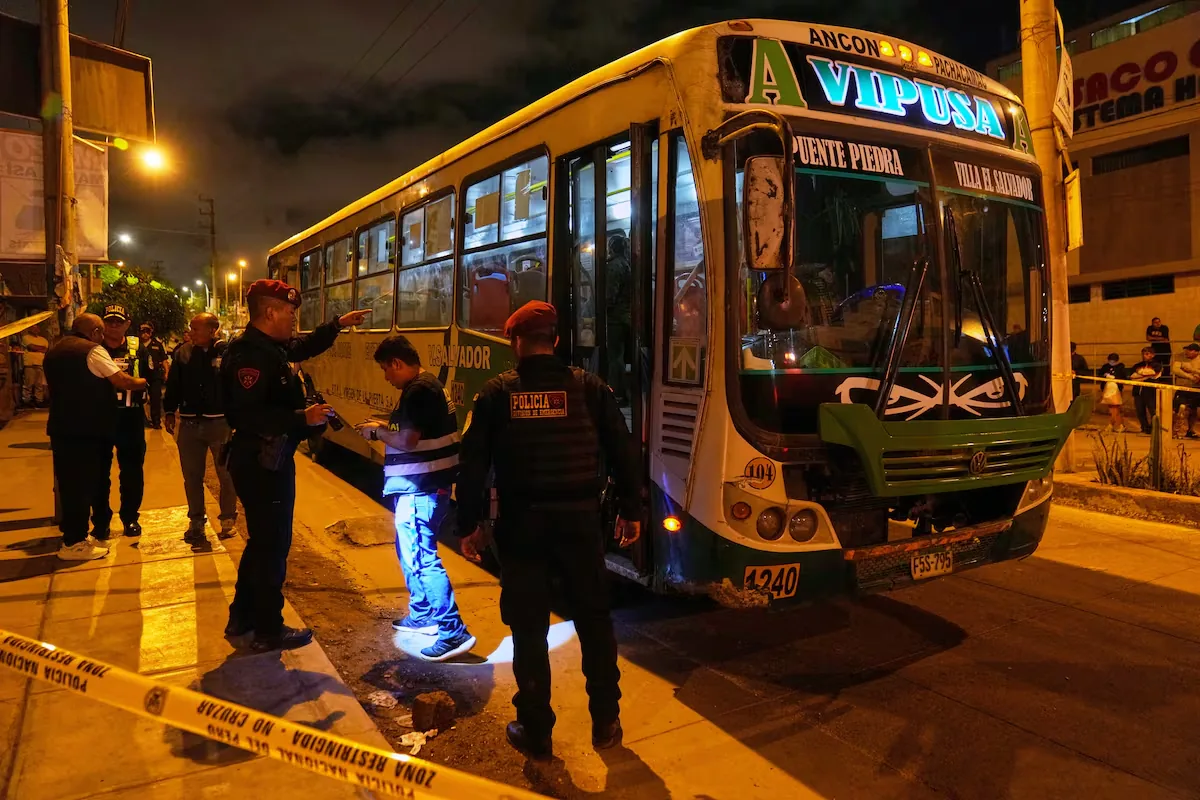
Keiko Fujimori reached the presidency with a simple promise: “Order returns.” But in her first month, transportation has become one of the arenas where that slogan faces its contradictions. Drivers and business owners are victims of mafias that charge fees and murder drivers, but they also form part of a system marked by informality and violations. Faced with the threat of a strike this Tuesday in Lima and Callao, the Government negotiated. The strike was suspended and, almost at the same time, a concession demanded by the unions arrived.
The Executive announced an exceptional regime that allows fines to be canceled by paying only 10% of the penalty. The benefit applies to cases in process, final fines, contested or in coercive collection. It will be valid for 90 days for traffic violations and 180 for public and private transport. The decree states that it seeks to “facilitate their effective payment and strengthen the efficiency of the sanctioning system.” Violations related to driving under the influence, informality, or assaults on inspectors, among others, are excluded.
The measure opens an uncomfortable flank for a Government that made order its banner. Between January and June 2026, the Lima Tax Administration Service registered 496,156 fines, 94.82% of them traffic-related. The reduction has been received by a sector of the population as a “blank check to violations.” The discussion raises to what extent the State can attend to a sector hit by crime without weakening the principle that rules must be followed.
In July, the Police reported that deaths from traffic accidents exceeded homicides recorded in the country: 1,785 deaths between January 1 and July 16, compared to 1,362 homicide victims. Driver recklessness and speeding appear among the main causes. The National Death System (Sinadef) has raised the number of deaths from road accidents to 2,113 up to August. “There are nine daily deaths on average from traffic accidents with a clear trend that 2026 will be the year with the highest number of deaths from traffic accidents in the last decade,” says analyst Juan Carbajal. In 2025 there were 3,026.
The other side of the crisis is told with weapons and indiscriminate executions. According to the Crime Observatory of the Public Ministry, between August 2024 and May 2026 there were 214 attacks against public transport, with 283 victims among dead and injured. An interprovincial union assures that between January and July there were 113 attacks, more than the 107 in all of 2025. Fujimori responded with the Shield Plan, which deployed more than 4,000 police with military support. The attacks, however, have not disappeared.
The Coordinator of Urban Transport Companies of Lima and Callao, which brings together 71 companies and about 7,000 units, promoted the strike finally suspended. Its president, Héctor Vargas, rejects that the reduction of fines determined the decision. “We respect people’s criticism. But we did not back down because of the reduction of fines, but because the president has already made us aware of her government plan regarding security.” Last Saturday, Keiko Fujimori held a meeting with some transport unions where she made commitments about an elite unit, prison control, and territorial control.
Vargas, meanwhile, attributes much of the system’s chaos to informal operators. “The majority percentage of accidents are caused by informal operators; we do not deny our responsibility, but we must be honest in saying that informality causes much more harm than formality,” he says without providing figures. Formal companies demand protection against crime and rules against informal operators, while receiving extraordinary relief on already imposed sanctions.
Martín Ojeda, general manager of the only interprovincial transport union in Peru, questions that the Government has only dialogued with certain representatives. “We want this situation not to be politicized. Those who applaud will not get the solution. The State has to listen to everyone.” He also regrets that extortion gangs are also attacking interprovincial buses. “They have crossed a line. There have already been 19 attacks against interprovincial buses this year. This means that these gangs are more consolidated and are trying to take over the entire transport market,” he says.
While the Government deactivated the Lima strike, the conflict moved to the Amazon. Transporters and trade unions began a 48-hour strike in Loreto on August 25 over fuel prices, the electricity crisis, and illegal mining. They demand that the subsidy, approved by Fujimori at the start of her government, be general and not targeted. Finally, the Juntos por el Perú caucus promoted a motion of interpellation against the Minister of Energy and Mines, Guillermo Shinno, over the rise in fuel prices.
Read more Buenos Aires suspends the project to convert a vault in the Recoleta cemetery into a café