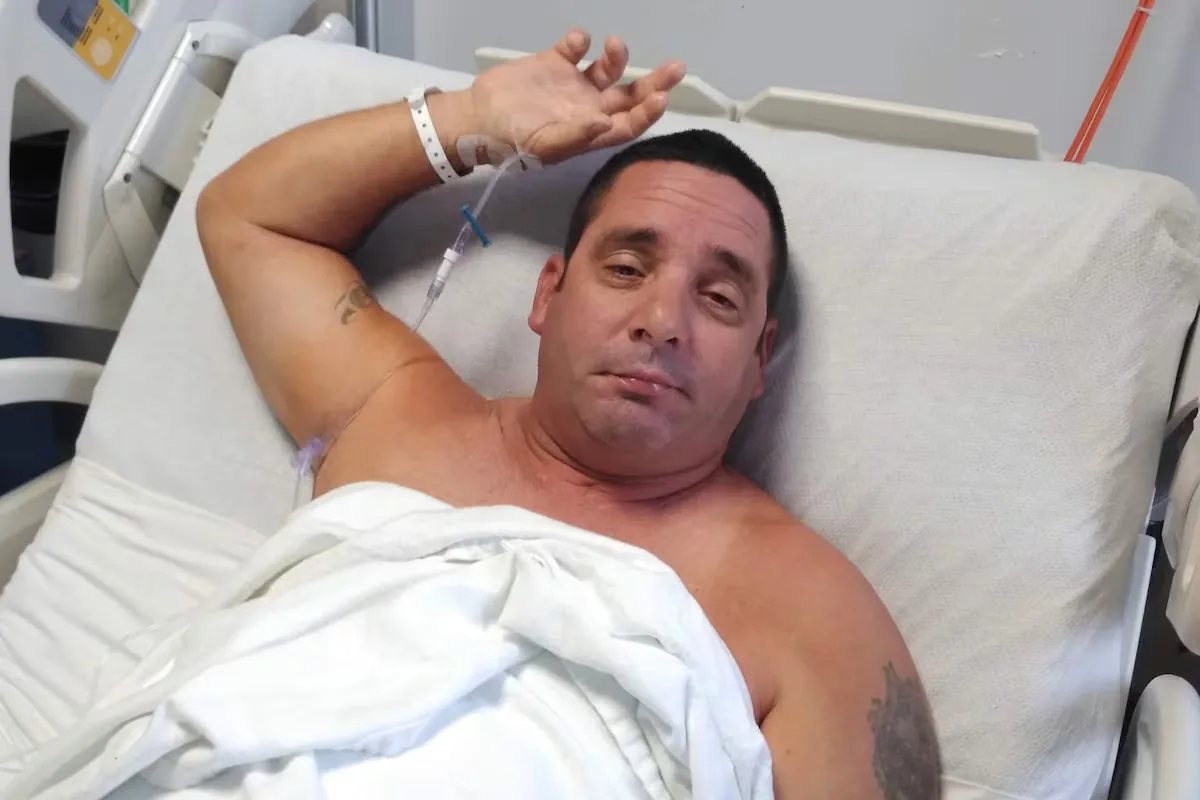
The faces have blurred over the days, as they have gradually landed in the truth that is to dawn in America and suddenly fall into Africa. On board an ICE Air flight that departed on August 20 from Alexandria airport in Louisiana, there was a man whom, however, almost everyone will remember. “He is a Cuban, yes, a Cuban whose guts were spilling out of his belly,” says a young Colombian who does not exactly know what he saw. A Honduran on the same plane also noticed the bulge protruding from the belly, “as if it were the intestine, it was all open, the belly sticking out.” When that man and four others refused to get off the plane in Liberia and continued to Equatorial Guinea, no one cared that he was sick and fell, pushed, face-first onto the pavement.
Read more Buenos Aires suspends the project to convert a vault in the Recoleta Cemetery into a café
The mother of that man, Caridad, refuses to eat at her home in Lehigh Acres, Florida. The sister, Dorty Sánchez, is desperate. One day they went on Facebook and paid attention to a video from Equatorial Guinea. One of the deportees to that country reported that with him there was someone in very poor health. “He said there was a young man with an open belly and his name was Leonardo Sánchez. And if he has an open belly and his name is Leonardo, that is my brother, there is no other.”
That’s how the family learned that Sánchez, who until now had been detained in Texas, was even farther from all of them, despite being a permanent resident of the United States. He had been arrested for drug possession, according to the family, and had been serving community service hours. Last year, at a gas station, he was detained by Immigration and Customs Enforcement (ICE) agents and initially transferred to the Alligator Alcatraz center. Since then, the mother and sister have done everything to get him out of confinement. “We had hired a lawyer from the Wannamaker firm and supposedly there were possibilities due to his medical condition.” But that lawyer, they say, scammed them, and now Sánchez is in such a strange place, with a painful body, not knowing if he will be able to have the surgery — the tenth — planned at Jackson Memorial Hospital.
“I’m not worth a dime,” says Sánchez, who appears on a video call with EL PAÍS from a room at the Bamy hotel in Malabo, the capital of Equatorial Guinea. The hotel is owned by the family of Teodoro Obiang Nguema Mbasogo, the president who has been in power for almost half a century. This month, several reports denounced that some people were threatened at gunpoint in that hotel, where the government was also housing Ebola patients. For some time now, the facility has also been hosting deportees who have arrived in that country as part of a $7.5 million agreement with the Donald Trump administration.
Sánchez rubs his beard; he has not been able to shave. They have not even given them a toothbrush or toothpaste, nor clothes. Four days after his arrival, he is still wearing the same gray pants he left the United States in on the more than 36-hour flight along with about twenty deportees who were never informed they were headed to Africa. During the journey, they were given sandwiches and water that they could barely bring to their mouths while remaining handcuffed and shackled. Sánchez says he was never allowed to go to the bathroom during all this time. “I wet my pants three times,” he assures.
As soon as he arrived at the hotel, he washed the pants and the belt, the only one he has to support the bulge in his belly. Sánchez holds his belly all the time, like someone holding himself up, preventing his body from falling apart. Almost 10 years ago, in Hialeah, he got into trouble and was stabbed several times. “It affected his intestine, he was in a coma for 40 days. The skin was left open and they had to do a graft and put the colon on the side,” his sister says. Later, when he fell into ICE’s hands, he found his attackers also detained, but they were released. “They put the one who stabbed me in the same unit as me and let him go. That’s what I told the judge,” he says.
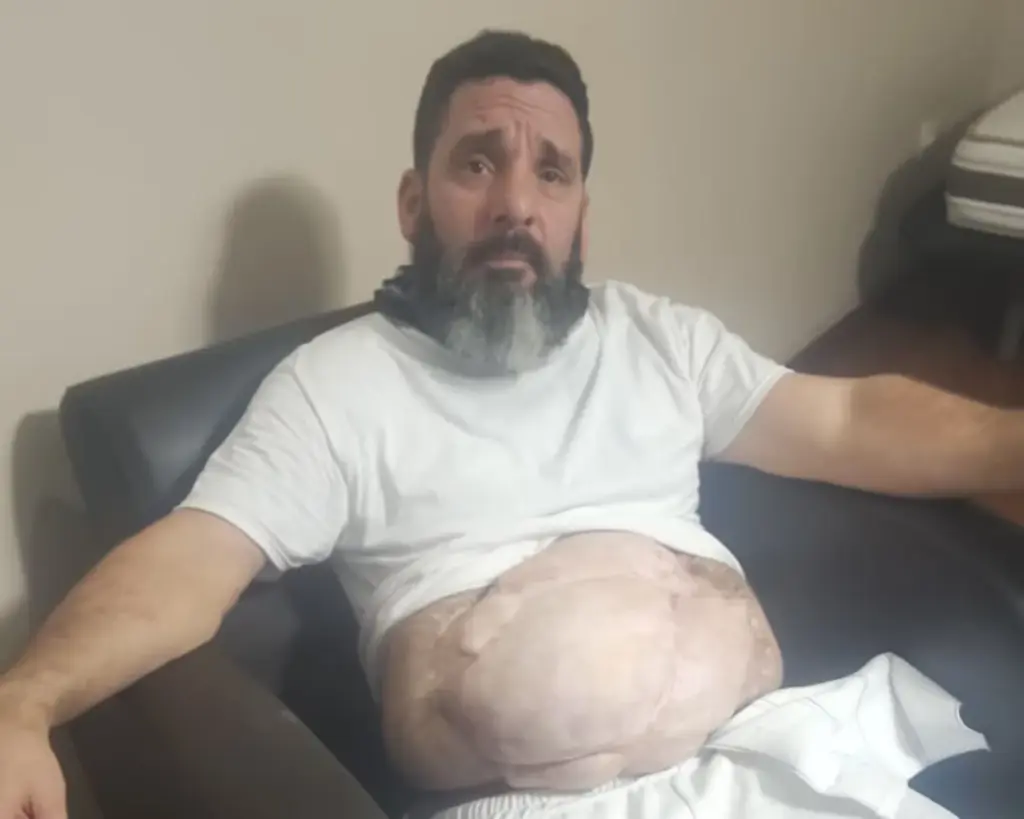
That bulge everyone notices on his belly is a large ventral hernia. Since he has had it, Sánchez has never been able to carry more than 20 pounds, barely finds work, and suffers pains that are unbearable. At the hotel, which is guarded by armed personnel and from which they are not allowed to leave, they have given him paracetamol to relieve the discomfort.
They also took him to a local hospital. “But at the hospital they said that if I didn’t have documents, the doctors wouldn’t be responsible for me. They asked the officer who brought me if they were responsible, and he said no, that he was only sent. The doctor said: ‘if you don’t take responsibility, how are we going to take responsibility?’” Sánchez recounts.
At this point, where the U.S. government has signed deportation agreements with more than a dozen African countries, not only is the danger and legal limbo these people face worrying, but also the medical care they receive. Savi Arvey, director of policies for refugee and immigrant rights at Human Rights First, a human rights organization that has tracked these deportations, says they are “deeply concerned” about the situation in Equatorial Guinea. “People detained at the hotel are deprived of access to essential medical care and subjected to conditions that further endanger their health and well-being, while suffering physical abuse by guards and being pressured to return precisely to the countries they fled to escape persecution or torture,” she says.
After several weeks speaking with migrants of various nationalities sent to the Central African Republic, Liberia, and Equatorial Guinea, this newspaper was able to confirm that not only are they not receiving adequate medical care, but they can barely communicate with doctors in places where almost everyone speaks French. Some, due to water or food, have reported stomach problems and allergies. Others have had episodes of malaria.
Pietro Lima, a 56-year-old Brazilian also deported to Equatorial Guinea, needs medication after losing 30% of his intestine and a kidney due to gunshots in his country. “ICE had my medication on hand and for five days I have had no medication, and I need to take it. I spoke with people here and they don’t know anything about that,” he says.
Read more Patriotic Holidays Bonus 2026 in Chile: who receives it, amounts and requirements
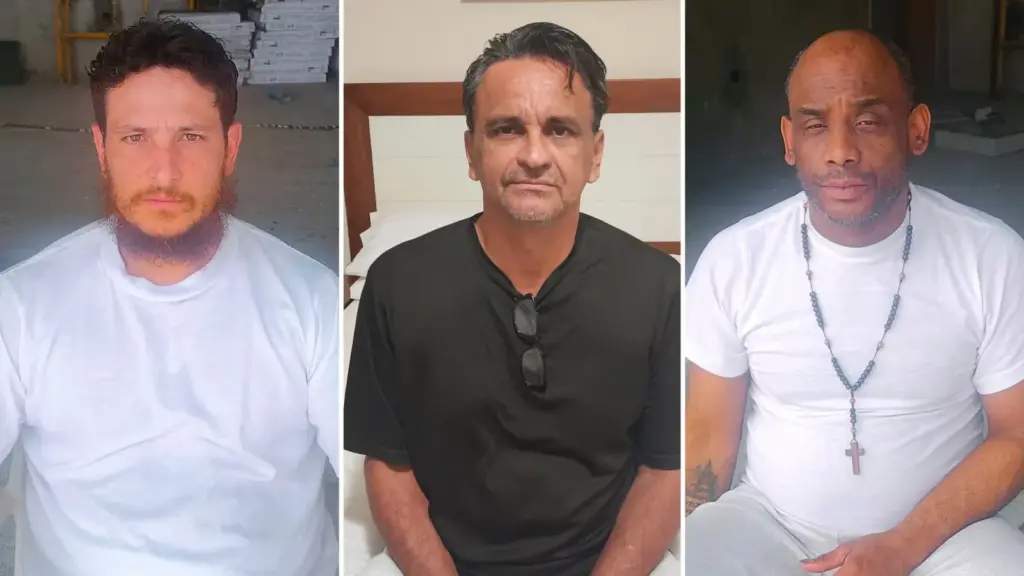
When questioned about the health situation of Sánchez and other migrants deported to Africa, a spokesperson for the U.S. Department of Homeland Security told El PAÍS that “all these undocumented immigrants were deported to a safe third country.” “We are enforcing the law as written. If a judge determines that an undocumented immigrant has no right to remain in this country, we will proceed with their removal. Period. The Trump administration is using all legal options to carry out the largest deportation operation in history, as President Trump promised,” the spokesperson said. The State Department, for its part, has not yet responded to our questions on the matter.
“This is human trafficking”
The flight that left Louisiana on August 20 made a stopover in Dakar, Senegal, to refuel the aircraft. Then it continued its journey to Monrovia, Liberia, a country that agreed to receive migrants after a $5 million agreement with Washington. Pietro Lima, the Brazilian, never thought he would end up in that place. “Three days before, at the detention center, they tried to force me to sign a paper saying if I wanted to go to Liberia and I didn’t sign it,” he says.
Already in Liberia, some migrants got off the plane, but there was a group that refused to get off. Pietro, and the Cubans Darwin Hernández, Emilio Destrade, Carlos Rodríguez, and Leonardo Sánchez were willing to do anything not to go to a territory they do not know. Through the plane windows, a large police operation was visible. “We told them we didn’t feel safe, but they forced us to get off. Four of them carried me, they beat me while I was handcuffed,” Rodríguez says. Leonardo Sánchez was thrown down the plane’s stairs and fell on the pavement with his hernia exposed.
The Cubans and the Brazilian began to protest. “We are not from Africa, we are from another part of the world,” Rodríguez told them. Because of the commotion, they were put back on the plane, and ICE officers told them to stay calm, that they would be taken back to the United States. The plane took another route and almost three hours later they were in Equatorial Guinea, an unprecedented incident, the first time a group of deportees refuses to get off a plane and ends up somewhere else.

“How can a government, in a few hours, send us to another country and that country accept us?” Rodríguez asks. “This is human trafficking, they have trafficked us on a plane,” he says.
The government of that African country, which has been receiving deportees since late 2025, issued a statement assuring that it would treat “any national of a third country transferred by the Government of the United States of America to Equatorial Guinea in a manner consistent with its international legal obligations” and that they would not be “subjected to persecution on grounds of race, religion, nationality, membership of a particular social group or political opinion, nor to torture.”
Finally, the migrants arrived at Malabo International Airport after 8 p.m. According to Lima, they were taken down through a back part of the facility, in the dark, away from any public eye. “To hide from people what was happening,” he says. “When the plane landed, we wondered what place this was. No one told us anything. They asked us to get off and we didn’t accept either. But we saw that below there were more than 30 hooded police officers with weapons. We were scared.”
In a van, still handcuffed, they were taken to the Bamy hotel, just three kilometers from the airport, about a 10-minute drive. “The only Latinos here are us,” Rodríguez says. “Here we are prisoners. If we are free, as they say, why can’t we cook our food or go to the market to buy it?” To this day they have no identification, no passports or any legal document provided by the Liberian or Equatorial Guinean authorities. They do not know what will happen to them.
Michael Flynn, executive director of the Global Detention Project, an organization that investigates and documents the detention of migrants, asylum seekers, and refugees worldwide, told this newspaper that Equatorial Guinea “lacks an asylum framework to properly process refugee applications.” “Testimonies from detainees indicate that they do not receive safe or adequate food, that they are not provided with necessary medical treatment, and that they are completely unaware of what is happening to them or what their fate will be. The uncertainty must be truly distressing,” he says. “The detention of these people is part of a highly concerning trend in which migrants are deported from the United States to countries with which they have no significant ties, only to be subjected to detention, often without access — or with very limited access — to legal assistance or effective remedies.”
Read more The Green Party and the PT consider running solo in several States for 2027