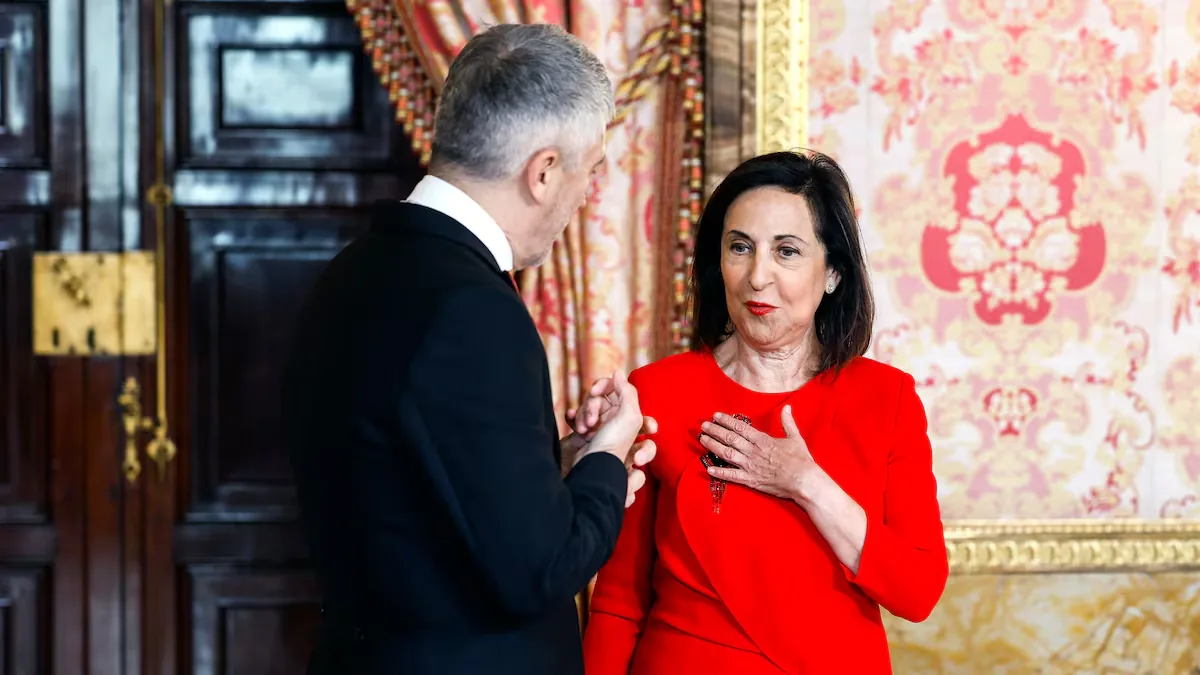
Fernando Grande-Marlaska and Margarita Robles, both judges, have known each other through that common past long before both held a ministerial portfolio in 2018, in that first executive of Pedro Sánchez after the no-confidence motion against Mariano Rajoy, which was dubbed the “beautiful government.” Each arrived, however, by different paths. Marlaska was then one of the surprises of a cabinet forcibly appointed with speed. No one expected the president to call him, not so much because of his supposed closeness to the PP ―he was elected in 2013 as a member of the General Council of the Judiciary at the proposal of the popular party― but because only a few months earlier he had refused to head a PSOE list for the Madrid City Council with no chances of success. And yet, he did so for him to occupy the Ministry of Interior and Marlaska accepted without hesitation.
Read more The battle for spaces to house migrants prolongs the Ceuta crisis
Robles, however, appeared in the ministerial pools since it was glimpsed that Rajoy could be ousted. She was a deputy, had been collaborating closely with Sánchez for a long time, and he had made her his parliamentary spokesperson. Her resume also highlighted that with Felipe González as president, she had already held a prominent position: Secretary of State for the Interior within that 1994 experiment of uniting the Justice and Interior portfolios in the hands of another magistrate, Juan Alberto Belloch. For this reason, her name was considered to be, precisely, the one to occupy the portfolio that finally fell to Marlaska and, even, that with her, the union of this ministry with that of Justice would be repeated. Finally, Sánchez offered her Defense, which she accepted only when he assured her that this ministry would regain direct command over the National Intelligence Center (CNI), which under the PP had come to depend on the vice-presidency.
A former collaborator of the Minister of Interior assures that the confrontation between the two has existed since both took office. Was there any specific event that triggered it? “Simply, there has never been a good relationship,” adds the same source. The difference now is that this confrontation has become more visible than ever due to the crisis caused by the arrival by swimming to Ceuta on July 30 and 31 of 80,000 irregular migrants. Last Tuesday, while Robles assured during her appearance in Congress that the CNI had warned of suspicious movements on the other side of the border pointing to an attempt at a massive crossing, Marlaska took advantage of the Council of Ministers’ press conference to contradict her and insist, as he had done days before, that there was never a secret service report in which what finally happened was “glimpsed.” The Government and the PSOE have tried to minimize the clash, but with little success.
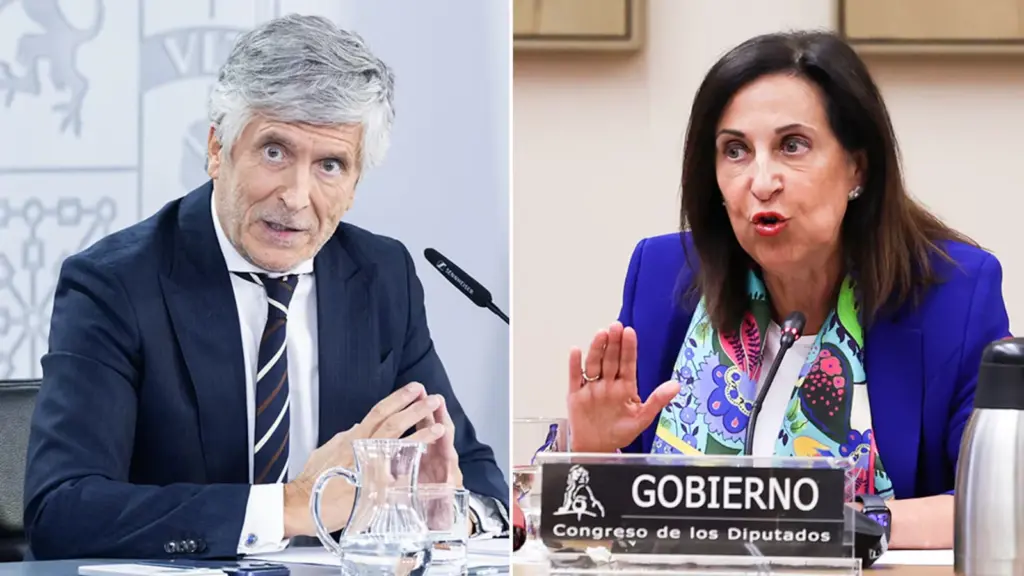
Now visible, the discrepancies and friction have lasted eight years, “with an occasional episode of dirty war,” assure sources familiar with them. When Marlaska took over the portfolio, he found that Robles had slipped in magistrate Félix Azón, a person she trusted, as director general of the Civil Guard, a military police force whose main appointments must be agreed upon by both ministries. When he was ratified in Interior with the first coalition government with Podemos, Marlaska dismissed him without consulting his government colleague. Robles’s response was not to attend the inauguration ceremony of the new head of the armed institute, María Gámez. It would not be the last time the minister would make a similar gesture. Nor did she attend the one held five months later, in which General Pablo Salas assumed the position of Deputy Operational Director (DAO). The reason: the appointment was not consulted with her either.
Along with the Civil Guard, the other focus of tensions between the two has been the scope of action of their ministries in the different crises of very different kinds that have shaken Spain in recent years. From the pandemic to the previous massive entry of irregular migrants into Ceuta, that of May 2021, not forgetting storm Filomena. During the lockdown, Robles tried to get the military, deployed in the so-called Operation Balmis, to perform police functions. Marlaska refused. The Minister of Interior was also annoyed by the unconsulted deployment of the Military Emergency Unit (UME) during the snowstorm that paralyzed part of Spain. But what finally poisoned the relationship between them then was Marlaska’s decision to summarily dismiss, in January 2021, a Civil Guard officer who served as a liaison with the Defense Staff (EMAD) for having been vaccinated against COVID when it was not his turn. Along with him, other military personnel had irregularly received that first dose, including the head of the EMAD, General Miguel Ángel Villarroya, a man of Robles’s utmost trust, who was forced to resign to the minister’s annoyance.
The tables turned months later, when the previous massive crossing into the autonomous city occurred. It then emerged that 55 unaccompanied minors had been returned to Morocco without respecting legal procedures. That expulsion, which would end with a disqualification sentence for the then Government delegate, Salvadora Mateos, put Marlaska in the eye of the storm. When Robles was asked in an interview about that controversy, she subtly questioned her government colleague’s ability to face that migratory crisis. What neither of them knew then was that their mobile phones had been infected by the Israeli-origin spy program Pegasus ―Sánchez’s and the Minister of Agriculture, Luis Planas’s terminals were also infected―, an episode that ended up being investigated by the National Court.
Apparently dormant in recent times, Ceuta has reignited this struggle in an unusual way. And not only because of the controversy over the CNI’s role in the migratory crisis, but also because of each one’s vision of the role Morocco has played in it. Last August 12, during her visit to Ceuta, Robles broke the script set by La Moncloa of not pointing fingers at the Maghrebi country and, after touring the city and talking with several residents, stated: “Ceuta and Melilla are not Spanish, they are very Spanish. Ceuta and Melilla are not to be touched.” It was her response to Rabat’s statements claiming sovereignty over the two North African cities. Marlaska, however, repeatedly avoids making any gesture that could annoy Morocco and, to that end, insists again and again that collaboration with the Maghrebi country is “extraordinary, exceptional.” Both in this and in the controversy over the existence or not of a CNI alert, the minister feels backed by the president, seeing that the Government has adopted his position over Robles’s. As in serialized stories, the war will continue.
Read more Claudia 4.0 starts, the decisive stage