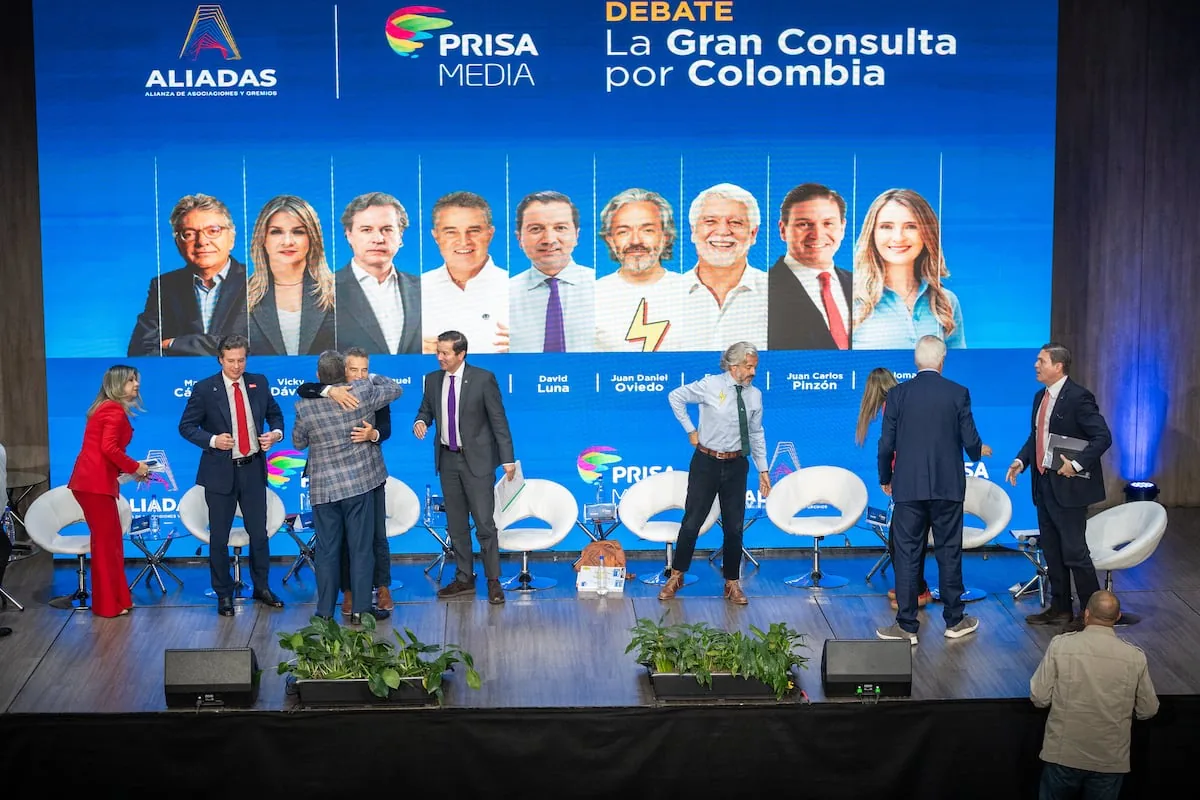
Seven weeks before the first presidential round, the campaign progresses without debates confronting the candidates. This Saturday, left-wing candidate Iván Cepeda proposed a meeting with his two main right-wing contenders, Paloma Valencia and Abelardo de la Espriella, an initiative that has not yet materialized and adds to several failed attempts to open these spaces. At this week’s Governors’ Summit, Cepeda himself canceled his participation at the last minute in the first space that would bring together most aspirants to present their proposals. His absence left the discussion without the frontrunner in the polls, in an episode that is merely a symptom of a broader problem: the difficulty in consolidating public discussion forums in this contest. Amid conflicting agendas, rejections, and failed formats, the campaign approaches its decisive stretch without citizens having witnessed a broad debate among those aspiring to reach the Casa de Nariño, in contrast to what happened in previous elections.
Read more The mouse to guard the cheese
The struggle for debates is not new. Several of the forums and discussions that have been organized have taken place without the participation of the main contenders: Iván Cepeda, Paloma Valencia, and Abelardo de la Espriella. Last April 8, El Espectador organized a space to learn about the aspirants’ positions on energy transition, which was attended only by Luis Gilberto Murillo, Mauricio Lizcano, Carlos Caicedo, and Roy Barreras, candidates who, together, account for less than 4% of voting intention. The Uribista Valencia had confirmed, but canceled her participation without further explanation.
The reason usually given for evading these spaces is agenda conflicts. Valencia’s campaign explains that in many cases it’s a matter of time, but her absence, in many others, is due to her opponent Cepeda’s decision not to expose himself (so far) to debates. If the favorite in the polls doesn’t go, neither does the second favorite. Sergio Fajardo, one of the candidates who proclaims himself a centrist, has not missed an opportunity to remind everyone that he is available and waiting to be included in these spaces. “Does that call also include those of us who are not the continuity of the Petro–Uribe polarization? I am ready,” he wrote on his X account.
The left-wing senator’s decision not to participate in these meetings stems from his distrust of the media, their organizers par excellence. His advisors, almost all former officials of this Government, have recommended that he distance himself from media attention. The candidate says it without hesitation, the few times he speaks. Since last October 26, when he won the internal consultation of the official Historical Pact, Cepeda publicly stated: “I am not going to debates, I say it clearly once and for all. Not to insult each other with other candidates, nor to threaten us, nor to denigrate us.” Instead, he talks about discussing proposals, but he has not yet made his government program public.
In March, President Gustavo Petro referred to his candidate’s decision via social media. After his predecessor, Iván Duque, stated in the media “whoever wants to be president has to go to debates,” Petro responded by recalling that, in the 2018 campaign, the then right-wing candidate abstained from participating in several of these spaces between the first and second rounds. In another social media post, the president published an image of one of the debates in which the person who beat him at the polls was absent. “A president is always open to debate and discussion. Here Duque stood me up and didn’t want to debate with me,” he wrote on his social media.
Read more Neither pan nor air fryer: this is the ‘gadget’ that cooks eggs without oil in a minute
The discussion about debates recycles every four years. For now, each formula bets on its communication strategies. Valencia highlights security strategies with more military personnel or her relationship with the business community, with proposals such as promoting fracking and a promised tax cut. The ultra De la Espriella, for his part, speaks on his social media about a firmer security strategy that allows him to work with active reserve military personnel.
The criminal lawyer, in fact, also does not want to participate in debates. In January, before the legislative elections and simultaneous presidential consultations, he had suggested a meeting with Cepeda, as they were then leading in the polls. He proposed that it focus solely on the relationship with Venezuela and armed groups such as the ELN and FARC dissidents. It was an informal invitation because he never finalized the space or date, and above all, one that was never repeated.
With strategies more focused on speaking to their own electorate, the campaign has progressed without a public and mass-dissemination space where citizens can directly contrast proposals. There are still calls from the country’s two largest television channels, which have national reach and usually mark the final stretch of the contest. Their realization will depend, once again, on the candidates’ willingness.