The presumption of innocence is the keystone of the criminal process at any of its stages, from beginning to end. It is essential for the judge to be impartial, which prevents them from already leaning against the person identified as a suspect from the outset, thus frustrating their possible defense, which is useless, of course, before a judge who is already biased and predisposed against them. Much of the above implies that evidence must be presented in the process, with the facts always being doubtful to the judge, because they have not witnessed them. However, in situations where it is impossible to doubt a fact because everyone knows it, evidence will no longer be presented because the fact is “notorious,” as it is technically called.
In the past, notorious facts were scarce, since except for events as famous as knowing who was the king on the throne at that moment, or the catastrophic eruption of a volcano, facts that occurred outside the process had to be proven. But for some years now, we have cameras that suddenly reveal what really happened from such diverse angles that, unless an unlikely forgery is proven, they leave no room for doubt.
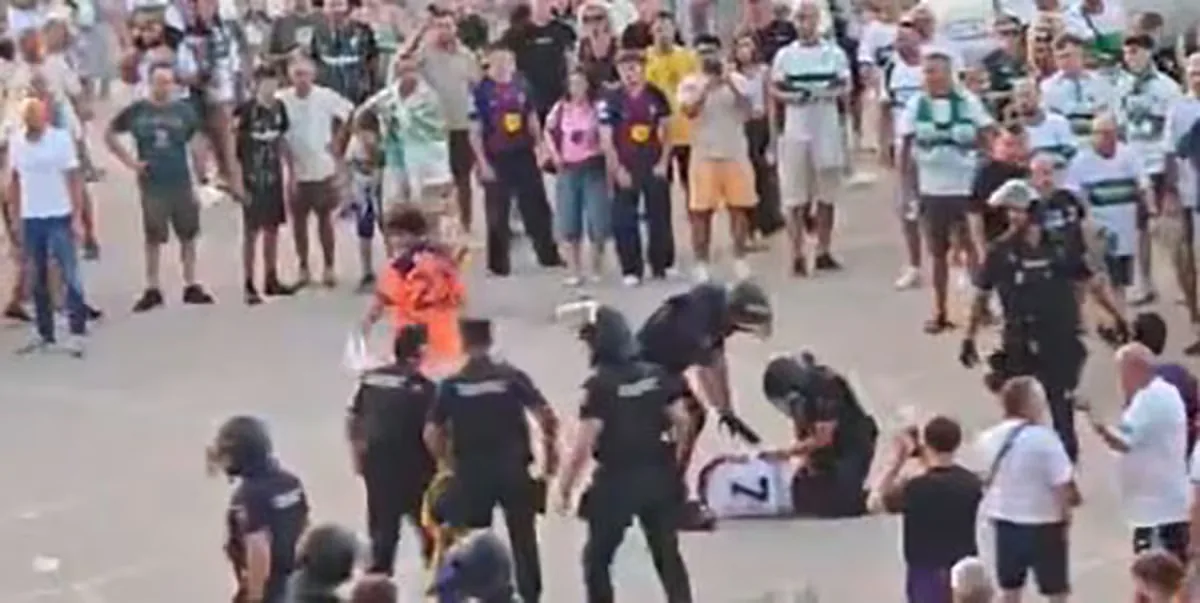
That is exactly what happened with the police aggression against a Futbol Club Barcelona fan in Elche. As in any other match, two fan groups are seen shouting all sorts of things at each other, absurdly provoking the lowest instincts of the rival—they will know why—separated by a group of police officers, as is also common. Suddenly, one of the police officers infiltrates the Barça fan group to take away an independence flag from one of the fans for unknown reasons, which in no case, under any circumstances, would be legitimate under the right to freedom of expression, according to repeated jurisprudence of the European Court of Human Rights. At the same time, that police officer removes the flag bearer from the group and, once separated, he and his colleagues begin to beat him, with the images showing no danger posed by a young minor, appearing to be underage, unarmed, facing a group of riot police in their usual heavy protective gear. The minor tries to break free from the aggression, at which point he falls and is subdued. Already on the ground, posing no objective danger, he receives an elbow from the acting police officer, and once handcuffed and carried by two agents, one of them delivers a precise right hook to his face.
There has been speculation on social media, and even by various police officers, that the young man had provoked, although it is difficult to guess what supposed provocation would legitimize the police, not only to take away a flag but to beat an unarmed minor, hit him once subdued on the ground, and slap him once handcuffed. Perhaps the situation is better explained by the shouts of some fans of the rival crowd, perfectly audible, urging the police to hit him for carrying an independence flag. Certainly, the agents investigated for these acts will have to discuss, in their defense, the specific application of criminal laws in their case, but not the reality of the facts just narrated. Just watch the images.
It rains on wet ground. Very recently, another police officer ran over a protester, a retiree, at a protest in Valencia, threw her to the ground, and caused injuries. Again, the cameras do not lie. And after all this, one must ask what is going through the mind of the police officer who acts this way, and what is also going through the minds of the colleagues who defend him by blatantly denying the obvious reality. I will not delve into the possible ideological bias of the police, although it is essential in a democracy that they do not hold an ideology contrary to fundamental rights, and this is not a trivial matter. In Germany, for obvious reasons, several agents have been investigated precisely for that reason, which shocks anyone who knows the history of that country. It might be positive, for exactly the same reason, not to trivialize ours, which is done too often by those who still believe that the violent patriotism practiced by the dictatorship is the best way to defend a country, when it is the direct path to its fracture and destruction, sooner or later. It is enough to recall the tremendous difficulties faced during the so-called Transition.
In any case, there is something very important to highlight to conclude. All the police officers who have falsely rushed to defend their colleagues are doing no favors to their profession. Too often, judges believe police versions of events in cases where there are no cameras, trusting that security forces will not lie. What we are seeing these days shows that this jurisprudence must be changed and conclude that there is a kind of excess believed to be legitimized among several police groups, which must be eradicated because it assumes it is appropriate to blatantly lie for corporate reasons. Fortunately, other police groups have also raised their voices denouncing the obvious aggression. They are the ones truly doing a favor to the security forces.
It is convenient for judges and prosecutors, in practice, to give full validity to everything the police say. They can do a cut and paste of police reports in their rulings and, moreover, avoid confrontations with officers and their superiors. But that is not their mission. Judges and prosecutors exist precisely to question every last comma of what the police say, both in the legal aspect—which should never be subject to police evaluation—and in the factual narrative, which should not be believed uncritically but verified through evidence presented in the process and the judge’s own logical reasoning, who must conduct a deep, thorough, and ultimately serious epistemic analysis of all those reports. Otherwise, it is not the judges who issue the sentence, but the officers, producing a usurpation that breaks the separation of powers.
All the above describes a serious and very real problem, known to any lawyer who works in criminal proceedings. Do not be naive and do not let ideology lead you to think that what happened does not matter because an independence supporter, an enemy of Spain—what an expression—deserves that and much more. Democracy must protect everyone. Even those labeled as traitors. Do we really have to believe that a 17-year-old kid is a traitor?