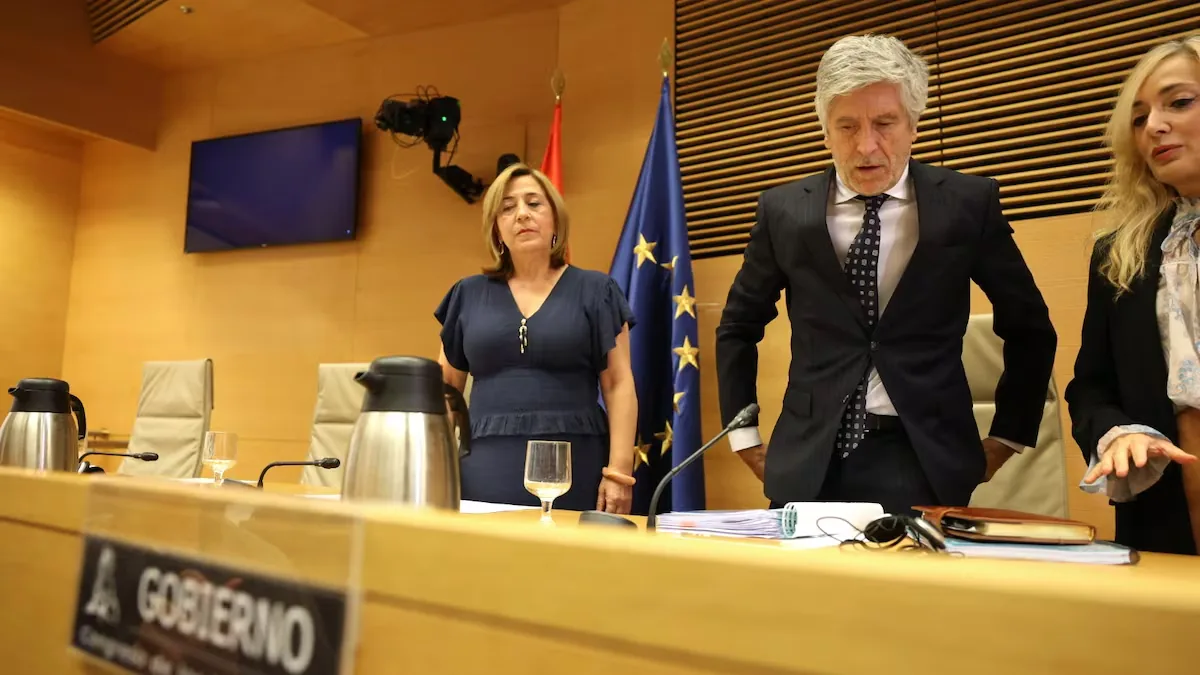
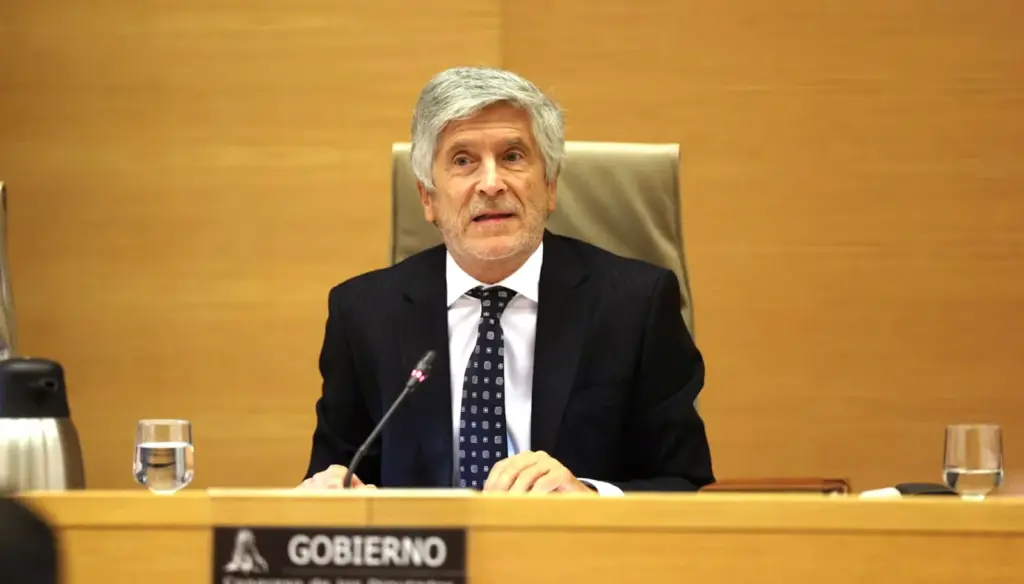
Criticism of the opposition, no acknowledgment of mistakes, and a call for calm after Thursday’s clashes in Ceuta. In his first appearance in Congress regarding the migration crisis, the Interior Minister, Fernando Grande-Marlaska, repeated much of the information he had already provided in his previous public appearances about his department’s deployment and avoided at all times referring to his confrontation with the Defense Minister, Margarita Robles, over the alleged prior alert transmitted by the National Intelligence Center (CNI) about a massive entry of irregular migrants on July 30 and 31. He only referred to this controversy during the reply turn, in this case to insist that no one warned about what finally happened.
He also did not criticize the actions of his department or the Executive, although he admitted that “necessary lessons” must be “drawn” to “prevent and face” in the future a situation like the one experienced in the autonomous city, which he has described as “one of the greatest recent challenges in border and migration management that our country has faced.” To this end, he announced an improvement of the facilities on the fence and the use of new means, such as more boats and the use of underwater drones and aerial surveillance.
Marlaska did refer to the increase in incidents in Ceuta in recent hours, in which there were attacks by groups of migrants on soldiers or the assault by neighbors on camps set up on some of the city’s beaches, which he attributed to recent speeches from “the far right, and now also the right” referring to PP and Vox, whom he accused of “inciting hatred.” “We have heard during these weeks speeches and statements that contribute to the stigmatization of migrants and that fuel social division at a time when what is needed is responsibility, calm, and a sense of state,” he emphasized after recalling the use of terms such as “invaders,” “criminals,” and “hunting immigrants.”
The minister also stressed, as he has done since the crisis broke out, praising the “close collaboration” of Morocco during the crisis, which he described as “sustained and effective over the years.” For Marlaska, that “coordination” with Rabat is what allowed the “return” within 48 hours after the massive entry of much of the 72,000 irregular migrants who entered Spanish territory. “At the political level, I am in permanent contact with my Moroccan counterpart [Abdelouafi Laftit]. And at the operational level, the police authorities of both countries work together in the fight against irregular migration and human trafficking,” he added, assuring that so far this year Morocco has intercepted thousands of people trying to reach the Spanish coasts by sea.
At that point, he faced criticism not only from PP and Vox but also from the parliamentary allies supporting the Government, including the Executive’s own minority partner, Sumar. The Popular Party and Santiago Abascal’s party have insisted on speaking of “invasion” to describe what happened. Vox’s spokesperson even referred to the event as a “hybrid act of war orchestrated by Morocco.” ERC has also attacked Marlaska’s view of Rabat’s position. “Don’t say anymore about Morocco’s collaboration. It’s ridiculous, grotesque, absurd,” their spokesperson, Francesc-Marc Álvaro, told him.
Also harsh was the intervention of Enrique Santiago, spokesperson for Sumar, who considered what happened on July 30 and 31 a “destabilization maneuver with geopolitical intentions” in which, besides Morocco — which he highlighted has refused to even receive the bodies recovered in the massive jump in Spanish waters — he implicated the United States and Israel. “No Spanish authority can say that Morocco is collaborating,” Santiago stressed. Jon Iñarritu, from EH Bildu, also said it “surprises” that the ministers agree in defending Morocco. Mikel Lejarda, from PNV, also questioned Rabat’s attitude.