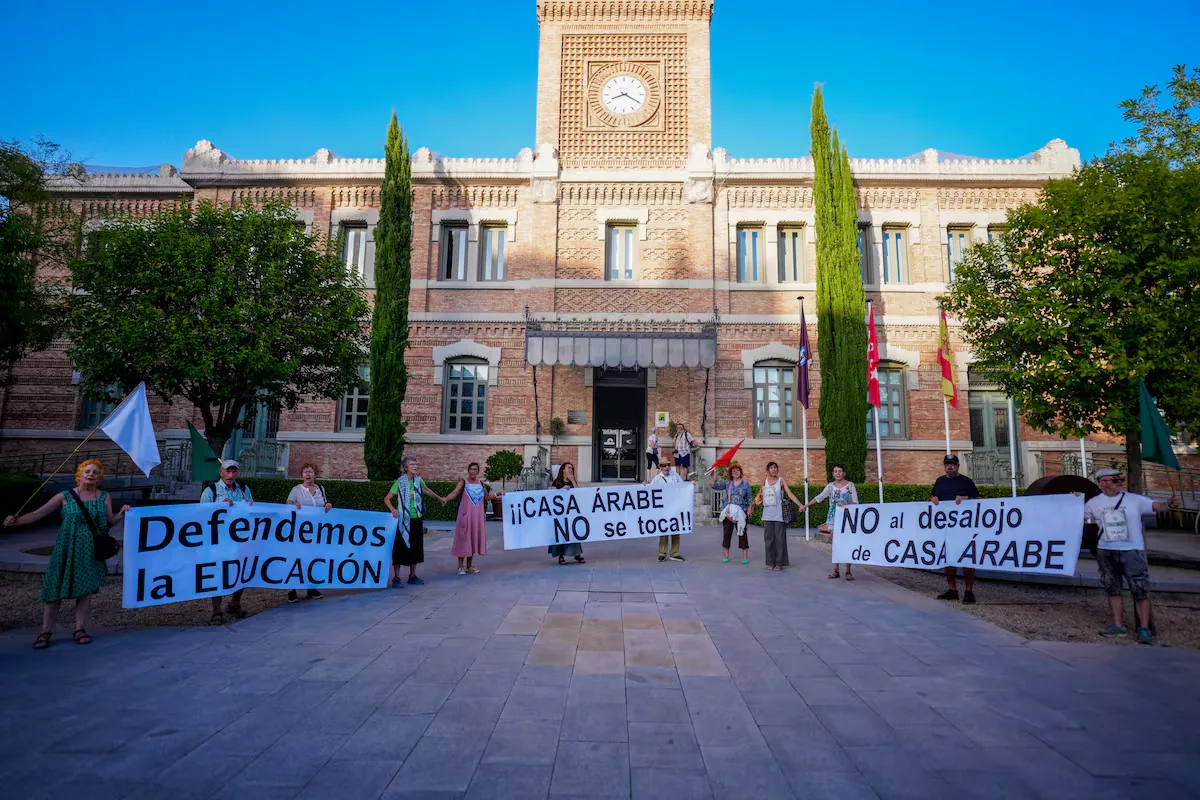
Just 48 hours before the deadline set by the Madrid City Council for Casa Árabe to vacate the Escuelas Aguirre, its defenders have taken another step in their fight against the Consistory’s decision. The collective Defensoras y Defensores de Casa Árabe has called for this Sunday, August 30, at seven in the evening, the so-called Festival of Resistance for Casa Árabe in Puerta del Sol. “The objective is for the mayor to listen to us, to rectify, and for avenues of dialogue to be sought,” explains Marta Tejada, spokesperson for the collective.
Read more Marlaska avoids self-criticism and accuses PP and Vox of “inciting hatred” in Ceuta
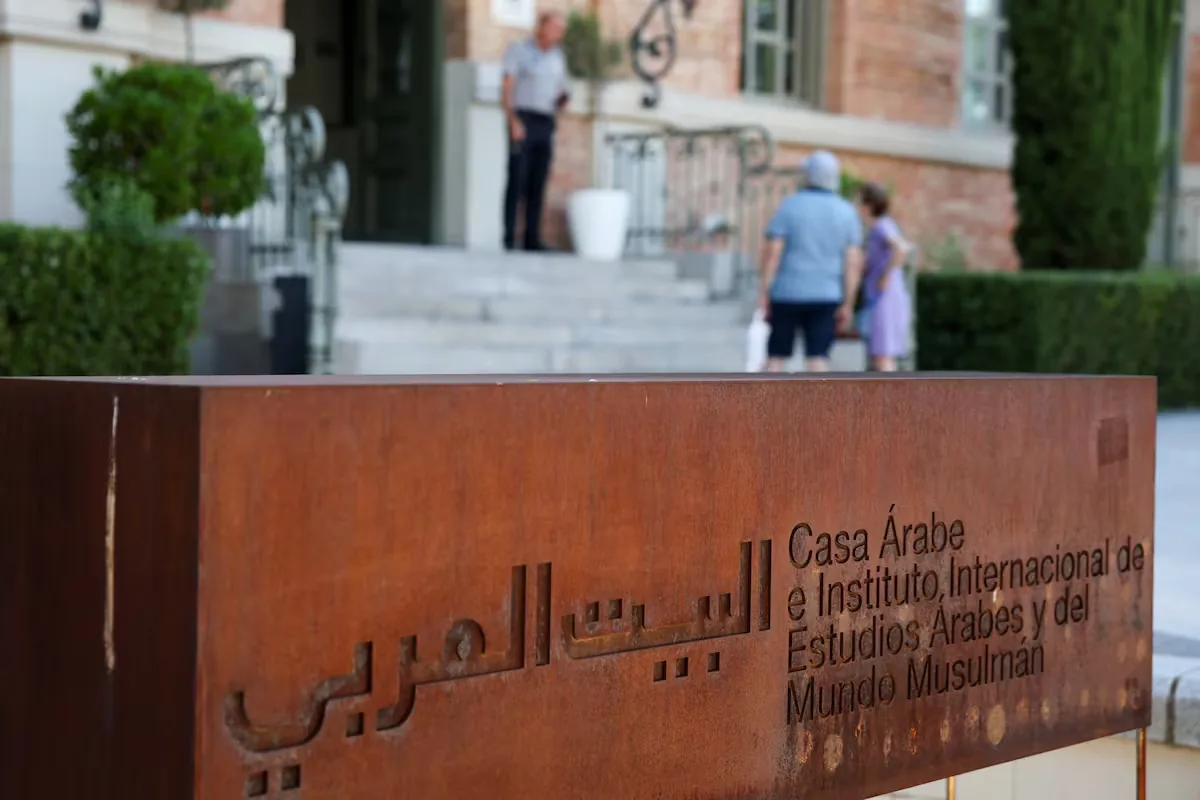
The call comes at the most delicate moment of a conflict open since June, when the municipal government announced its decision to reclaim the Escuelas Aguirre, at number 62 on Alcalá Street, home to Casa Árabe in Madrid since 2008. The City Council intends to rehabilitate the building and find a new use for it. The institution’s defenders, on the contrary, believe that the works can be undertaken without ending almost two decades of Casa Árabe’s presence in the building.
“Rehabilitating a building should not necessarily mean expelling an institution that has been part of its history since 2008,” they state in the protest’s call manifesto. Almeida harshly criticized last month the management of the institution’s former director, Irene Lozano, whom he held responsible for having led Casa Árabe to “bankruptcy” and for having neglected the conservation of the Escuelas Aguirre. The City Council also maintains that the building presents “significant structural problems” derived from a lack of maintenance and needs consolidation and conservation works.
Tejada questions whether these arguments justify the departure. Regarding the economic difficulties, she points out that, according to the information available to the collective, they come from an earlier stage and reminds that the institution now has a different management. “Perhaps in the past it could have been managed differently and right now the management is different,” she states, although she clarifies that the collective is independent of Casa Árabe and is unaware of the details of its accounts.
The organizers also do not deny the need to intervene in the Escuelas Aguirre if the state of the building requires it. What they reject is that the rehabilitation must lead to the definitive departure of the institution. “It is not necessary to evict an entire building to carry out works,” Tejada maintains. Among the possibilities she raises is temporarily closing certain rooms or parts of the building while the work is carried out. “We understand that the justification being given is not entirely sustainable,” she adds.
For the collective, moving Casa Árabe would mean “breaking a bond already built over almost two decades between the institution, the building, and Madrid” and giving up the symbolic value acquired by the Escuelas Aguirre as an open space between cultures. “Casa Árabe will continue to exist as an institution, but that space that has consolidated over the years into a place of reference for encounter and interculturality will be lost,” they add.
Tejada asserts, in this sense, the role of Casa Árabe as an institution that “builds bridges between both cultures, between Arab culture and us.” Music, poetry, exhibitions, and literature have served, she points out, to build these links. The spokesperson also fears that the departure will set a precedent: “This can happen now with Casa Árabe, but tomorrow it can happen with other types of buildings.” Her reading of the conflict goes even further: “In the end, culture is being sold.”
It is precisely this cultural activity that the organizers want to bring to the streets this Sunday. The festival will feature singer Linda Alahmad, musician and lutenist James Bitar, novelist Rima Bali, and poets Maisoun Shukair, Ley Cobo, Francisco Luque, María Victoria Caro, and Hicham Amraoui. They will be joined by Samir Elturky and Silvia Romero, with darbuka and violin, and a collective performance of Palestinian dabke, a traditional dance. According to Tejada, these are artists linked to Casa Árabe who now want to contribute to the mobilization so that “their voices are heard.”
The confrontation has gained significant repercussions even beyond the municipal level. The ambassadors of 17 Arab countries and the representative of the Arab League have come out in defense of the institution through a letter in which they describe Casa Árabe as “one of the most prestigious cultural institutions in Spain” and “an instrument of undeniable value” for strengthening relations between Spain and Arab states. For its defenders, this support reinforces the need to find a solution that allows the institution to remain in the Escuelas Aguirre.
But time is against them. The delegate for Urban Planning, Environment, and Mobility, Borja Carabante, reiterated on Wednesday in Arganzuela that the Consistory expects Casa Árabe to vacate the building by September 1 and has announced that the municipal government is preparing an “alternative plan” in case it does not, the details of which will be released before the deadline expires.
The announcement has worried the organizers. “I don’t know if it’s through legal means,” admits Tejada, who interprets Carabante’s words more as a warning than as a proposal to resolve the conflict. “I don’t see it as a very friendly option,” she says. Even so, the collective maintains hope that in these last few days a path for dialogue can open. Asked by EL PAÍS about this plan, the criticisms of Casa Árabe’s defenders, and the mobilization called for this Sunday, the City Council merely stated that the mayor would comment on the matter next week.
The defenders are not resigned to Casa Árabe finding another building. Tejada says she does not know if the institution already has a new location in the capital, but stresses that this is not the objective of the mobilization: “We are not fighting for an alternative building to be sought, we are fighting for it to continue there, in that same building.” The festival will be the last major mobilization before the deadline expires. “Culture is defended. Culture is diversity. Culture is also resistance,” proclaims the manifesto of the call. Music, literature, poetry, and dance will occupy Sol under another even more resounding slogan: “Casa Árabe stays.”